




NZD/USD Price Forecast: Kiwi bears target 0.5400 as RSI weakens
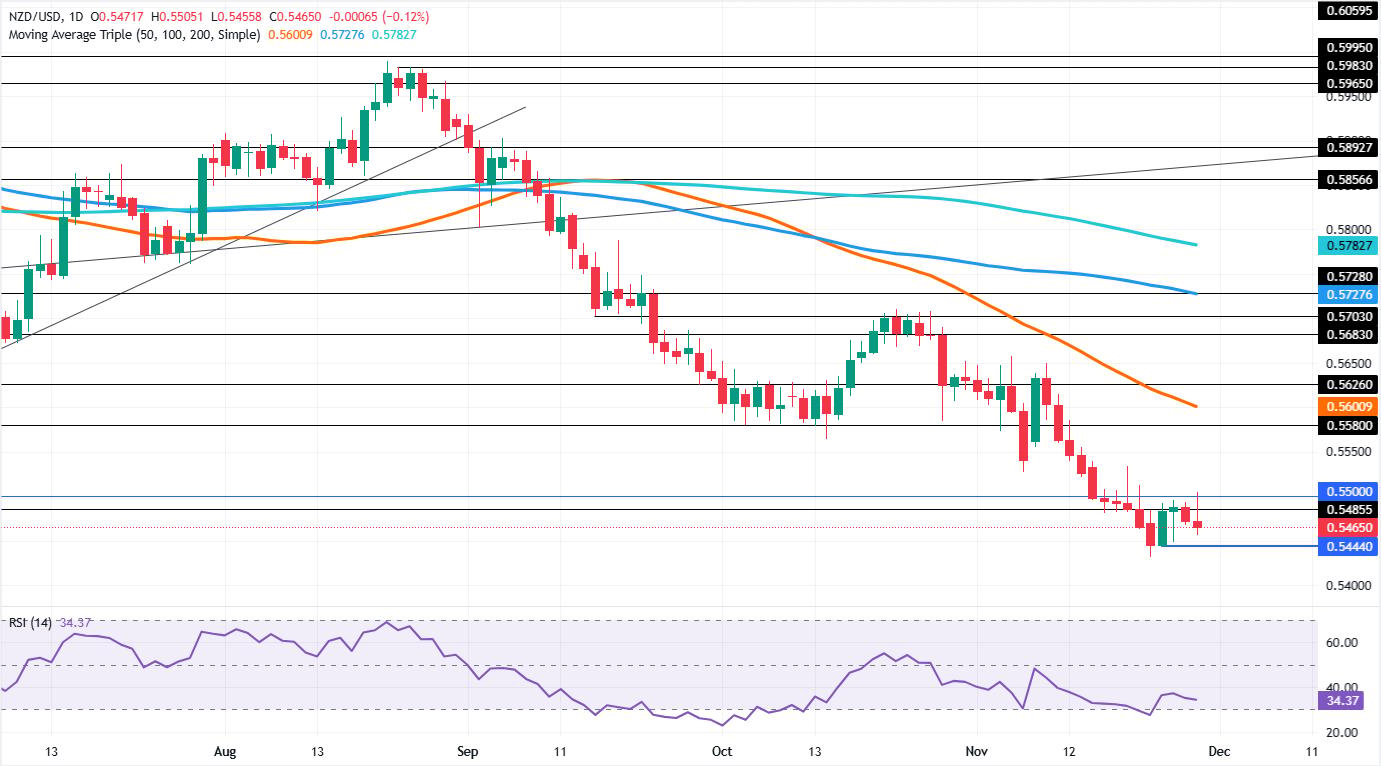
- NZD/USD slips 0.11% to 0.5465 after rejection near 0.5505.
- Break below 0.5450 exposes yearly low at 0.5444, then 0.5400.
- Bulls must reclaim 0.5500 before challenging resistance at 0.5534.
The Kiwi Dollar records a 0.11% loss against the US Dollar and extends its bearish trend, despite finishing the week virtually unchanged near 0.5465 at the time of writing. The pair reached a weekly high earlier in the day near 0.5505, but overall US Dollar strength pushed it lower.
NZD/USD Price Forecast: Technical outlook
The NZD/USD reversed course as it traded near the week's highs, an indication that sellers are leaning on 0.5600. Momentum is bearish, with the Relative Strength Index (RSI) trending towards its oversold territory, indicating sellers' strength. With that said, the path of least resistance suggests that further NZD/USD downside is expected.
For a bearish continuation, the first support for NZD/USD is 0.5450. Below this level, the year-to-date (YTD) low of 0.5444 emerges. Once breached, the next area of interest is 0.5400, followed by the psychological levels 0.5350 and 0.5300.
On the upside, the first resistance for NZD/USD is the 0.5500 level. On further strength, the next key resistance is the November 19 daily high at 0.5534, followed by the 50-day Simple Moving Average (SMA) of 0.5600.
NZD/USD Price Chart – Daily
New Zealand Dollar FAQs
The New Zealand Dollar (NZD), also known as the Kiwi, is a well-known traded currency among investors. Its value is broadly determined by the health of the New Zealand economy and the country’s central bank policy. Still, there are some unique particularities that also can make NZD move. The performance of the Chinese economy tends to move the Kiwi because China is New Zealand’s biggest trading partner. Bad news for the Chinese economy likely means less New Zealand exports to the country, hitting the economy and thus its currency. Another factor moving NZD is dairy prices as the dairy industry is New Zealand’s main export. High dairy prices boost export income, contributing positively to the economy and thus to the NZD.
The Reserve Bank of New Zealand (RBNZ) aims to achieve and maintain an inflation rate between 1% and 3% over the medium term, with a focus to keep it near the 2% mid-point. To this end, the bank sets an appropriate level of interest rates. When inflation is too high, the RBNZ will increase interest rates to cool the economy, but the move will also make bond yields higher, increasing investors’ appeal to invest in the country and thus boosting NZD. On the contrary, lower interest rates tend to weaken NZD. The so-called rate differential, or how rates in New Zealand are or are expected to be compared to the ones set by the US Federal Reserve, can also play a key role in moving the NZD/USD pair.
Macroeconomic data releases in New Zealand are key to assess the state of the economy and can impact the New Zealand Dollar’s (NZD) valuation. A strong economy, based on high economic growth, low unemployment and high confidence is good for NZD. High economic growth attracts foreign investment and may encourage the Reserve Bank of New Zealand to increase interest rates, if this economic strength comes together with elevated inflation. Conversely, if economic data is weak, NZD is likely to depreciate.
The New Zealand Dollar (NZD) tends to strengthen during risk-on periods, or when investors perceive that broader market risks are low and are optimistic about growth. This tends to lead to a more favorable outlook for commodities and so-called ‘commodity currencies’ such as the Kiwi. Conversely, NZD tends to weaken at times of market turbulence or economic uncertainty as investors tend to sell higher-risk assets and flee to the more-stable safe havens.
Recommended Articles


