




7 Best Indices Trading Platforms in Australia (2026): Compare CFD Brokers & Fees

When thinking of entering the global financial markets, many Australian investors consider index trading as one of their top options. That’s because instead of focusing on individual stocks, indices allow you to trade the performance of entire economies or sectors at a go. Whether you’re interested in the US economy or you fancy Europe and Asia, indices capture broader market trends, making them particularly attractive for both short-term traders and long-term investors.
This is why choosing the right indices trading platform is a critical decision on that journey. The quality of the trading platform you choose determines your overall experience, across trading, fees, and even profits. Since there are numerous indices trading platforms to choose from, this guide will evaluate the top 7 options to save you the stress. If you’re trying to decide where to trade indices or which indices CFD trading platform is the best for Aussies, this guide provides everything you need.
Quick Comparison Table
After hours of research, our team of experts has curated the best indices trading platforms for Aussies. Here’s a snapshot of how they compare:
7 Best Indices Trading Platforms in Australia (2026)
Now, let’s get into the full review of the index trading platforms that made our list.
1. Mitrade
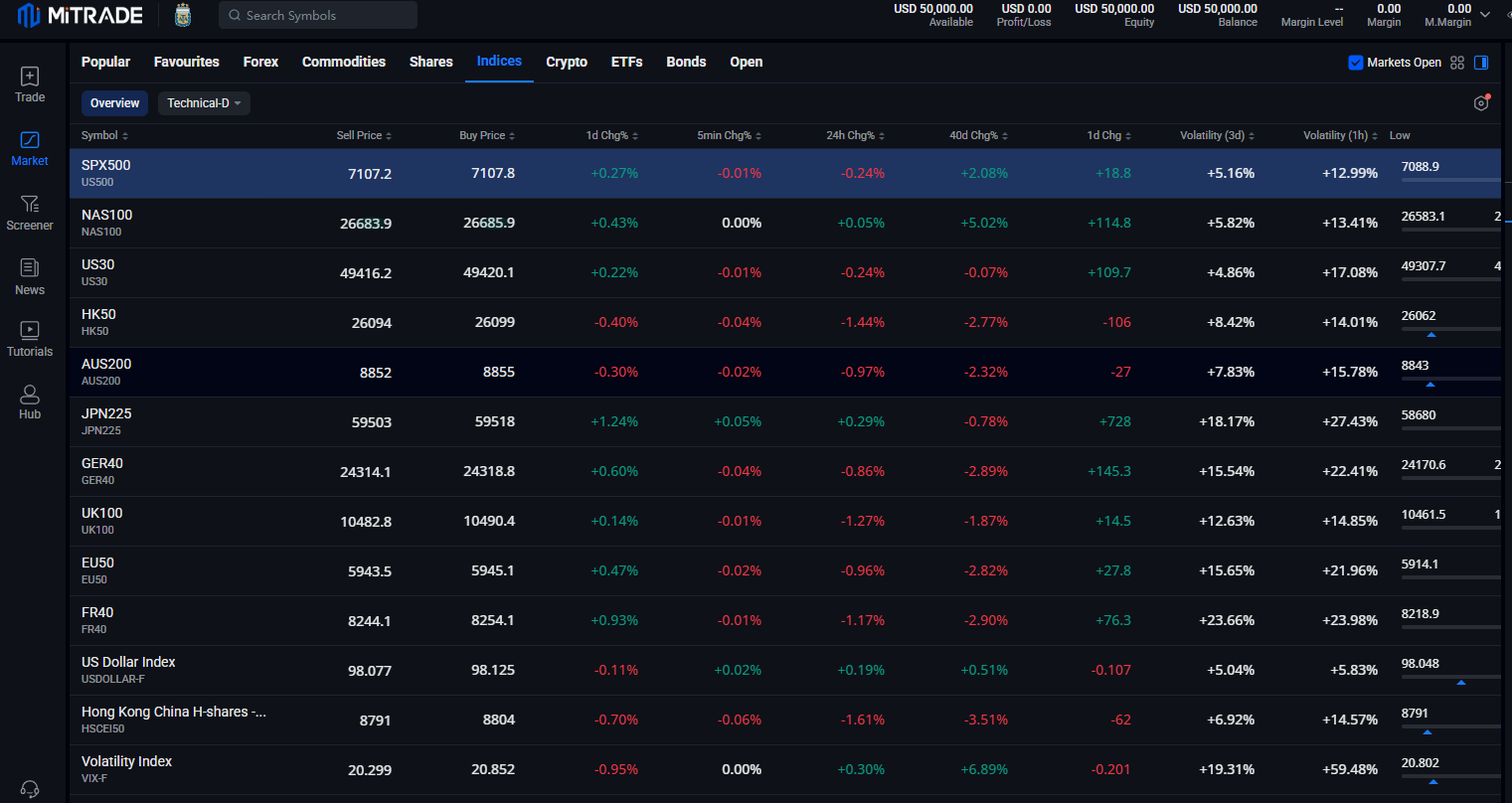
Mitrade is arguably the best indices CFD trading platform for Australian investors and traders due to its balance of simplicity, trade efficiency, and low costs. These reasons position it head and shoulder above its competitors, including beginner index traders and experienced ones.
The platform is designed to remove unnecessary complexity that users typically face, making it accessible for newbies while still giving pro traders enough depth. Another critical feature is its execution speed. With a platform primed for fast trades, indices trading on Mitrade offers a good shot at aligning with price movements.
On Mitrade, you’ll find a broad range of global indices, including US indices like the S&P 500 and NASDAQ, as well as European stock indices like the EU50 (Euro Stoxx 50), GER40 (DAX), and UK100 (FTSE 100). If you also prefer trading assets from the Asian markets, Mitrade has options like the JPN225 (Nikkei 225) and HK50 (Hang Seng Index). This means diversification across different global markets is not a problem.
If you’re the kind of Aussie trader who also wants home-based indices in your portfolio, you can also trade the AUS200 (S&P/ASX 200) on Mitrade through contracts for difference (CFDs).
Another reason Australian index enthusiasts choose Mitrade as their top platform is that the operator offers competitive pricing in terms of fees. With zero commission on index trading and a variable, tight spread, you not only enjoy a simplified trading experience, but you also get to save costs. From the average trader’s perspective, these costs that can add up very quickly can go into your pocket as potential gains.
Security and regulation are also other standout features. Mitrade holds a license from the Australian Securities and Investments Commission (ASIC). The platform also complies with the highest level of requirements, including Know Your Customer (KYC) and anti-money laundering (AML) checks to secure accounts and protect customers’ data and funds.
Additionally, worrying about currency conversion is not a thing on Mitrad because the platform is designed for Australians first. You can deposit, withdraw, and trade indices with the Australian Dollar (AUD) and numerous Aussie-friendly payment options, such as bank transfers, PayID, and niche fintechs like Azupay, are supported. With this level of support, you can expect a smooth onboarding right from the moment you create an account to when you open your first trade.
So, if you are an Australian thinking of where to trade indices, we recommend that you include Mitrade at the top of your considerations.

 Enjoy simple and fast trading Flexible leverage options availabl Follow real-time trading strategies Demo account with $50,000 virtual funds

2. eToro

eToro is a top trading platform with a strong presence across Europe. The operator is renowned for its social trading feature, which allows users, especially beginners, to mirror the trades of verified traders. This feature alone sets eToro apart from most of its competitors, making it a good choice for index trading beginners keen on simplified trading and the option of getting guidance from experienced users instead of building trading strategies from scratch.
The supported indices on eToro are also diverse, with key options from the US, EU, and Asian markets available via CFDs. Moreover, you can find specialised indices like the semiconductor index and other instruments from specialised sectors on eToro. The platform’s simple interface and overall design, built around community interaction and shared insights, is also worth noting.
Similar to Mitrade, eToro fees are primarily spread-based. However, the spreads here can be slightly higher than specialised CFD brokers like Mitrade, depending on the asset. There are also additional costs to consider, such as withdrawal fees and inactivity charges.
eToro also operates under strong regulatory frameworks, with standard account protection measures like two-factor authentication, KYC, and activity alerts. However, if you’re big on market analysis, eToro doesn’t boast the deepest analytical tools. Instead, the indices trading platform is built for accessibility and community-based trading, especially for beginners looking for a supportive environment to learn and grow.
3. Plus500

Plus500 is another platform that thrives on offering traders a simple trading experience. However, during our Plus500 review, we also noticed that it has a fast execution speed that is crucial when trading indices.
The mix of simplicity and optimal execution makes it easy for traders to take positions in the market without any hassles or complexities. Plus500 also provides access to a wide range of indices CFDs across major global markets. The platform offers dozens of popular international indices, including the S&P 500, Nasdaq 100, Germany 40, France 40, and UK 100.
Its pricing model is also spread-based. There are no commissions charged on trades, making it easier to plan properly and understand your costs upfront. Notably, these spreads are variable, so you can expect different costs depending on the selected asset and market conditions.
With security features, such as account verification, standard encryption, and continuous monitoring, there’s a solid level of protection for Plus500 users. However, the indices CFD trading platform focuses more on simple trade execution than deep market analysis, which makes it less suitable for advanced traders who may need heavily technical tools.
4. IG Markets
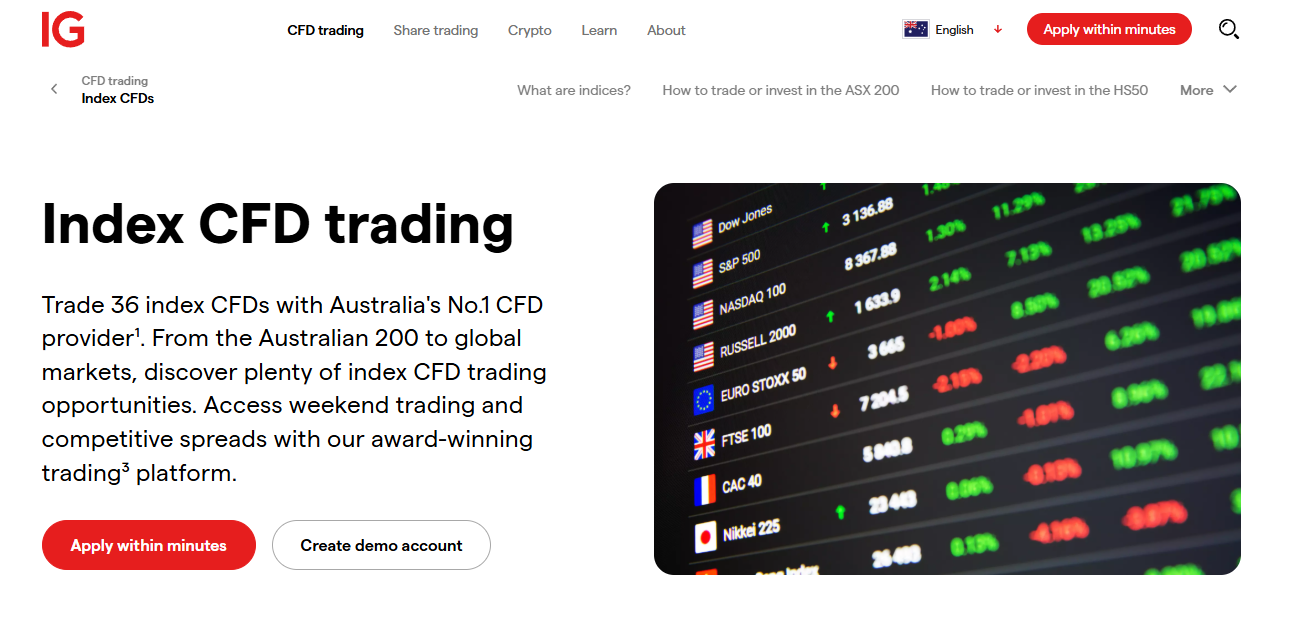
IG Markets is one of the most popular and well-established trading platforms for Australians and global index traders, thanks to its market depth and high level of professionalism over the years.
On IG, you’ll find a deep range of indices across 80+ international markets for CFD trading. These include the FTSE 100, Germany 40 (based on DAX), US Tech 100 (Nasdaq), Wall Street (Dow Jones), and US 500 (S&P 500). We also discovered that the platform offers 9 options indices across major markets. If you also like to trade during the weekend, you can leverage IG Markets’ weekend trading feature, which allows users to trade some key indices on Saturdays and Sundays.
These features come along with advanced charting tools and research resources for detailed market analysis, making IG more attractive to experienced traders who need detailed market insights.
However, this depth comes at a cost, as the platform’s interface is complex, and its fees are higher than what you’ll get on simpler platforms. These fees include spreads, commissions, and additional charges depending on the asset. Holding positions over the weekend also comes at higher costs.
Security and regulation are strong points for IG, with a long-standing reputation and compliance with financial standards across the jurisdictions in which it operates. Overall, advanced traders and investors looking for an indices trading platform will fancy IG Markets.
5. CMC Markets
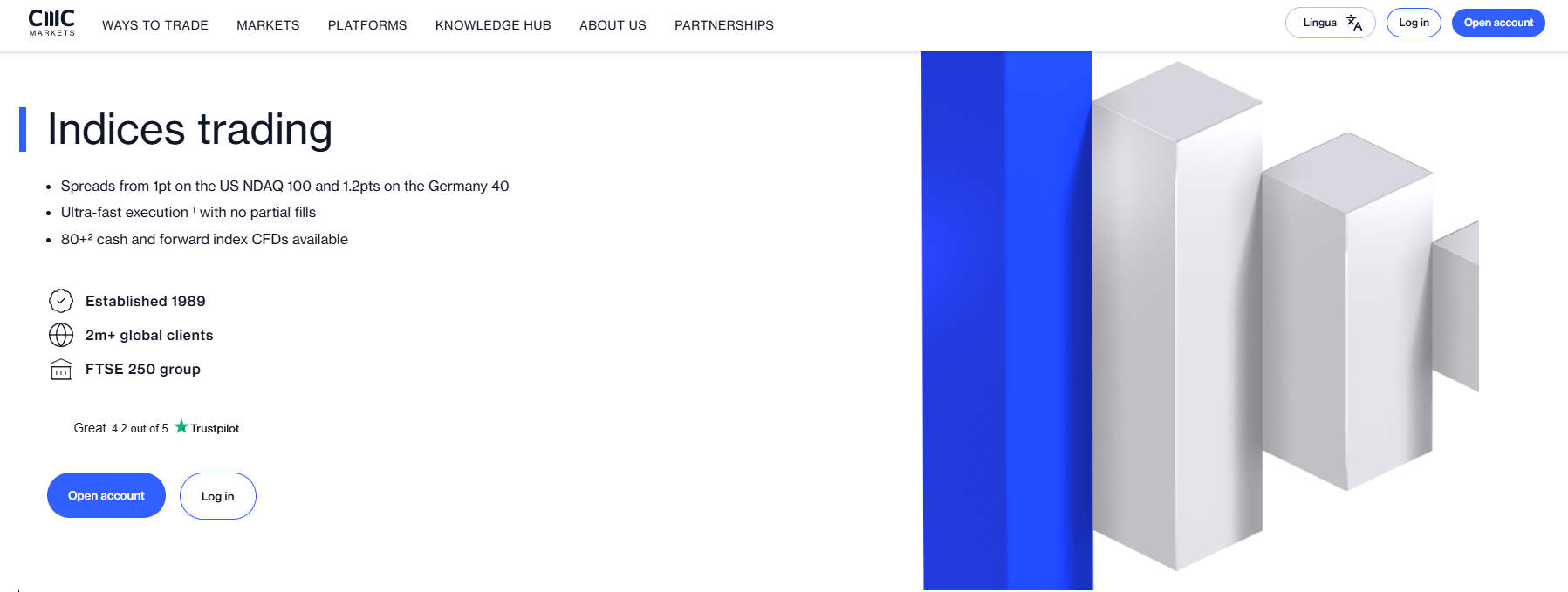
CMC Markets is one of the most competitive trading platforms for Australians in terms of costs and strong analytical tools. The platform offers tight spreads across major indices, making it appealing for traders, especially beginners, who want to maximise their small budgets.
The platform also provides advanced charting features, enabling users to conduct detailed technical analysis. Due to these complex tools, the interface on CMC Markets can be complicated for beginners, but it provides greater control and flexibility for experienced traders.
In terms of security, the platform is licensed, it complies with regulatory oversight, and offers standard security features to its users. If cost efficiency and analytical depth are your priorities, CMC Markets is a viable option among the best indices CFD trading platforms for Australians.
6. Pepperstone
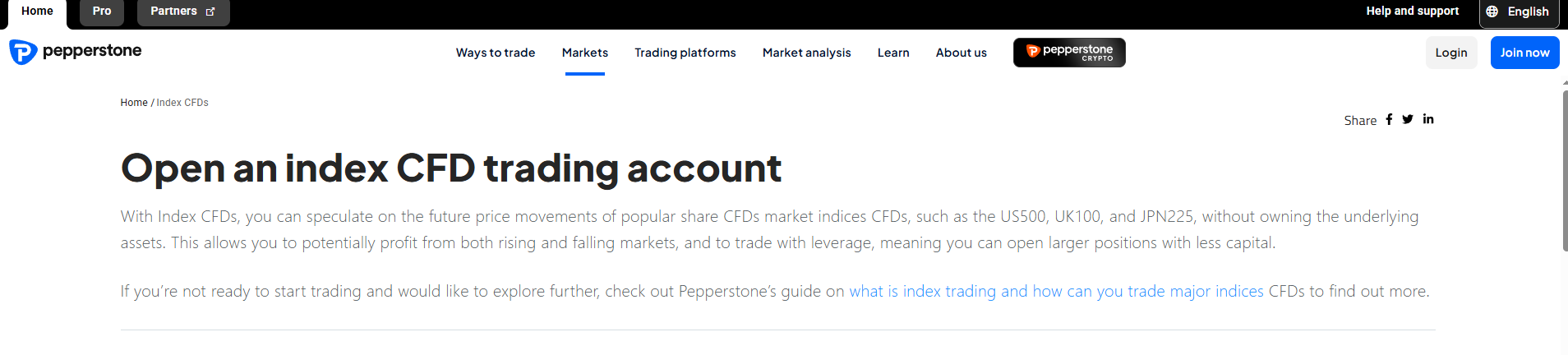
Pepperstone is another top indices trading platform with a presence in Australia. The platform is particularly popular among traders who are keen on precision due to its fast execution speed. It also shines due to its support for multiple built-in trading platforms, including MetaTrader and cTrader. With these tools, you can customise your trading activities to your taste.
The range of indices CFDs on Pepperstone is also impressive, with competitive spreads and fast order execution. However, its focus on technical tools makes it more complicated, especially for new traders who may need time to adapt.
Still, Pepperstone is regulated and offers secure account management systems. For experienced traders who desire performance and flexibility, Pepperstone is a strong choice.
7. AvaTrade
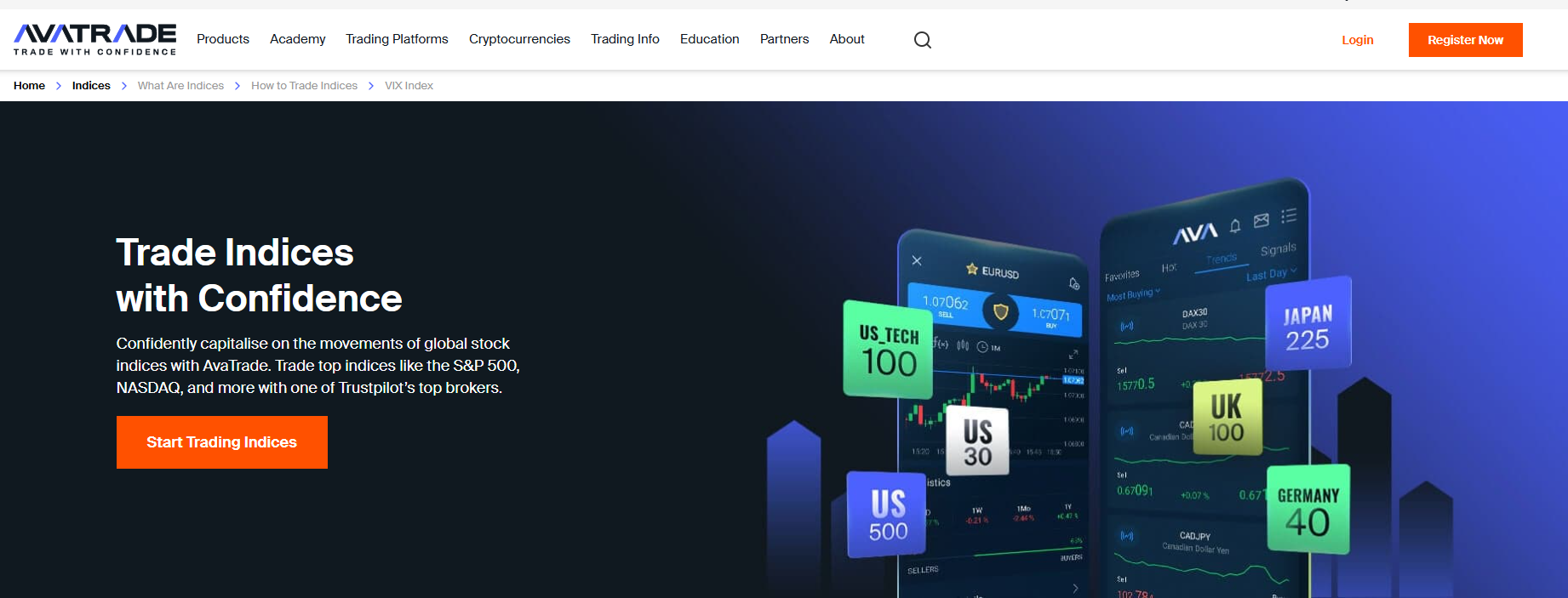
AvaTrade is the last indices trading platform on our list, but this doesn’t mean the platform is the least in terms of performance. This is because it offers a balance of simple trading experience and versatility. For context, AvaTrade supports multiple trading interfaces, including MetaTrader and its own built-in charts. It provides access to a range of index CFDs like its competitors. Similarly, AvaTrade runs on fixed spreads, which can help traders predict costs more easily.
Overall, AvaTrade is suitable for beginners and experienced traders looking for a mix of user-friendly design, educational resources, and versatility.
Fees in Indices CFD Trading
Every index trading platform charges fees, which is why you must pay attention before choosing one. Typically, these are the costs you’ll incur when trading indices:
Commission: This is typically a flat trading fee charged by the platform. For every trade you execute, the cost applies.
Spread: For zero-commission platforms, a spread is the difference between the buy and sell price. These costs are factored into your trades and serve as revenue for the platform.
Overnight or weekend fees: These are costs incurred if you hold positions beyond a trading day or during the weekend. They vary by platform and usually apply to swing traders or long-term holders.
Additional fees may include inactivity charges, withdrawal fees, and currency conversion costs.
How to Start Trading Indices CFDs in Australia
In Australia, most traders access indices through CFDs (Contracts for Difference). This model allows you to trade price movements without owning the underlying asset, providing flexibility and access to both rising and falling markets.
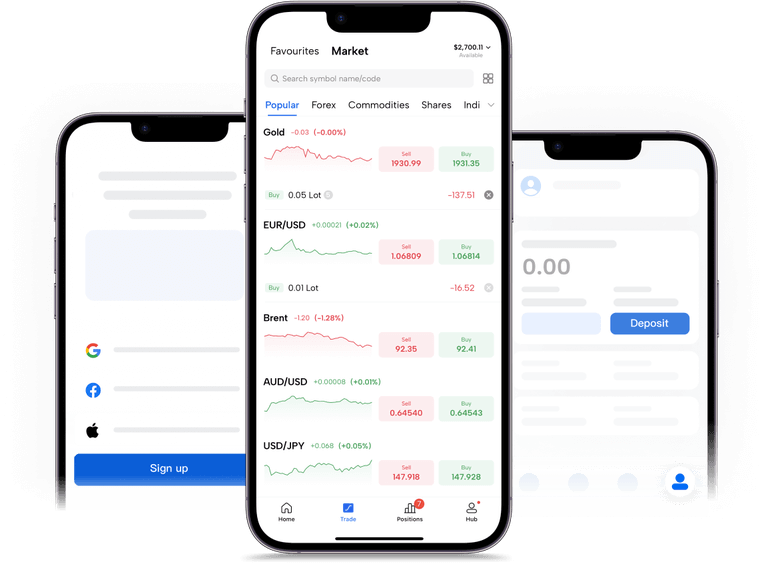
However, not all platforms are built the same. Some prioritise simplicity, others focus on advanced tools, and a few attempt to balance both. One of the platforms who offer a mix of both is Mitrade. Here’s how to trade Indices CFDs on Mitrade in Australia:
Create a Mitrade account and complete identity verification
Deposit funds using any of the supported payment options
Explore the supported index CFDs and choose your preferred one
Analyse the market and decide what position to take
Open a position (go long or short) based on your projection
Index trading is one of the flexible ways to access global markets from Australia, with platforms like Mitrade offering user-friendly experiences at low costs. If you’re just starting with index trading, we recommend beginning with smaller trades and building consistency over time before entering the market fully
1. What is the best indices trading platform in Australia?
Mitrade is considered the best platform for trading indices in Australia due to its balance of simplicity, fast execution, and flexibility via leveraged trading.
2. Where can I trade indices?
You can trade indices through CFD platforms such as Mitrade, IG Markets, and CMC Markets.
3. What is an indices CFD trading platform?
An index trading platform offers you access to trade index price movements without owning the underlying asset.
Disclaimer: The content presented above, whether from a third party or not, is considered as general advice only. CFD trading involves significant risk of loss. Past performance does not guarantee future results. This article serves informational purposes only and does not constitute financial advice. Consider your risk tolerance before trading.


