




Australians love ETFs, and a large share of that money now flows into US shares. Yet the same US market can be bought in very different ways.
An S&P 500 fund listed on the ASX and one listed in New York track the same index. They still differ on hours, currency, fees, tax and flexibility.
This guide compares ASX ETFs vs US ETFs from an Australian trader's point of view. It also shows where US ETF CFDs fit for traders who want to go short as well as long.
What Is the Difference Between ASX ETFs and US ETFs?
An ASX ETF is a fund listed on the Australian Securities Exchange and traded in Australian dollars, while a US ETF is listed on a US exchange and traded in US dollars.
Both can hold the same shares. An ASX fund can even hold US companies, or own a US fund directly.
The ASX now lists 458 ETFs, according to its July 2026 update. The US market is far larger, with thousands of funds and much deeper trading.
For Australians who want US exposure, there are three main routes. Each one behaves differently.
An ASX ETF that holds US shares. It trades on the ASX in Australian dollars during local hours.
A US listed ETF. It trades in New York in US dollars, overnight in Australia.
A CFD on a US ETF. It tracks the US fund's price without owning units, and lets you go long or short.
Trading Hours: Day Versus Night
ASX ETFs trade during the local day. On the ASX, normal trading runs from 10am to 4pm Sydney time on weekdays.
US ETFs trade on New York hours. During Australian daylight saving, the regular US session runs from about 1:30am to 8am Sydney time.
That gap matters more than it seems. An ASX ETF holding US shares trades while the US market is closed.
So its price during the Australian day reflects the previous US close, plus moves in US futures and the exchange rate. The real action in its holdings happens overnight.
Some trading platforms, including Mitrade, offer extended sessions on US ETF CFDs. They open in the Australian evening and run until about midday Sydney time.
Which hours suit you?
If you trade during the day, ASX ETFs fit your schedule. You can watch the market and react in real time.
If you prefer evening trading, US ETFs or US ETF CFDs fit better. Their main moves happen while US markets are open.
Currency Risk: The Hidden Return
For Australians, currency can matter as much as the fund itself. A US ETF is priced in US dollars, so its value in Australian dollars changes with the exchange rate.
Many ASX ETFs that hold US shares are unhedged. They trade in Australian dollars, but their value still moves with the AUD/USD rate.
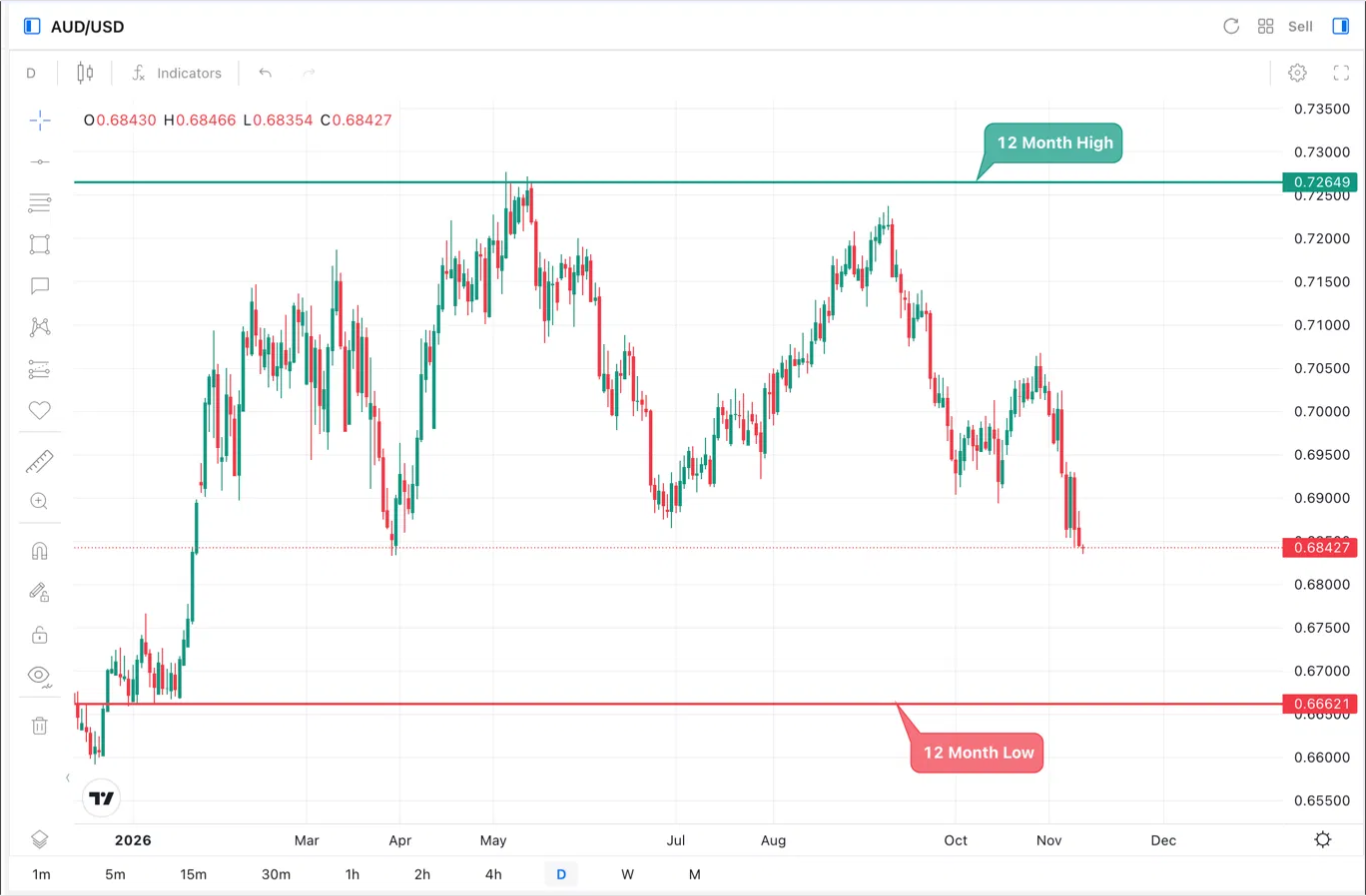
Image: Mitrade (AUD/USD Daily Chart)
Over the past year, AUD/USD ranged from a low of 0.66621 to a high of 0.72649. That is a rise of about 9% from low to high.
Over that move, a US ETF that went nowhere in US dollars would have lost about 8% for an Australian investor. The currency alone did the damage.
The reverse also applies. When the Australian dollar falls, unhedged US holdings gain value in local terms.
Hedged versus unhedged
Some ASX ETFs remove most of this currency effect. The iShares S&P 500 AUD Hedged ETF is one example.
A hedged fund tracks the index return more closely in Australian dollars. An unhedged fund adds a currency bet on top.
Neither is better in every case. The choice depends on whether you want exposure to the Australian dollar as well as US shares.
US listed ETFs and US ETF CFDs are always in US dollars. If you trade them, you carry the currency risk unless you manage it separately.
Liquidity and Spreads
Liquidity decides how easily you can enter and exit a trade at a fair price. On that measure, the biggest US ETFs are in a league of their own.
The SPDR S&P 500 ETF Trust held about $793 billion in assets as of November 2026, with a gross expense ratio of 0.0945%. Funds that size trade millions of units a day, which keeps spreads tight.
The largest ASX ETFs trade well too, but many smaller ASX funds trade thinly. In thin markets, the gap between buy and sell prices can widen.
ASX ETFs also rely on market makers to keep prices close to the fund's value. When the US market is closed, those market makers price in more uncertainty.
What this means for traders
For long term investors buying once a month, small spread differences rarely matter. For active traders entering and exiting often, they add up.
That is one reason short term traders often prefer the most liquid US funds. Broad market ETFs such as SPY and QQQ usually offer the tightest pricing.
Fees: Management Costs, Brokerage and Currency Conversion
ETF costs come in three layers. Each one affects your return.
Management fees. These are charged inside the fund every year. Large index ETFs are now very cheap on both markets.
The iShares S&P 500 ETF listed on the ASX charges a management fee of 0.04% a year. That is even lower than SPY's expense ratio.
Brokerage. Every trade on a share platform costs something. Some platforms charge more for US trades than for ASX trades.
Currency conversion. Buying US listed ETFs usually means converting Australian dollars to US dollars. Platforms often charge a margin on that conversion, both when you buy and when you sell.
For a buy and hold investor in a broad index, ASX ETFs often work out cheapest overall. There is no currency conversion, and fees are competitive.
How CFD costs differ
ETF CFDs work differently. There is no management fee paid directly, but you pay the spread and overnight funding on positions held past the daily cut off.
Funding adds up over months, so CFDs suit shorter time frames. Our ETF CFD trading guide covers those costs with real examples.
Tax Differences for Australian Residents
Tax can change the real return between two funds that track the same index. This section covers the main points, not personal tax advice.
Franking credits
ASX ETFs holding Australian shares can pass on franking credits from company dividends. For many local investors, that is a valuable tax benefit.
US ETFs do not carry franking credits. Neither do ASX ETFs that only hold US shares.
US withholding tax
Dividends from US ETFs face US withholding tax. Under the tax treaty between the two countries, the general rate on dividends is 15%.
To claim that treaty rate, Australians usually complete a W-8BEN form with their platform. Without it, more tax may be withheld.
US estate tax
Holding US listed shares directly can create a US estate tax issue for non US residents. The IRS requires an estate tax return when US assets above $60,000 are held at death.
Australian domiciled ETFs generally avoid this issue for local investors. It is worth checking with a tax adviser before building large direct US holdings.
CFDs and tax
CFDs do not give you ownership, dividends or franking credits. Gains and losses are generally treated differently from long term share investments, so seek advice on your situation.
Choice: What Only the US Market Offers
The ASX offers a wide and growing ETF range. Still, some exposures are easier to find in the US.
US markets list deep ranges of sector funds, single country funds and thematic funds. They also list leveraged and inverse ETFs, which are far more common there than on the ASX.
Many of these US funds are available as CFDs. Mitrade lists sector ETFs such as XLK and XLF, country ETFs covering South Korea and Taiwan, and leveraged funds such as TQQQ.
Leveraged ETFs need extra care. Combined with CFD leverage, small index moves can create large losses.
“Trade ETF CFDs with an ASIC-regulated broker. Fast AUD funding via PayID. ”
One Index, Three Routes: A Simple Example
Imagine the S&P 500 rises 2% overnight in US trading. Here is how each route would feel to an Australian.
The ASX ETF holder
The US market closes while Australia sleeps. When the ASX opens at 10am, the ASX listed S&P 500 ETF reprices to reflect the US gain.
If the Australian dollar also rose overnight, part of that 2% gain disappears for an unhedged fund. A hedged fund would show something closer to the full index move.
The investor did not need to do anything. The gain simply appears in the morning.
The US listed ETF holder
The investor holding SPY directly watches the 2% gain happen live in US dollars. Converted back to Australian dollars, the result again depends on the exchange rate.
They also own the units outright, with dividends paid in US dollars after withholding tax.
The ETF CFD trader
A trader holding a long CFD on SPY at 5:1 leverage gains 2% on the full position value. Because the margin was only 20% of that value, the gain equals about 10% of the margin used.
The same maths works in reverse. A 2% fall would cost about 10% of the margin, which is why stops matter so much.
A trader who had gone short before the move would have lost instead. That two way exposure is the main reason traders choose CFDs over owning the fund.
ASX ETFs vs US ETFs: Which Suits You?
The right choice depends on what you are trying to do. Here is a simple way to think about it.
Choose ASX ETFs if you:
Invest for the long term and buy regularly.
Want to trade during the Australian day.
Value franking credits and simple local tax reporting.
Prefer to avoid currency conversion, or want a hedged option.
Choose US listed ETFs if you:
Want the deepest liquidity and the widest range of funds.
Are comfortable holding US dollars and completing a W-8BEN form.
Can manage the extra paperwork and possible estate tax issues.
Choose US ETF CFDs if you:
Trade short term moves rather than investing for years.
Want to go short as well as long.
Prefer to trade in the Australian evening and late morning.
Understand leverage, which ASIC caps at 5:1 for retail share and ETF CFDs.
Many Australians use more than one route. A core ASX ETF for long term savings can sit alongside short term CFD trades on US funds.
ASX ETFs vs US ETFs: FAQs
Are ASX ETFs or US ETFs cheaper?
Both markets offer very low management fees on large index funds. ASX ETFs often work out cheaper overall because they avoid currency conversion costs.
Do ASX ETFs that hold US shares have currency risk?
Yes, unless they are hedged. Unhedged ASX ETFs holding US shares still move with the Australian dollar against the US dollar.
Why do ASX ETFs holding US shares trade when the US market is closed?
They trade on the ASX during Australian hours. Market makers price them using the last US close, US futures and the exchange rate.
Do I need a W-8BEN form for US ETFs?
Usually, yes. It lets you claim the reduced treaty rate on US dividends instead of a higher default rate.
Can I short an ETF in Australia?
Shorting ETFs directly is difficult for most retail investors. A CFD lets you sell a US ETF first and buy it back later, profiting if the price falls.
Can I trade US ETFs on Mitrade?
Yes. Mitrade is regulated by ASIC and offers CFDs on dozens of US ETFs, plus a free demo account for practice.


You might be interested in…
Disclaimer: The content presented above, whether from a third party or not, is considered as general advice only. CFD trading involves significant risk of loss. Past performance does not guarantee future results. This article serves informational purposes only and does not constitute financial advice. Consider your risk tolerance before trading.


