




An ETF lets you buy a whole market in one trade. A CFD on that ETF goes further, because it lets you profit from a fall as well as a rise.
That flexibility is why many Australian traders use ETF CFDs on US funds. It is also why they need a clear plan before they place an order.
This guide shows how to trade ETF CFDs in Australia, step by step. It uses real screenshots from a Mitrade demo account and walks through a long trade and a short trade on the Nasdaq 100 ETF.
What Is an ETF CFD?
An ETF CFD is a contract that tracks the price of an exchange traded fund, so you can trade its moves without owning the fund's units.
If you buy and the ETF rises, you profit. If you sell first and the ETF falls, you also profit.
You never hold the underlying units, so there is no share registry and no transfer of ownership. The trade settles in cash when you close it.
Mitrade already explains how ETFs work as investments. This guide focuses on trading them as CFDs.
Step 1: Choose the Right ETF
Dozens of ETFs are available on the platform. They fall into a few clear groups.
Broad market ETFs. These track a whole index, such as SPY for the S&P 500 or QQQ for the Nasdaq 100. They suit traders who want exposure to the overall market.
Sector ETFs. Funds such as XLK, XLF and XLE track technology, financials and energy. They suit traders with a view on one part of the economy.
Country ETFs. Funds covering South Korea, Taiwan, China, Singapore and Brazil let you trade a whole national market in one position.
Thematic ETFs. Funds such as LIT for lithium and URA for uranium follow a single theme. They tend to move more than broad market funds.
Leveraged and inverse ETFs. Funds such as TQQQ and SQQQ use built-in leverage. They need extra care, which is covered in Step 6.
The platform also offers a separate list of European ETFs quoted in euros. For an Australian trader, those add a second currency to the trade, so profits and losses also move with the euro.
For a first trade, a liquid broad market ETF is the simplest choice. This guide uses the Invesco QQQ ETF, which tracks the Nasdaq 100.
Step 2: Read the ETF Contract
Every ETF on the platform has its own contract details. They tell you what one lot means and what the trade will cost to hold.
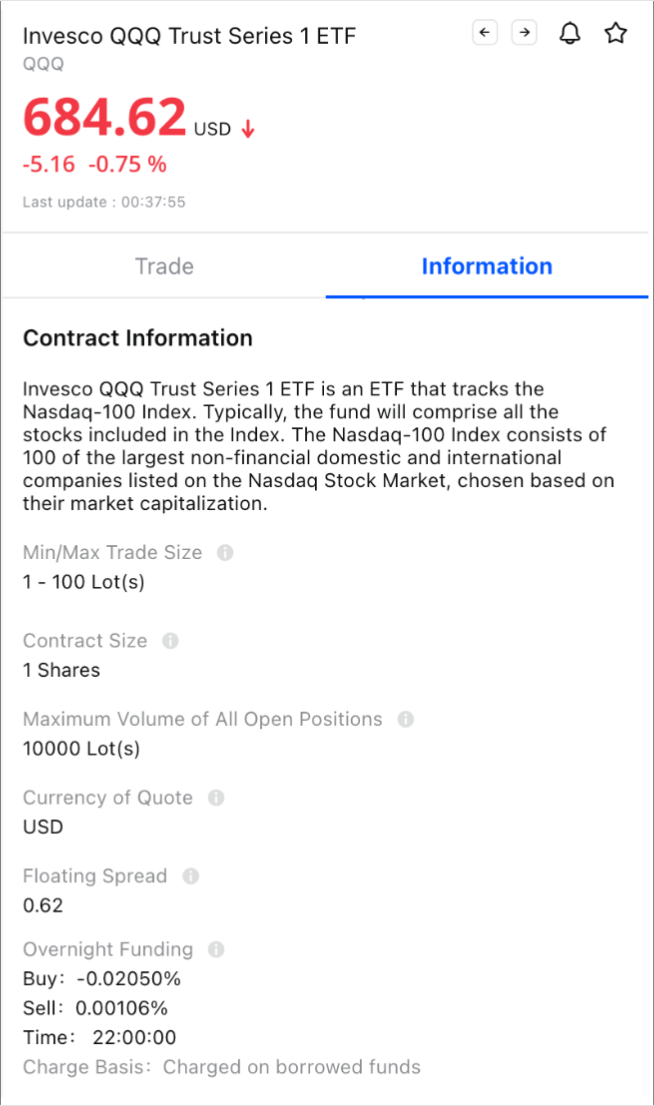
Image: Mitrade (QQQ Contract Information)
Contract size
One lot of QQQ equals one share of the ETF. So 55 lots means a position in 55 units.
Trades range from 1 to 100 lots on this ETF. That makes sizing far simpler than on gold, where one lot covers 100 ounces.
Spread
The floating spread was 0.62 at the time of the screenshot. The order screen also shows the estimated spread cost before you trade.
Overnight funding
Positions held overnight pay or receive a funding adjustment. On the demo account, buy positions paid 0.02050% per night, while sell positions received a small credit of 0.00106%.
The charge applies only to borrowed funds, not the full position. That is different from gold, where funding is charged on the full size.
The adjustment is applied at 9am Sydney time during daylight saving.
Trading hours in Australian time
US ETFs trade on US market hours, which fall overnight in Australia. The platform also offers extended sessions before and after the main US session.
During daylight saving, the pre market session runs from about 8pm to 1:30am Sydney time. The regular US session follows until 8am.
After hours trading then continues until about midday. Between midday and 8pm, the market is closed.
That schedule suits Australians who trade in the evening. It also means prices can gap between sessions, so stops matter.
Step 3: Mark the Zones on the Chart
Before choosing a direction, mark where the ETF has turned before. Those zones decide the entry, the stop and the target.
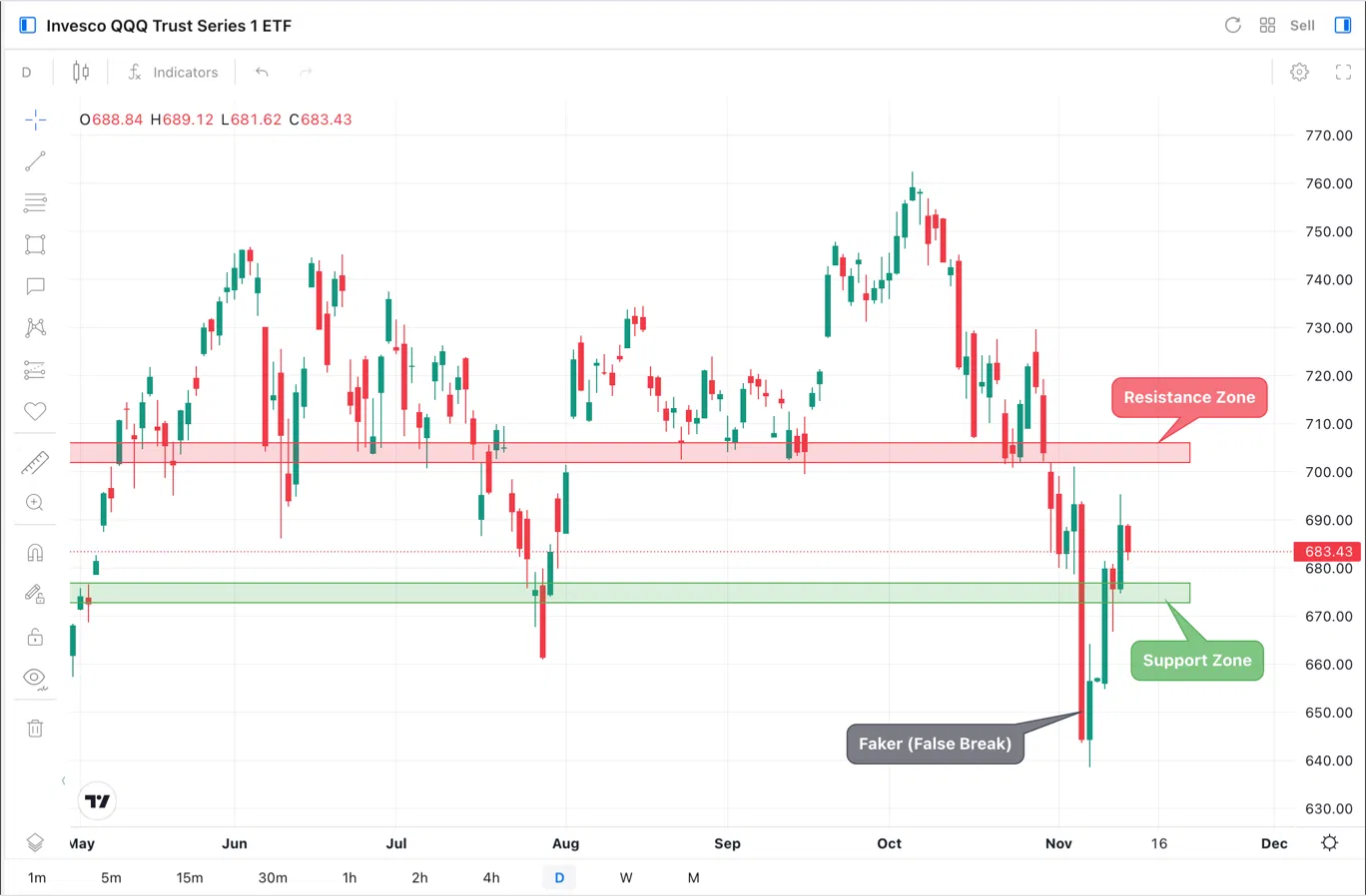
Image: Mitrade (QQQ Daily Chart With Support and Resistance Zones)
Resistance sits at about 701.94 to 706.03. This zone flipped between support and resistance from June to September and held as support in late October.
It broke in early November. Now it sits overhead as resistance.
Support sits at about 672.81 to 676.91. It held in June and again in early August.
In early November, QQQ dropped well below support to about 640. It then reclaimed the zone within days, which made it a false break.
At the time of the screenshot, QQQ traded at about 683, just above support. Our support guide explains how to draw zones like these.
Step 4: Plan a Long Trade on QQQ
A long trade profits if the ETF rises. The cleanest entry is near support, using a Buy Limit order that waits for price to come back.
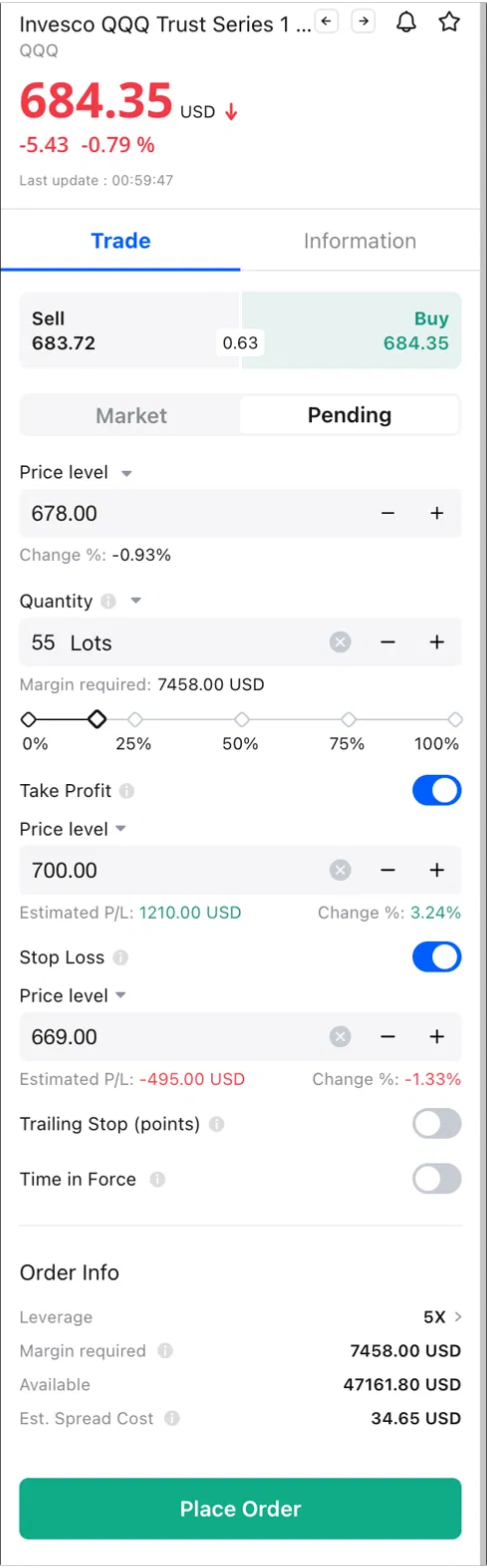
Image: Mitrade (QQQ Buy Limit Order)
Entry. The Buy Limit sits at 678.00, just above the support zone.
Stop loss. The stop sits at 669.00, below the whole zone. A close below it would cancel the reason for the trade.
Take profit. The target sits at 700.00, just before resistance begins.
Size. At 55 lots, the estimated loss at the stop is $495. The estimated gain at the target is $1,210.
That is a reward to risk ratio of about 2.4. On a $50,000 demo balance, the risk is about 1% of the account.
The estimated spread cost is $34.65. That is the cost of entering the trade before the price moves at all.
Step 5: Plan a Short Trade on QQQ
A CFD lets you sell an ETF first and buy it back later. That means a falling market can be traded too.
The short trade uses the same zones in reverse. It sells near resistance and targets support.
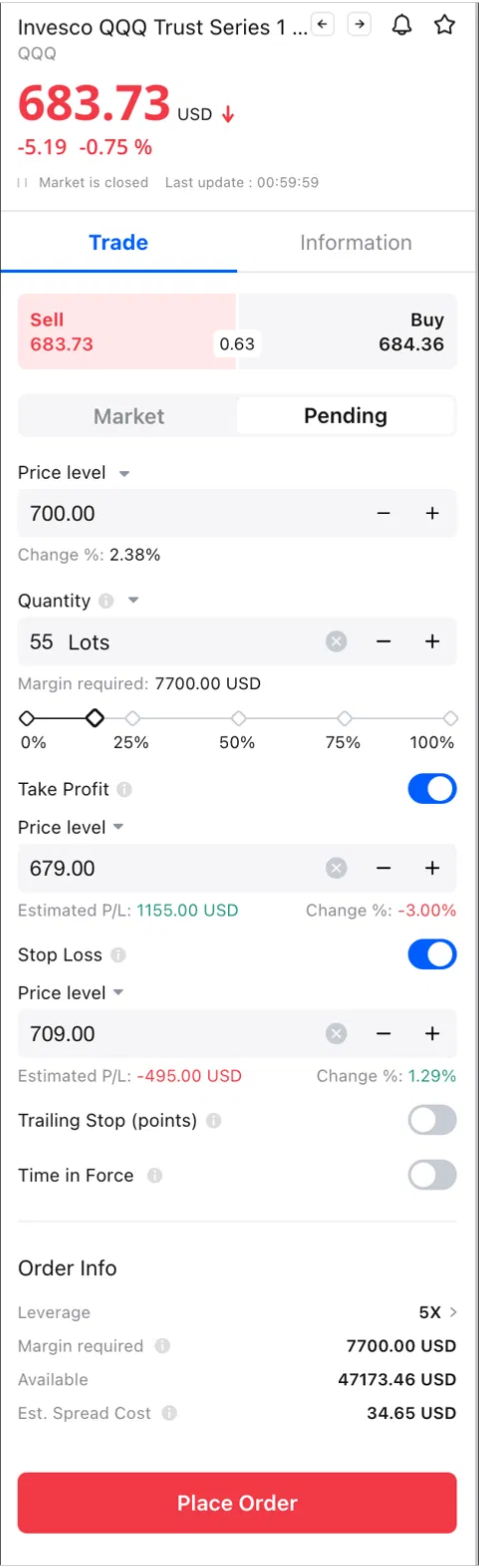
Image: Mitrade (QQQ Sell Limit Order)
Entry. The Sell Limit sits at 700.00, just below the resistance zone.
Stop loss. The stop sits at 709.00, above the whole zone.
Take profit. The target sits at 679.00, just above support.
Size. At 55 lots, the estimated loss at the stop is $495. The estimated gain at the target is $1,155.
That is a reward to risk ratio of about 2.3. Both trades risk the same amount, because both stops sit nine points from the entry.
Shorting has its own risks
An ETF can rise sharply after good news, earnings or a change in interest rate expectations. A short position needs a stop just as much as a long one.
Gaps between sessions can also push the price past a stop. On US ETFs, that risk is highest around the open of the regular session.
“Trade ETF CFDs with an ASIC-regulated broker. Fast AUD funding via PayID. ”
Step 6: Understand Leverage, Margin and Funding
In Australia, ASIC caps retail leverage on share and ETF CFDs at 5:1. That means you put up at least 20% of the position value as margin.
Both order screens were set at 5X. The long trade controls 55 units at 678, worth $37,290, and needs $7,458 in margin.
The short trade controls 55 units at 700, worth $38,500. Its margin is $7,700, again exactly 20%.
Margin is the deposit, not the risk. The risk is set by the stop distance and the number of lots.
How funding works on borrowed funds
Because funding applies to borrowed funds, it only covers the part of the position you did not pay for. At 5:1, that is 80% of the position value.
On the long trade, the borrowed amount is about $29,832. At the buy rate of 0.02050%, that costs about $6.12 per night.
On the short trade, the borrowed amount is about $30,800. At the sell rate shown, it would earn a small credit of about $0.33 per night.
Funding rates change over time, so check the Information tab before holding any ETF trade for weeks. A slow long trade can lose a meaningful share of its profit to funding.
The double leverage trap
Leveraged ETFs such as TQQQ already use leverage inside the fund. ProShares says TQQQ aims for three times the daily return of the Nasdaq 100.
Trade that fund as a CFD at 5:1, and the exposure to Nasdaq moves becomes far larger than the margin suggests. A small move in the index can wipe out the margin quickly.
These funds also reset daily, so their value can drift over time in choppy markets. They suit short term trades with tight risk control, not long holds.
Step 7: Manage ETF Trades Around the US Session
Most of the action in US ETFs happens while Australia sleeps. So the plan has to work without you watching the screen.
Let pending orders do the waiting
Pending orders sit on the platform until price reaches them. Both QQQ orders above can be placed in the evening and left to fill overnight.
Each order already carries its stop and target. If the trade fills at 3am, it is protected from the first second.
Check the calendar before you sleep
US interest rate decisions, inflation data and jobs reports can move ETFs sharply. Big tech earnings can also shift QQQ, because a few large companies make up much of the fund.
If a major release lands overnight, decide in advance whether to hold the trade through it. Some traders cancel pending orders before big events and place them again afterwards.
Review in the morning
The after hours session runs until about midday Sydney time. That leaves a window after breakfast to check what filled and adjust any open trades.
Move a stop only to reduce risk, never to give a losing trade more room. If the reason for the trade has gone, close it.
Common Mistakes When Trading ETF CFDs
Most ETF CFD losses come from a few repeat habits. Each one has a simple fix.
Ignoring the hours. US ETFs move most while Australians sleep. Use stops and pending orders rather than watching all night.
Using the wrong leverage. Check that leverage shows 5X on the order screen before you trade.
Treating leveraged ETFs like normal ones. TQQQ and SQQQ move much faster than QQQ, so size them much smaller.
Holding long trades for months. Overnight funding adds up, so CFDs suit shorter time frames better than long term investing.
Forgetting currency. US ETFs are quoted in US dollars and European ETFs in euros, so results change with exchange rates.
Chasing price between zones. Wait for the price to reach a zone, or let a limit order do the waiting.
How to Trade ETF CFDs: FAQs
What is the difference between an ETF and an ETF CFD?
Buying an ETF gives you units in the fund. An ETF CFD only tracks the price, so you can go long or short without owning the units.
What leverage can Australians use on ETF CFDs?
ASIC caps retail leverage on share and ETF CFDs at 5:1. That means a margin of at least 20% of the position value.
When can I trade US ETFs from Australia?
During daylight saving, extended trading on the platform runs from about 8pm to midday Sydney time. The regular US session runs from 1:30am to 8am.
Can I short an ETF with a CFD?
Yes. You can sell first and buy back later, profiting if the price falls. A stop loss is essential on every short trade.
Are leveraged ETFs safe to trade as CFDs?
They carry much higher risk. Their built in leverage combines with CFD leverage, so even small index moves can create large losses.
Can I practise trading ETF CFDs on Mitrade?
Yes. Mitrade is regulated by ASIC and offers a free demo account with $50,000 in virtual funds, which was used for every trade in this guide.

 Enjoy simple and fast trading Flexible leverage options available Follow real-time trading strategies Demo account with $50,000 virtual funds


You might be interested in…
Disclaimer: The content presented above, whether from a third party or not, is considered as general advice only. CFD trading involves significant risk of loss. Past performance does not guarantee future results. This article serves informational purposes only and does not constitute financial advice. Consider your risk tolerance before trading.


