




Gold Price Today: XAU/USD Nears $3,700 as AI Fears Ease | Mitrade AU


Gold rallied back above US$3,600 on Friday, 27 November, approaching US$3,700 as selling pressure eased following a volatile period for technology shares and precious metals.
FXEmpire’s gold feed showed approximately US$3,675.25 at 7:31 pm AEDT, up about 3% from its previous close. Earlier, Reuters reported that a US holiday lull had helped calm AI-related market concerns and reduce pressure on bullion.
For Australian traders, US$3,700 is now the immediate recovery test. A sustained break above it could bring US$3,800 into focus. However, the rebound does not yet establish that the broader decline has ended.
Persistent inflation, uncertainty about Fed tightening and holiday trading conditions remain important considerations.
Why Is Gold Rising Alongside Improving Market Sentiment?
Reduced liquidation pressure is helping bullion
Gold can sometimes recover alongside equities when demand for cash eases.
During a sharp market decline, investors may sell liquid holdings to reduce leverage or meet obligations elsewhere. When that pressure subsides, gold can rebound even if demand for defensive assets has not increased.
Reuters linked Friday’s recovery partly to the holiday pause in technology-stock selling and associated asset liquidations.
This provides a more precise explanation than assuming that stronger risk appetite always supports gold. Its relationship with equities changes depending on liquidity conditions, interest rates and investor positioning.
The next question is whether the recovery survives the return of fuller market participation after the holiday.
A rebound does not confirm a change in Fed policy
A pause in selling can support prices without removing the underlying monetary-policy headwinds.
Gold pays no interest, so higher expected returns on interest-bearing assets can reduce its appeal. A stronger US dollar can also make bullion more expensive for overseas buyers.
Friday’s rally should therefore be assessed alongside real yields, the dollar and investment flows. A price recovery alone does not establish that the Fed is approaching the end of its tightening cycle.
How Does the AI Boom Affect Gold Prices?
The World Gold Council’s Joseph Cavatoni addressed this question in an analysis published on 23 November.
A key distinction is that technology demand overall accounted for around 6%–7% of annual gold demand in 2025. That figure includes applications beyond AI. It should not be presented as AI’s direct share of global gold consumption.
Cavatoni identified four important indirect channels:
These forces can pull gold in different directions. AI’s effect on the wider economy is therefore likely to matter more than the gold physically used in chips and data centres.
Why AI Credit Risks Matter for the Gold Outlook
Financing conditions provide another link between AI investment and financial markets.
In her 10 November speech, Fed Vice Chair for Supervision Michelle Bowman said AI-related debt was on track to exceed US$800 billion in 2026. She also highlighted substantial potential payments associated with off-balance-sheet commitments.
For gold, a deterioration in credit conditions could produce competing effects:
Demand for defensive assets and lower bond yields could support bullion.
Investors seeking cash could sell gold alongside other liquid assets.
A reassessment of growth and inflation could change expectations for monetary policy.
These are possible transmission channels, rather than evidence that financial stress must produce an immediate gold rally.
Credit concerns also do not guarantee monetary easing. Policymakers must assess financial conditions alongside inflation and employment.
Core PCE Inflation Keeps the Fed Outlook in Focus
The Bureau of Economic Analysis reported that October core PCE inflation increased 3.3% year on year and 0.3% month on month. Headline PCE inflation rose 3.8% annually and 0.3% monthly.
The data show that inflation remains above the Fed’s 2% objective. Friday’s gold rally therefore comes against a backdrop in which price pressures remain a policy concern.
For bullion, a more durable recovery would become easier to support if incoming information reduced expectations for future tightening. Conversely, persistent inflation could keep yields and the dollar elevated.
The eventual end of a hiking cycle need not coincide exactly with gold’s lowest price. Markets can anticipate policy changes, but those expectations can also prove premature.
Gold Technical Analysis: US$3,700 Is the Immediate Test
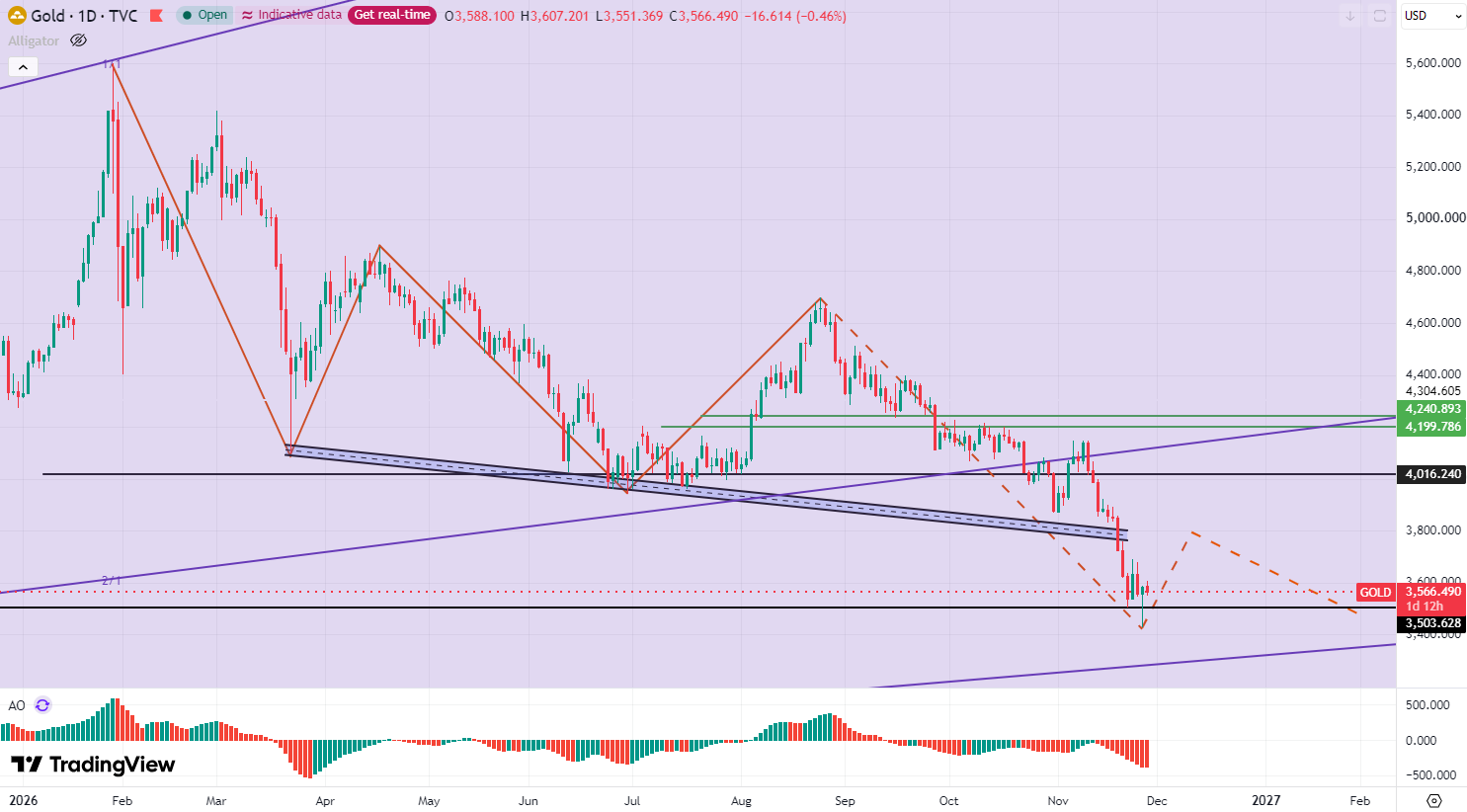
Source: Tradingview
A sustained break above US$3,700 could extend the rebound
Gold’s approach to US$3,700 makes this the nearest psychological resistance reference.
A sustained move above it, followed by a successful retest, would provide stronger evidence than a brief intraday spike. That would bring US$3,800 into focus as the next recovery hurdle.
Holiday trading conditions make confirmation particularly useful.
US$3,800–US$3,870 remains a broader hurdle
A recovery through US$3,800 would represent progress, but gold would still face the earlier breakdown area around US$3,870.
Sustained trading above both levels would challenge the bearish outlook more meaningfully. Beyond that zone, US$4,000 becomes a higher psychological reference rather than an immediate target.
US$3,600 is the first support reference
If the rally loses momentum, US$3,600 is the first major round number to reassess.
Holding above it would preserve the possibility of further consolidation and another recovery attempt. Losing it and failing to reclaim it would weaken Friday’s improvement.
US$3,500 remains a more distant downside reference. Its significance depends on actual price behaviour rather than an assumption that it must hold.
What Should Australian Gold CFD Traders Watch Next?
1. Gold: Can XAU/USD Break and Hold US$3,700?
A sustained breakout would strengthen the case for a move towards US$3,800. Rejection would leave the rally vulnerable to consolidation.
2. Support: Can Buyers Defend US$3,600?
Holding this level would preserve the improved short-term picture. A failed recovery would weaken it.
3. AI Financing: Are Credit Conditions Stabilising?
Watch whether concerns about financing and investment returns ease as normal market participation resumes.
4. Fed Policy: What Changes Before the December Decision?
The next scheduled decision is 9 December in the US, corresponding to 6:00 am AEDT on 10 December, with the press conference at 6:30 am AEDT. This is a potential catalyst, not a predetermined turning point for gold.
Explore Gold Markets with Mitrade
Mitrade offers eligible Australian clients gold CFD trading and a demo account for exploring the platform. Review current product specifications, margin requirements and trading costs before deciding whether live trading suits your circumstances.

Trade XAU/USD with Tight Spreads
Disclaimer: The content presented above, whether from a third party or not, is considered as general advice only. Trading OTC derivatives involves significant risk and may not be suitable for all investors. CFDs are leveraged products, and you may lose all the funds in your trading account. You do not own or have rights to the underlying assets. This content is general information and does not take into account your objectives, financial situation or needs. Consider the PDS, FSG, TMD and other relevant disclosure documents before deciding whether to trade, and seek independent advice where appropriate. Past performance and demo results are not reliable indicators of future performance.


