




What Comes Next for Australian Interest Rates Ahead of the RBA's November Meeting
Australian interest rates have climbed four times in 2026, and the next move is now genuinely uncertain. The Reserve Bank of Australia meets again on November 3, and the experts cannot agree on what it will do.
Westpac still expects another hike, while CommBank expects a pause. Weak September jobs data has pushed money markets firmly toward a hold, yet the RBA's own minutes leave the door open.
One release will likely settle the debate. September inflation data lands on October 28, just six days before the decision. For traders on Mitrade, the ASIC regulated platform, that week could move the AUD, the ASX 200 and bank stocks all at once.
Where Australian Interest Rates Stand Now
The RBA cash rate is the interest rate the Reserve Bank of Australia sets on overnight loans between banks, and it now sits at 4.60%, its highest level in about 15 years.
The Board lifted the rate to 4.60% on September 29 in a unanimous decision. It said inflation remains elevated and warned it would raise the cash rate further if needed.
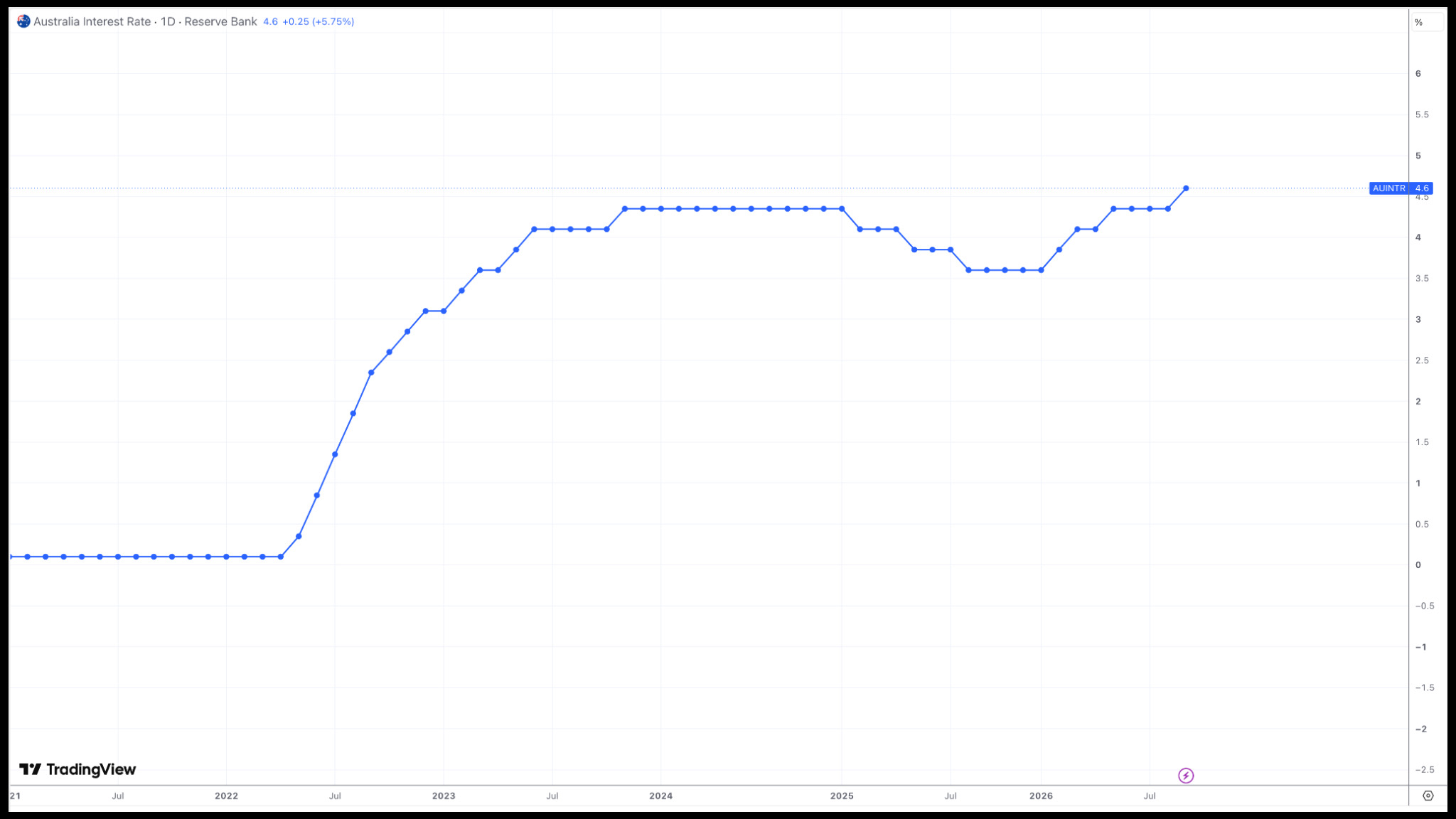
Image: TradingView (Australia Interest Rate Monthly Chart)
The chart puts this cycle in context. The RBA held the cash rate at 4.35% from late 2023 into early 2025, then cut it to 3.60% during 2025.
That easing did not last. The RBA reversed course in 2026, lifting the rate from 3.60% to 4.60% in four steps and taking it above the previous cycle's peak.
Why the RBA Hiked in September: Inside the Minutes
The minutes from the September meeting, released on October 13, explain why the Board moved. They point to three reasons for the hike.
First, risks the RBA flagged in August had already arrived. The Middle East conflict pushed oil well above forecast, and domestic fuel prices ran about 13% higher than the RBA had assumed.
Second, inflation had stayed above target for too long. Surveys suggested business inflation expectations may be rising, so the Board judged that acting quickly was the safer path.
Third, the Board questioned whether rates were high enough. Its models suggest the neutral interest rate may have risen, which would make policy less restrictive than it looks.
The minutes also flagged a new pressure. Members noted signs of AI boom price pressures emerging in Australia, alongside widespread domestic cost increases.
The key line for traders was the Board's promise to do what is necessary, including raising the cash rate further if required. That is not a commitment to hike, but it keeps November firmly in play.
The Data That Will Decide November
The RBA has made clear that its next move depends on the data. Two releases matter more than any others before November 3, and the first has already landed.
Jobs: the first test points to a pause
September's jobs report, released on October 15, was weaker than expected. Employment fell by 39,300 people, and the unemployment rate held at 4.7%, a five year high, after August was revised up from 4.6%.
Participation also slipped to 66.8%, a sign some people stopped looking for work. Moody's Analytics noted that firms are cutting shifts and casual hours first while holding onto full time staff.
Governor Michele Bullock has said unemployment between 4.5 and 5% would probably take enough heat out of the labour market. At 4.7%, unemployment now sits comfortably inside that range, which eases pressure on the RBA to keep tightening.
Inflation on October 28
Headline CPI rose to 4.0% in the 12 months to August, below the 4.1% economists expected. Trimmed mean inflation, the RBA's preferred measure, held at 3.6% for a third straight month.
Fuel was a major driver, with automotive fuel prices up 14.8% over the year. That matters because energy costs are exactly the risk the RBA cited when it hiked.
The September CPI release is due on October 28. A trimmed mean reading above 3.6% would strengthen the case for a hike, while a softer number would support a pause.
With the jobs data pointing to a cooling economy, the CPI release is now the main event. Only a clearly hot inflation number is likely to put a November hike back on the table.
Markets vs Banks: Who Is Right?
Before the jobs data, the banks were split down the middle. Westpac and ANZ expected a hike to 4.85% in November, while CommBank and NAB expected the RBA to hold at 4.60%.
Westpac has kept its call for a November hike, and EY still expects at least one more increase before year end. CommBank expects a hold but says the meeting remains live.
Money markets have moved firmly the other way. After the jobs report, they priced a 90% chance that the RBA holds in November, up from 66% before the data.
The odds of a December hike also fell, to 32%. Markets have not ruled out further tightening, but they now see it as a later and less certain story.
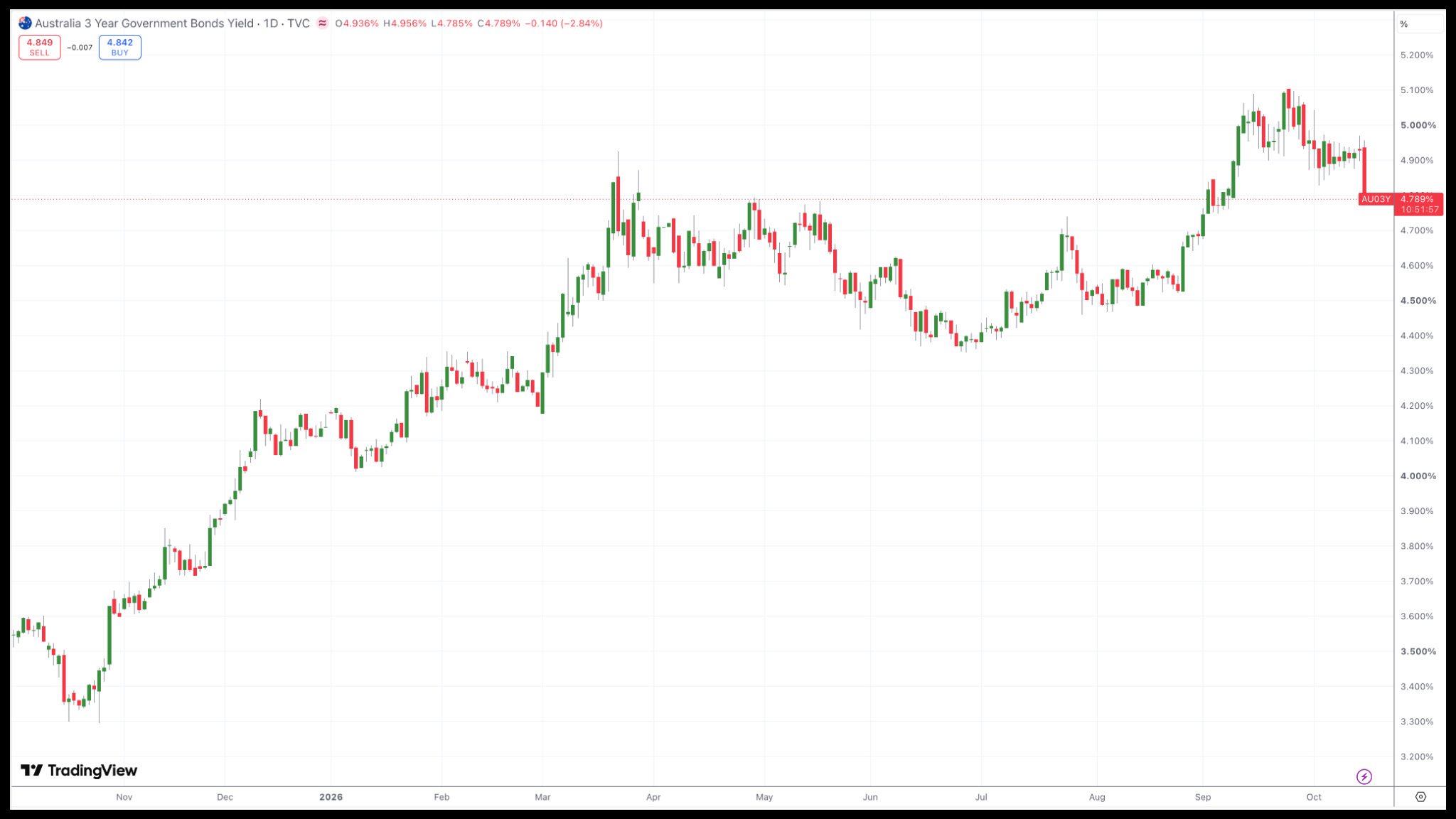
Image: TradingView (Australia 3 Year Government Bond Yield Daily Chart)
The three year bond yield shows how expectations have shifted. It climbed from around 3.75% in December to a peak near 5.1% in late September, as the market priced in a longer hiking cycle.
The yield had already eased to around 4.88% before the jobs data, then dropped sharply to about 4.79% on the day of the release. That fall signals lower expected rates, though the yield still sits above the 4.60% cash rate, a sign markets expect rates to stay high for some time.
What a November Hike or Hold Means for the AUD
Interest rates are the AUD's biggest short term driver. Higher Australian rates make the currency more attractive to hold, especially when other central banks are also tightening.
The US Federal Reserve raised its target range to 3.75% to 4% in September. With the RBA at 4.60%, the gap in Australia's favour now stands at 60 basis points.
The minutes raised a point that matters directly for the AUD. Board members noted that holding rates while other central banks tightened could weaken the currency and loosen financial conditions.
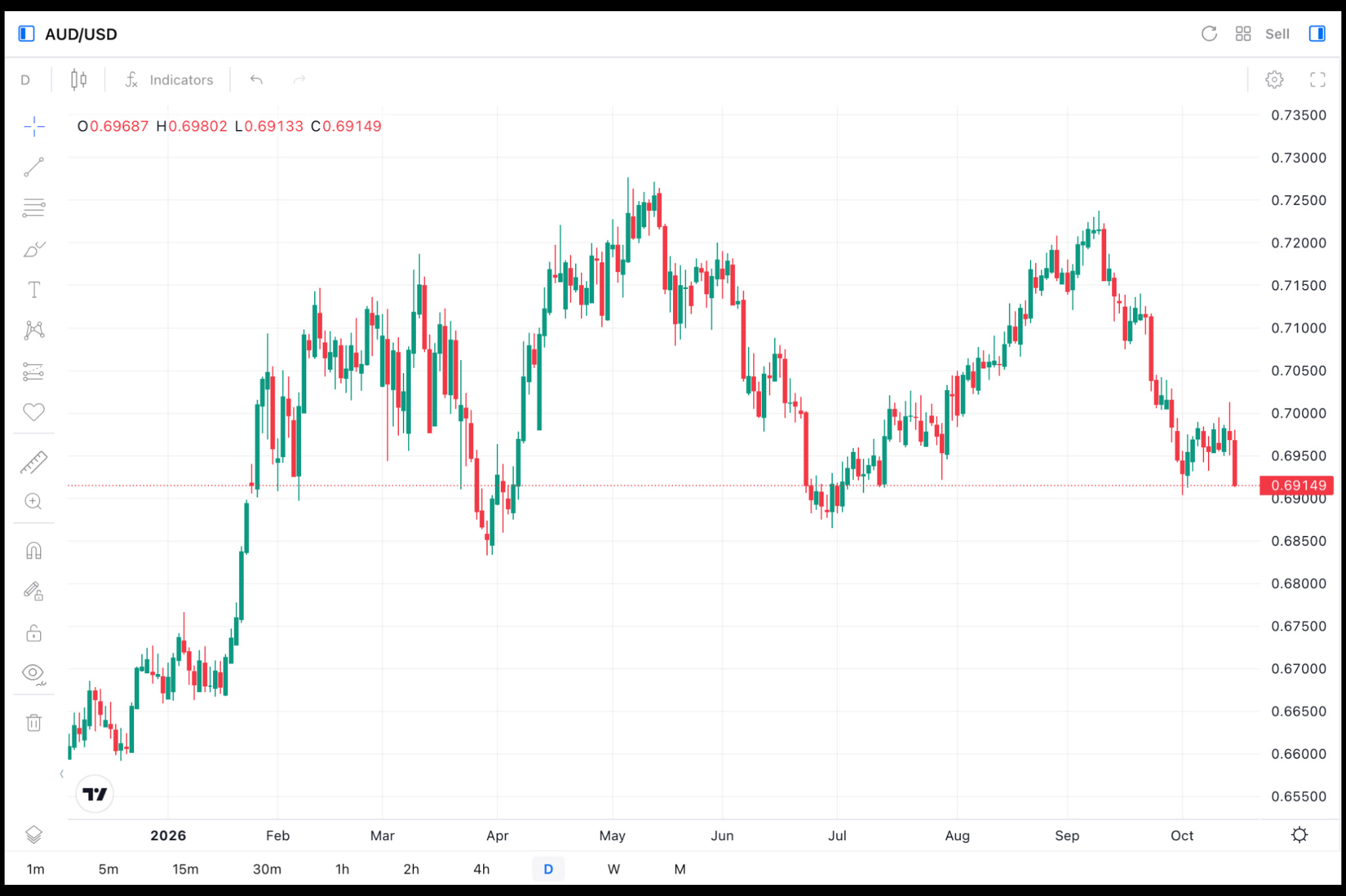
Image: Mitrade (AUD/USD Daily Chart)
The Mitrade chart shows the AUD has struggled despite the September hike. AUD/USD is down 2.66% over the past month, though still up 4.53% year to date.
The pair peaked near 0.724 in early September, then slid below 0.70 into October. It fell a further 0.3% to around 0.6953 after the weak jobs data, edging closer to the lows it set in late June.
A surprise November hike would likely lift the AUD sharply, since markets now barely expect it. A hold that comes with a dovish tone could push AUD/USD back toward its June lows. For daily levels, Mitrade's AUD/USD analysis page tracks the pair.
What It Means for the ASX 200 and Bank Stocks
Higher rates usually weigh on shares. They raise borrowing costs for companies and households, and they make cash and bonds more attractive compared with equities.
The ASX 200 (AUS200) reflects that pressure. The index is up just 1.22% year to date and down 0.97% over the past year, despite four rate hikes and solid company earnings.
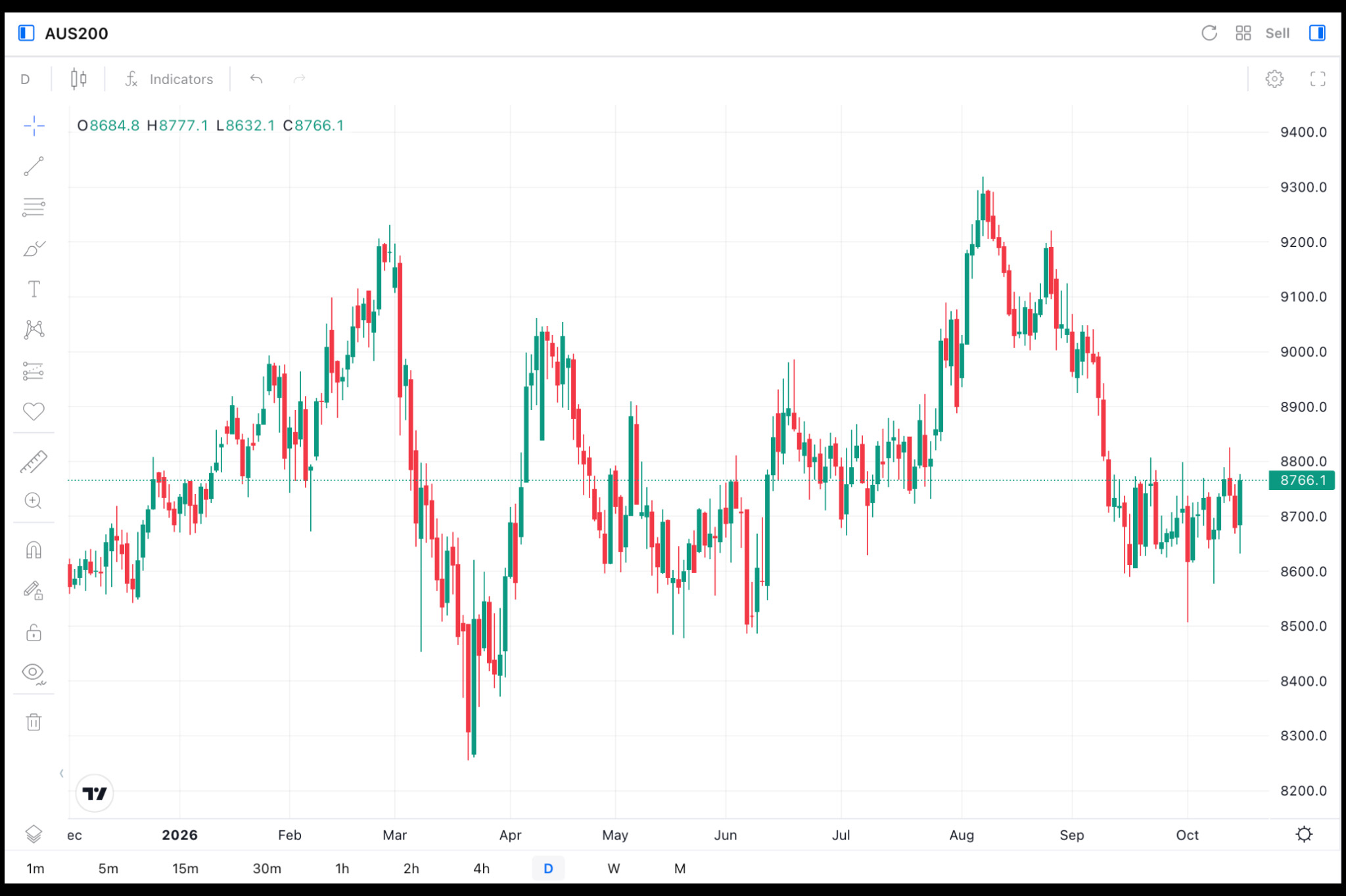
Image: Mitrade (AUS200 Daily Chart)
The chart shows a peak near 9,300 in early August, followed by a sharp September sell off as hike expectations grew. The index has since bounced to around 8,812, rising 1.46% in the week to October 13.
Banks are often assumed to benefit from higher rates, because they can earn more on loans. 2026 has shown that the relationship is not that simple.
Commonwealth Bank (CBA) is down 4.27% year to date and 15.93% over six months. The stock peaked in April, gapped sharply lower in May and has trended down since August.
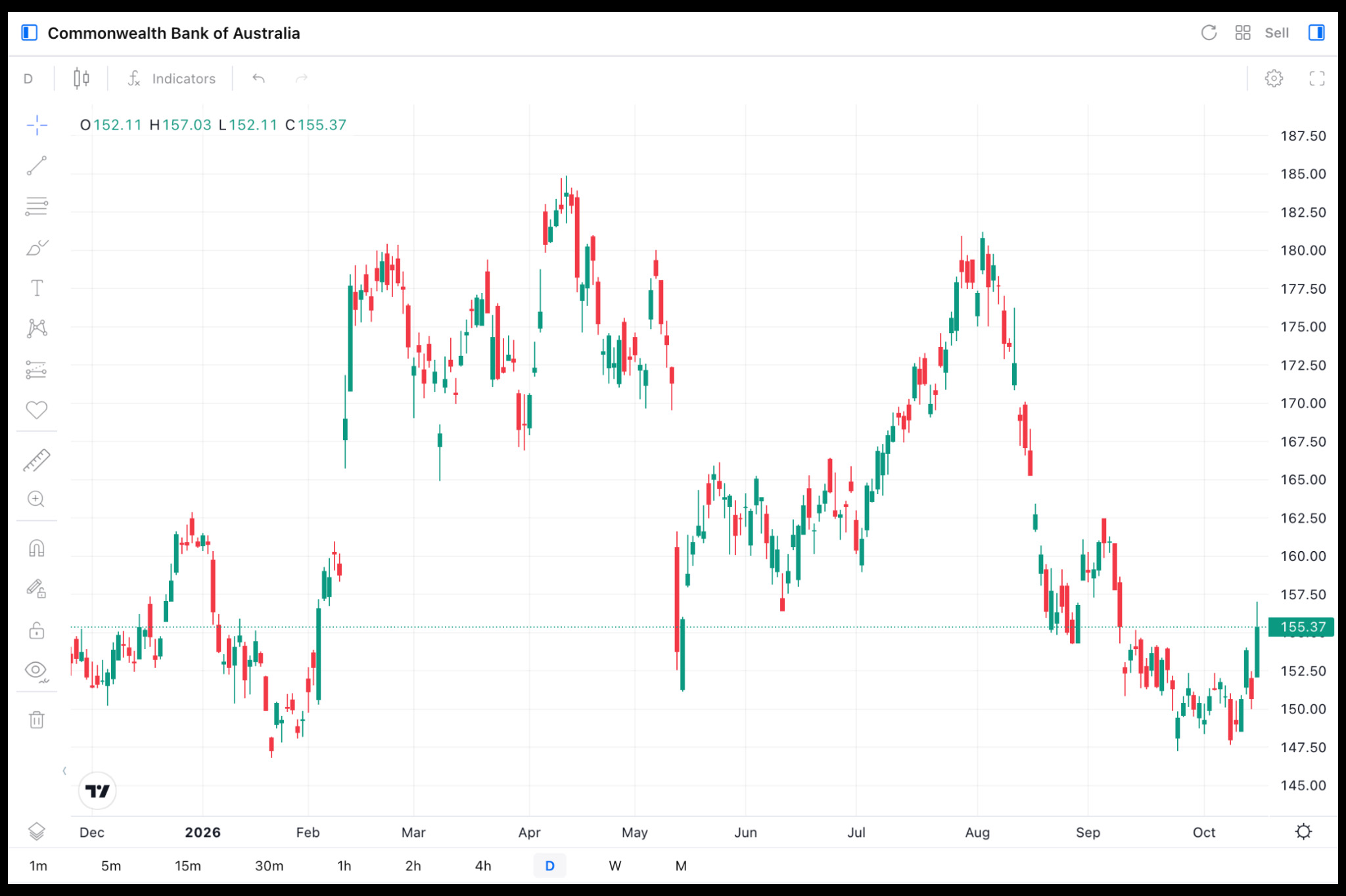
Image: Mitrade (CBA.AU Daily Chart)
Higher rates can lift margins, but they also slow credit growth and raise the risk of bad debts. The RBA noted that house prices have fallen in most capital cities and new housing loans have dropped, which is a headwind for lenders.
Three Scenarios for the November Decision
With the outcome so uncertain, it helps to map out each path before the data arrives. Each scenario carries a different message for traders.
Scenario one: a hike to 4.85%
This now needs a clearly hot September CPI, with trimmed mean inflation rising well above 3.6%. Because markets price only around a 10% chance of a hike, the surprise would likely lift the AUD sharply.
The ASX 200 would probably come under pressure, with property, retail and other rate sensitive sectors leading losses. Bank stocks could see a mixed reaction, as higher margins are offset by fears over loan growth and bad debts.
Scenario two: a hawkish hold
This is the middle path, where the RBA holds at 4.60% but signals that December or February remains live. Westpac's view and the hawkish minutes make this a realistic outcome, and the AUD would likely stay range bound.
Shares could rise modestly on relief, though gains may be capped by the warning that more hikes are possible. This scenario fits a CPI print that holds steady rather than surprising either way.
Scenario three: a dovish hold
A soft CPI reading on top of the weak jobs data could push the RBA to signal that rates have peaked. That would likely weigh on the AUD, especially if the Fed keeps tightening at the same time.
The ASX 200 would probably welcome the news, with rate sensitive sectors rallying hardest. This is the outcome money markets currently lean toward, so much of the move may already be priced in.
Key Dates Before the RBA Decision
Several events will shape the November call. Traders should mark these dates before opening positions.
October 15: Australian labour force data for September (released, unemployment held at 4.7%).
October 28: Australian September CPI release, plus the US Fed decision.
November 3: The RBA decision at 2:30pm Sydney time, alongside a new Statement on Monetary Policy.
October 28 is the pivotal day. A strong CPI print and a hawkish Fed on the same day could create sharp swings in the AUD and the ASX.
How to Trade the RBA Decision on Mitrade
Mitrade offers CFDs on AUD/USD, the AUS200 index and major bank stocks, so traders can position for either outcome. Traders can go long if they expect a hike to lift the AUD, or short if they expect a dovish hold.
Some traders wait for the CPI release before acting. Others take smaller positions early and add after the data, which spreads the risk across both events.
Central bank days often bring price gaps and fast moves. Mitrade lets traders set a stop loss and take profit on the order screen before placing each trade.
Under ASIC rules, leverage is capped at 30:1 on major currency pairs, 20:1 on major indices and 5:1 on shares. Leverage magnifies losses as well as gains, so smaller positions make sense around volatile events.
New traders can practise first on a free demo account. Testing a strategy around the October 28 CPI release is a low risk way to see how rate news moves markets.


You might be interested in…
1. What is the current RBA cash rate?
The RBA cash rate is 4.60% after a 25 basis point hike on September 29. It is the fourth increase of 2026 and the highest level in about 15 years.
2. Will the RBA raise rates in November 2026?
A hike now looks unlikely but not impossible. Money markets price around a 90% chance of a hold after weak jobs data, although Westpac still expects a hike to 4.85%.
3. When is the next RBA meeting?
The RBA's next meeting runs over November 2 and 3. The decision will be announced at 2:30pm Sydney time on November 3.
4. What data will decide the RBA's November move?
September CPI on October 28 is now the key release. The September jobs figures, released on October 15, already pointed to a cooling labour market.
5. How does an RBA rate hike affect the Australian dollar?
A hike usually supports the AUD by making it more attractive to hold. A surprise hike tends to have the biggest effect, because markets have not priced it in.
6. Can I trade the RBA decision on Mitrade?
Yes. Mitrade is regulated by ASIC and offers CFDs on AUD/USD, the AUS200 index and major bank stocks, plus a free demo account for practice.
Disclaimer: The content presented above, whether from a third party or not, is considered as general advice only. CFD trading involves significant risk of loss. Past performance does not guarantee future results. This article serves informational purposes only and does not constitute financial advice. Consider your risk tolerance before trading.


