


Here’s What a $10,000 Investment in Nvidia Stock Will Be Worth by 2030
Key Points
Nvidia still has a sizable addressable market that could help sustain its impressive growth until the end of the decade.
The company could get close to a $10 trillion valuation even if it grows at a conservative pace.
- Motley Fool Issues Rare "Total Conviction" Buy Alert ›
Nvidia (NASDAQ:NVDA) has made investors significantly richer over the past four years, turning a $10,000 investment into nearly $179,000 as of this writing.
This massive surge in Nvidia's shares has been fueled by the advent of artificial intelligence (AI). When OpenAI's ChatGPT, introduced publicly in November 2022, became a big hit, companies lined up to buy Nvidia's graphics processing units (GPUs) after it emerged that the semiconductor giant's chips played an instrumental role in training the chatbot.
Missed AI’s "Act 1"? Act 2 Could Be 15x Bigger. Most investors think they missed the AI boat because they didn't buy Nvidia in 2005. But according to our analysts, we’re only at the end of "Act 1"—the R&D phase. "Act 2" is the global rollout. Continue »
The AI economy and Nvidia have come a long way since then. AI is now finding its way into several industries, boosting productivity and economic growth. The good news for Nvidia investors is that AI adoption isn't showing any signs of slowing, which explains why the company continues to deliver robust growth even after becoming significantly larger over the past four years.
We will take a closer look at the company's prospects in this article and assess whether investing $10,000 in Nvidia stock over the next five years could be a profitable move.

Image source: Nvidia.
Nvidia is the world's largest company, but it can become even bigger
Nvidia's AI-driven surge has made it the world's largest company with a market cap of $5.2 trillion. So, expecting another 20x jump in Nvidia's stock price over the next five years would be quite absurd, as it would put its market cap past $100 trillion. However, that doesn't mean Nvidia stock can't climb higher over the next five years.
After all, the company is still growing at an impressive pace despite the scale it has achieved. Nvidia's revenue in the first six months of fiscal 2027 (which will end in January 2027) increased by 96% over the same period last year to $177.8 billion. The company expects fiscal Q3 revenue of $108 billion, an 89% jump from the year-ago period.
Analysts expect a 91% spike in Nvidia's revenue for fiscal 2027 to $411.6 billion. Meanwhile, earnings per share are expected to almost double in fiscal 2027 to $9.31. Importantly, Nvidia CEO Jensen Huang is confident that the company's growth will continue unabated next year. He recently noted at a conference that the number of chips the company sells will double in 2027, according to CNBC.
Huang added that continued investments in AI infrastructure will drive this incredible growth, as companies and governments look to make the most of the technology's benefits. For example, the World Economic Forum noted earlier this year that AI could increase labor productivity by 1.5% to 3% over the next decade, citing the chief economist of consulting giant EY.
Moreover, investors will do well to note that AI is moving beyond data centers into real-world applications, such as robots and cars. Known as physical AI, Nvidia is pushing into this niche where machines can make complex decisions on their own. From performing precision-related tasks such as threading needles in surgical wards to operating on a conveyor belt, Nvidia is moving into a new frontier that could supercharge its long-term growth.
Nvidia's physical AI offerings are already being used by the likes of Amazon and Japan's national AI venture, and I won't be surprised to see the tech giant pulling in more customers. That's because the physical AI market's revenue is expected to grow to 430 billion euros by 2030, suggesting this niche could move the needle significantly for Nvidia over the next five years.
Throw in the $3 trillion to $4 trillion revenue opportunity that Nvidia sees in the AI infrastructure market in 2030, and it is easy to see why analysts have become extremely bullish about its growth prospects through fiscal 2029 (which will end in January 2029).
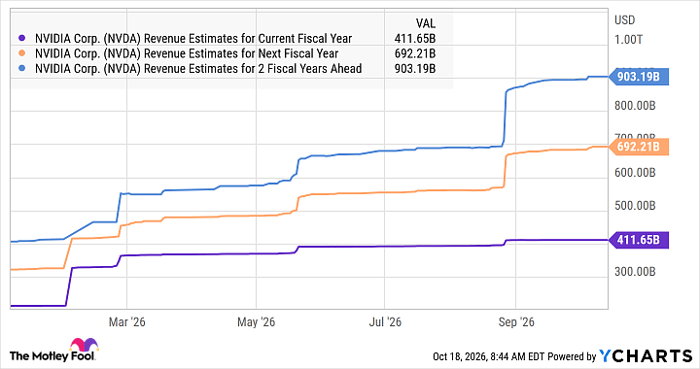
NVDA Revenue Estimates for Current Fiscal Year data by YCharts
According to the above chart, Nvidia's revenue could increase by 68% in fiscal 2028, which is almost in line with the company's guidance of 70% growth. That's expected to be followed by a 30% increase in fiscal 2029 to $900 billion. There is a solid chance Nvidia will maintain strong growth in fiscal years 2030 and 2031 as well, which could set the stock up for further gains.
The stock can still deliver impressive gains
Let's assume Nvidia's top line increases by even 10% in fiscal 2030 and 2031 (which will end in January 2031), its top line could reach $1.09 trillion in 2030 (given that fiscal 2031 will coincide with the majority of calendar 2030).
Now, this AI stock trades at 18 times sales. Assuming Nvidia trades at half of this sales multiple after five years, its market cap could jump to $9.8 trillion (based on the $1.09 trillion revenue estimate). That implies a potential upside of 88% from current levels. So, a $10,000 investment in this semiconductor stock will be worth more than $18,800 by 2030.
However, that could be a conservative estimate, as Nvidia could grow faster and command a premium valuation after five years. That's why investors can still consider buying this AI bellwether, as it has the potential to make investors richer owing to emerging niches within the AI ecosystem.
Should you buy stock in Nvidia right now?
Before you buy stock in Nvidia, consider this:
The Motley Fool Stock Advisor analyst team just identified what they believe are the 10 best stocks for investors to buy now… and Nvidia wasn’t one of them. The 10 stocks that made the cut could produce monster returns in the coming years.
Consider when Netflix made this list on December 17, 2004... if you invested $1,000 at the time of our recommendation, you’d have $380,363!* Or when Nvidia made this list on April 15, 2005... if you invested $1,000 at the time of our recommendation, you’d have $1,315,732!*
Now, it’s worth noting Stock Advisor’s total average return is 919% — a market-crushing outperformance compared to 211% for the S&P 500. Don't miss the latest top 10 list, available with Stock Advisor, and join an investing community built by individual investors for individual investors.
See the 10 stocks »
*Stock Advisor returns as of October 18, 2026.
Harsh Chauhan has no position in any of the stocks mentioned. The Motley Fool has positions in and recommends Amazon and Nvidia. The Motley Fool has a disclosure policy.
Recommended Articles


