


If I Could Only Own 1 Artificial Intelligence (AI) Memory Stock for the Next 5 Years, It Wouldn't Be Micron.
Key Points
High bandwidth memory and advanced DRAM are becoming critical in the AI chip value chain.
While Micron is one of the better-known AI memory stocks, a competitor from South Korea could be a compelling alternative.
SK Hynix has a substantial lead in the HBM market, and its tailwinds look strong over the next several years.
- Motley Fool Issues Rare "Total Conviction" Buy Alert ›
Micron Technology (NASDAQ: MU) has become a major beneficiary of rising demand for memory chips, which has fueled record revenue and earnings growth over the last year. What investors may not fully understand is that Micron isn't the only company poised to capitalize on artificial intelligence's insatiable appetite for memory.
If I could own just one AI memory stock for the next five years, my choice would be SK Hynix (NASDAQ: SKHY). Let's dig into why I think SK Hynix stock deserves a closer look.
Missed AI’s "Act 1"? Act 2 Could Be 15x Bigger. Most investors think they missed the AI boat because they didn't buy Nvidia in 2005. But according to our analysts, we’re only at the end of "Act 1"—the R&D phase. "Act 2" is the global rollout. Continue »
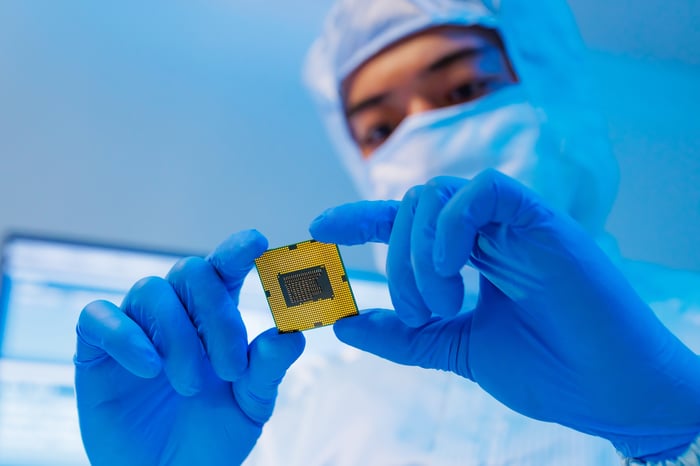
Image source: Getty Images.
SK Hynix is the leader in high bandwidth memory
Most investors think of Nvidia and its graphics processing units (GPUs) when they think about AI. These processors wouldn't be nearly as effective without high bandwidth memory (HBM). HBM allows AI accelerators to access large quantities of information quickly, making it a critical input for training generative AI models.
As Nvidia and other semiconductor designers develop more powerful chip architectures, the memory accompanying these chips needs to be faster, more efficient, and capable of handling larger workloads. This is where SK Hynix stands out.
According to Counterpoint Research, SK Hynix accounted for 50% of global HBM revenue as of the second quarter, nearly as much as Samsung and Micron combined. SK Hynix achieved its market leadership through early investments in advanced memory packaging and manufacturing technologies, giving it a first-mover advantage in the HBM market.
SK Hynix's tailwinds are durable
One of the biggest risks facing memory manufacturers is the industry's cyclical boom-and-bust cycle. When demand accelerates, manufacturers expand production. Naturally, supply catches up, prices fall, and profit margins deteriorate.
Advanced AI memory introduces an interesting nuance. The companies designing next-generation AI accelerators need memory suppliers capable of meeting increasingly demanding technical requirements. In turn, this encourages close collaboration between semiconductor designers like Nvidia and memory producers.
SK Hynix is positioned particularly well for this transition. The company began mass shipments of HBM4 during the second quarter, while continuing development of its next-generation HBM4E products. These developments should strengthen its relationships with customers building more powerful accelerated computing systems.
Interestingly, SK Hynix's opportunities extend beyond Nvidia's GPUs. AI hyperscalers such as Alphabet, Amazon, Microsoft, Meta Platforms, OpenAI, and Anthropic are all developing custom silicon chips. This provides yet another tailwind for increased memory demand and could help SK Hynix diversify across different AI computing architectures. In other words, SK Hynix doesn't need one chip designer to dominate the AI infrastructure era indefinitely. It simply needs advanced memory to remain essential to the broader AI ecosystem.
Is SK Hynix stock a good buy?
While AI-driven growth has fueled substantial earnings expansion for SK Hynix, the company's valuation remains fairly modest on a forward price-to-earnings (P/E) basis.
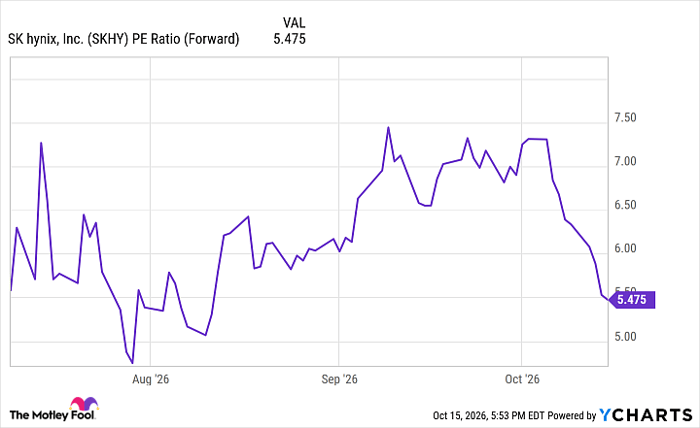
SKHY PE Ratio (Forward) data by YCharts
The company's leadership in the HBM market and progress in new chip technology give SK Hynix strong competitive advantages that extend beyond today's memory supercycle. When combined with its attractive valuation profile, I view SK Hynix as a compelling long-term buy for investors seeking exposure to the AI infrastructure boom.
Missed Nvidia in 2009? This Rare Signal Is Flashing Again
In 2009, a "Double Down" signal flashed for a little-known chipmaker called Nvidia. If you’d invested $5,000 then, you’d be sitting on $2,783,470 today.*
Now, for the first time in years, that same "Total Conviction" signal is flashing for a company 1/100th the size of Nvidia. It’s a key player in the $1.8 trillion space race, and with the stock recently sitting 20% off its highs, the window to get in early is closing fast.
Continue »
*Stock Advisor returns as of October 18, 2026.
Adam Spatacco has positions in Alphabet, Amazon, Microsoft, and Nvidia. The Motley Fool has positions in and recommends Alphabet, Amazon, Meta Platforms, Micron Technology, Microsoft, and Nvidia. The Motley Fool has a disclosure policy.
Recommended Articles


