


Better AI Chip Stock: Taiwan Semiconductor vs. Micron
Key Points
Micron and Taiwan Semiconductor are two major players in the chip space.
Micron has major upside ahead.
Taiwan Semiconductor's foundry business looks more stable, and the market is valuing it accordingly.
- Motley Fool Issues Rare "Total Conviction" Buy Alert ›
While companies like Nvidia and AMD may get most of the headline glory in the AI realm for their powerful processors, the reality is these companies only design some of the chips that go into data centers. The fabrication muscle in the sector lies in a handful of chip foundry businesses, with Taiwan Semiconductor Manufacturing (NYSE: TSM) and Micron (NASDAQ: MU) being the two largest in the world by market cap.
But which one makes for the better buy? Let's dig in, as these two are very different investments.
Missed AI’s "Act 1"? Act 2 Could Be 15x Bigger. Most investors think they missed the AI boat because they didn't buy Nvidia in 2005. But according to our analysts, we’re only at the end of "Act 1"—the R&D phase. "Act 2" is the global rollout. Continue »

Image source: Getty Images.
Micron and Taiwan Semiconductor aren't competitors
On the surface, Micron and Taiwan Semiconductor are both chip foundry companies. Both take in client orders, then create their chips. However, that's where the similarities end.
Micron and Taiwan Semiconductor produce two entirely different types of chips; Micron designs and makes memory chips, and Taiwan Semiconductor makes logic chips designed by other companies. Both are required in accelerated computing units like GPUs, but each serves a different role.
Furthermore, the technologies behind each one are radically different. There isn't a ton that separates one memory chip from another. Take basic computer RAM, for example. Nobody cares a lot about which brand of RAM is in a laptop, only what capacity that RAM has. That's because most memory chips are practically the same, although Micron is challenging that notion. It recently agreed to design an industry-first custom memory chip for Nvidia's GPUs, which could be a different avenue to lock in better long-term contract deals.
Because one manufacturer's memory chips are much like another's, they are subject to commodity-like pricing. This year, demand for memory chips has steeply outpaced supply, causing prices to soar. The shortage is expected to get worse in 2027 and 2028, which would allow Micron to keep turning huge profits on its chips.
The logic chips that come out of Taiwan Semiconductor's foundries are completely different. Companies like Nvidia and AMD design processors, and their various devices can deliver competitive edges on a range of criteria as the chipmakers work to improve speed, energy efficiency, transistor density, and more. Choosing a reliable chip manufacturer is a big part of this design process, and with TSMC's massive production facilities, proven track record, and leading technology, it's the partner that is most often selected. However, TSMC has relatively greater production capacity than the memory chip industry, and has been expanding production capacity in recent years, so it was able to mostly handle the AI demand rush.
Micron is growing faster and priced cheaper
Micron holds an edge in the revenue growth department, as it's still benefiting from the effect of soaring memory chip prices due to the shortage. However, TSMC's growth rate isn't bad either.
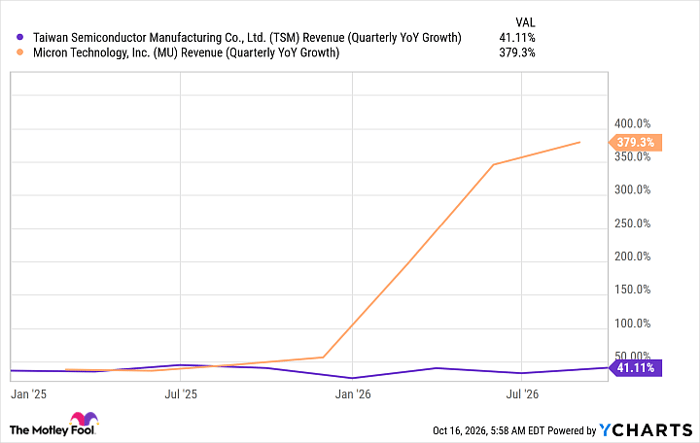
TSM Revenue (Quarterly YoY Growth) data by YCharts.
Another area where Micron holds an edge is valuation. Investors today can pick up Micron shares at a much cheaper 5.3 times forward earnings compared to TSMC's 24.
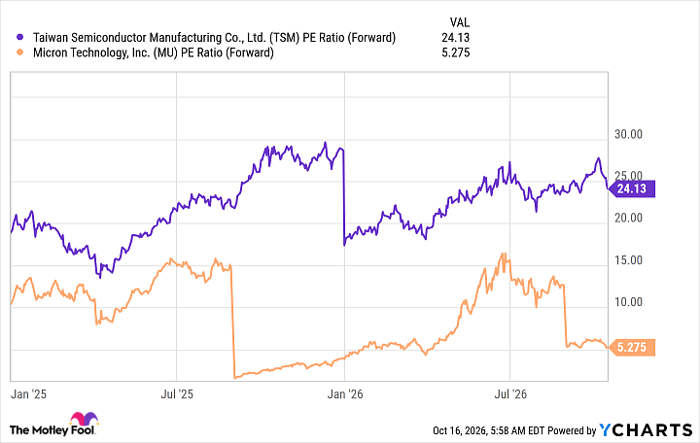
TSM PE Ratio (Forward) data by YCharts.
Why the huge price discrepancy? It all has to do with Micron operating in what has historically been a highly cyclical industry. Every time memory demand outpaces supply, the chipmakers start to build new fabs. By the time they come online, the demand waves have often slackened, supply leaps ahead, and prices tumble.
The market isn't convinced that the current wave of intense memory chip demand driven by the AI infrastructure build-out will last, and it's discounting it as a result. But Micron and others in the memory industry have said the shortage is going to get worse before it gets better. If Micron's stock rises throughout the year due to strong demand, it could deliver incredible returns.
TSMC is also a solid investment, and because the logic chip industry is not as cyclical (it still is, but not to the same degree), the market is not as concerned about its outlook, and therefore is not valuing the stock at a discount.
I think this is a huge mismatch, and Micron makes for the better buy, at least when upside potential is considered. While TSMC is still a fantastic investment, the mismatch between Micron's stock price and its earnings potential is just too much to ignore. Investors should pounce on the deal.
Should you buy stock in Taiwan Semiconductor Manufacturing right now?
Before you buy stock in Taiwan Semiconductor Manufacturing, consider this:
The Motley Fool Stock Advisor analyst team just identified what they believe are the 10 best stocks for investors to buy now… and Taiwan Semiconductor Manufacturing wasn’t one of them. The 10 stocks that made the cut could produce monster returns in the coming years.
Consider when Netflix made this list on December 17, 2004... if you invested $1,000 at the time of our recommendation, you’d have $380,363!* Or when Nvidia made this list on April 15, 2005... if you invested $1,000 at the time of our recommendation, you’d have $1,315,732!*
Now, it’s worth noting Stock Advisor’s total average return is 919% — a market-crushing outperformance compared to 211% for the S&P 500. Don't miss the latest top 10 list, available with Stock Advisor, and join an investing community built by individual investors for individual investors.
See the 10 stocks »
*Stock Advisor returns as of October 18, 2026.
Keithen Drury has positions in Micron Technology, Nvidia, and Taiwan Semiconductor Manufacturing. The Motley Fool has positions in and recommends Advanced Micro Devices, Micron Technology, Nvidia, and Taiwan Semiconductor Manufacturing. The Motley Fool has a disclosure policy.
Recommended Articles


