


Nokia Falls Over 9% Pre-Market as AI Data Center Investment Concerns Weigh on Optical Networking Equipment Stocks
TradingKey - In US pre-market trading on September 14, as of press time, Nokia (NOK) fell over 9% to $10.05. The company's Helsinki-listed ordinary shares dropped nearly 9% over the same period, with the magnitude of adjustments across both listings being roughly similar.
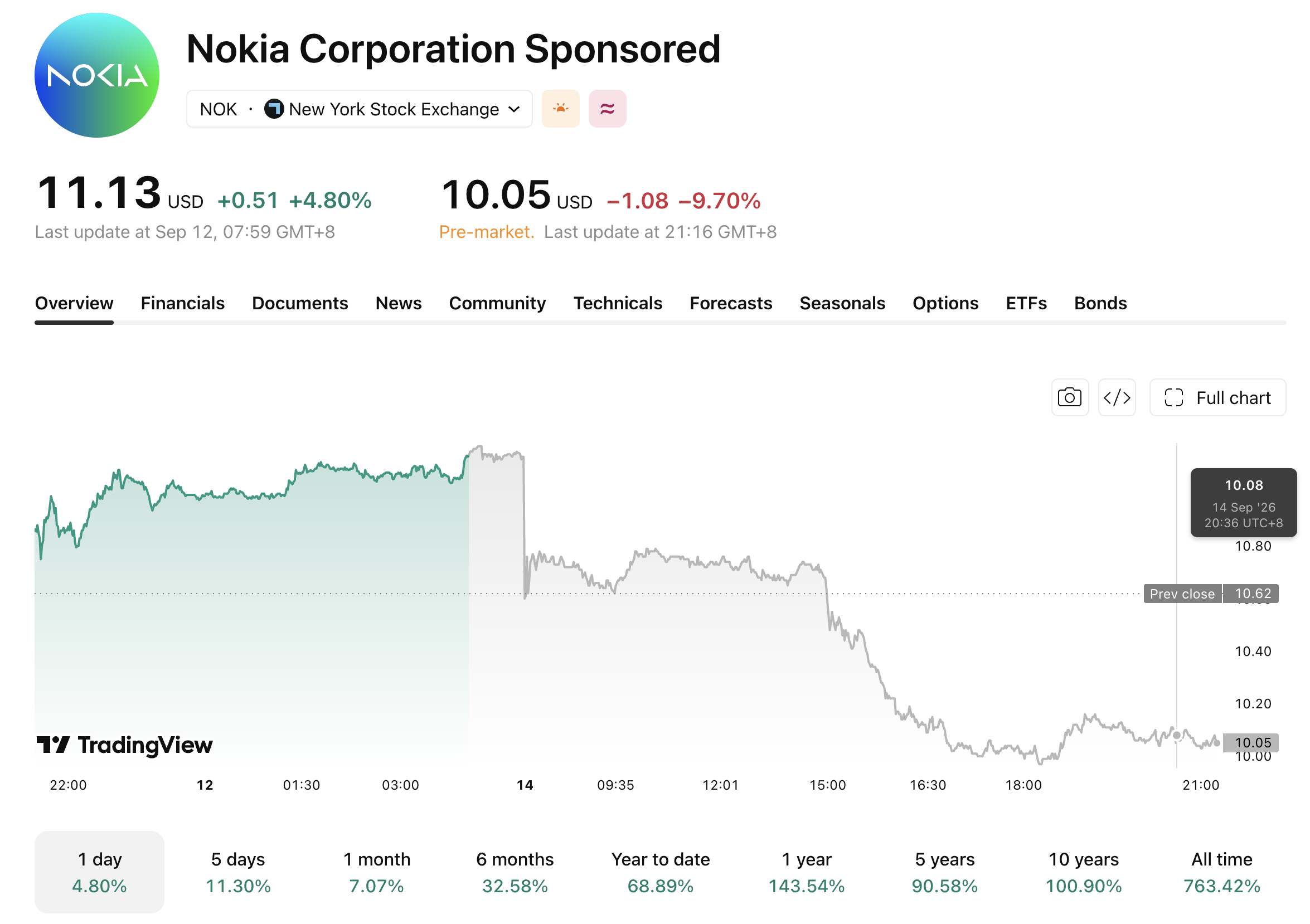
[Source: TradingView]
During the same period, Marvell Technology (MRVL), Intel (NVDA), Micron (MU), and Corning (GLW), among other semiconductor and AI infrastructure-related stocks, dropped significantly, while Nasdaq 100 index futures fell about 1.5% at one point.
Previously, Anthropic CEO Dario Amodei called for slowing down the pace of capability enhancements in frontier AI models to allow more time for safety research and external evaluations. OpenAI CEO Sam Altman and Elon Musk subsequently expressed support.
The statements prompted the market to reassess the pace of frontier model development, drawing attention to the demand prospects for AI data center construction as well as chips, optical networks, and switching equipment.
Why Is Nokia Affected by the AI Stock Pullback?
Nokia participates in AI infrastructure development through its optical networks, IP routing, data center switching, and interconnect products. In the second quarter of 2026, revenue from AI and cloud customers grew significantly, becoming a major driver of growth for the company's Network Infrastructure business.
During the quarter, Nokia's revenue from AI and cloud customers reached 446 million euros, up 103% year-over-year, or 105% on a constant currency basis. Order intake from AI and cloud customers reached 2.8 billion euros, with the company securing long-term orders in both its Optical Networks and IP Networks businesses. Nokia expects approximately half of these orders to convert into revenue over the next 12 months.
Revenue for Nokia's Network Infrastructure business stood at 2.037 billion euros for the quarter, up 12% year-over-year on both a reported and constant currency basis. Among these, Optical Networks and IP Networks revenue grew by 20% and 16%, respectively, on a constant currency basis.
The company expects Network Infrastructure revenue for 2026 to grow 12% to 14% at constant currency and constant scope, with Optical Networks and IP Networks combined growing 18% to 20%. Following technical adjustments due to two businesses being classified as discontinued operations, full-year comparable operating profit guidance is 2.1 billion to 2.6 billion euros, while operational expectations remain unchanged.
Going forward, investors will focus on the revenue conversion of the 2.8 billion euros in orders from AI and cloud customers, optical network capacity expansion, and the investment plans of AI and cloud customers. Order delivery speed and supply capacity will be key factors influencing revenue growth in the Network Infrastructure business.
Recommended Articles


