


Warren Buffett Is Sending a Stark Warning to Investors. History Says He's Right.
Key Points
Despite recent record-breaking gains, the market is facing new challenges at every turn.
Warren Buffett warned earlier this year that too many investors are taking on unnecessary risk.
History suggests that investors may want to prepare for volatility.
- 10 stocks we like better than S&P 500 Index ›
It's been a rough few weeks for the stock market, and the future could be even rockier.
Oil prices are soaring amid increased tension in the Middle East. A discouraging inflation report this week puts more pressure on the Federal Reserve to raise interest rates. Bond market mayhem is rattling investors, as yields reach their highest levels in years. And to top it off, fresh concerns about artificial intelligence could put a damper on tech stock growth -- and Anthropic's upcoming initial public offering (IPO) in October.
Missed Nvidia in 2009? This Rare Signal Is Flashing Again. In 2009, a "Double Down" signal flashed for a little-known chipmaker called Nvidia. For the first time in years, that same "Total Conviction" signal is flashing for a company 1/100th the size of Nvidia. Continue »
When the market becomes chaotic, however, there's one investor many turn to for calm reassurance: Warren Buffett. Earlier this year, Buffett discussed his take on the current market, offering both reassuring advice and a blunt warning about the future.
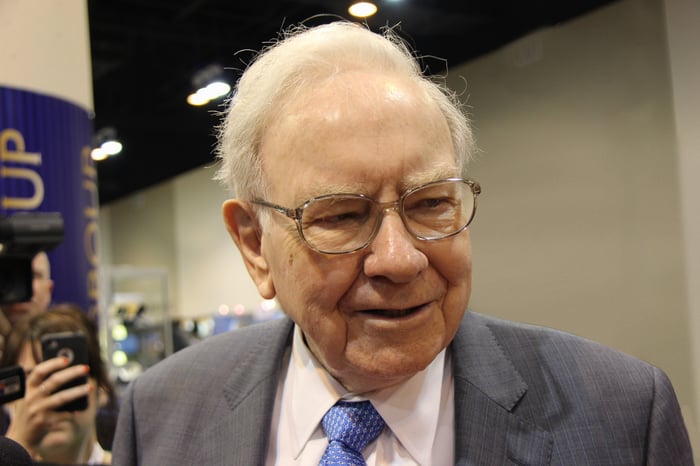
Image source: The Motley Fool.
Some investors could be making a grave mistake right now
Major indexes have soared over the past few years. The S&P 500 (SNPINDEX: ^GSPC), Nasdaq Composite (NASDAQINDEX: ^IXIC), and Dow Jones Industrial Average (DJINDICES: ^DJI) have each reached multiple record highs since the most recent bear market ended in 2022.
But it's easy for some investors to become lax with their strategies when the market is booming. Even the weakest stocks can soar if they receive enough hype, but those gains typically won't last. When the market inevitably declines, these are the stocks that are hit the hardest.
Buffett warned of this in a CNBC interview during Berkshire Hathaway's 2026 annual meeting. When asked his thoughts on this historically expensive market, he warned that many investors are getting too comfortable with risk.
"I've compared the markets to a church with a casino attached," he explained, with the former representing long-term investing and the latter, short-term risk-taking. "The casino has gotten very attractive to people," he warned, adding that "that's not investing, it's not speculating, it's gambling."
History has a warning of its own
In the interview, Buffett went on to emphasize: "[T]hat doesn't mean that investing is terrible. It does mean that prices for an awful lot of things will look very silly."
Decades of history suggest Buffett is right. When the market becomes inflated, there's a significant risk that many stocks are overvalued -- meaning their prices are too high for what the companies are realistically worth. These stocks tend to underperform the market over time, and the weakest of them may not survive a bear market or recession at all.
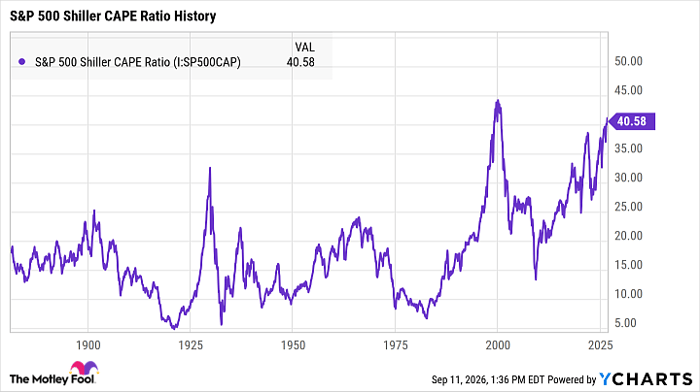
Right now, the market is warning that we may be experiencing elevated valuations. The S&P 500 Shiller CAPE Ratio is a metric dating back to 1871 that gauges the market's valuation over time. The higher this ratio climbs, the more likely it is that the market is overvalued.
Over the past 155 years, this ratio has averaged around 17. It reached its first major peak of nearly 35 just before the Great Depression began, and it later spiked to an all-time high of 44 during the dot-com bubble -- signaling that the market was significantly overvalued.
S&P 500 Shiller CAPE Ratio data by YCharts
More recently, it's remained elevated above 40 since May of this year. While no metric can predict the market's future performance, this ratio does suggest that this is the most richly valued market since the dot-com bubble.
There's still plenty of good news for investors
The good news, however, is that the right investing strategy can protect against potential volatility. As Buffett said, investing itself is not terrible right now. Over the long term, the stock market has always thrived.
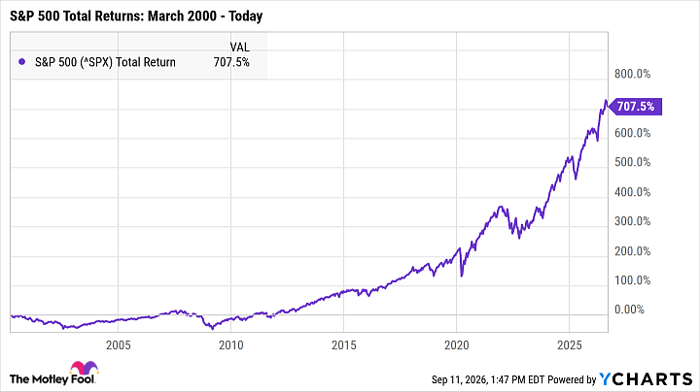
For example, the dot-com bubble officially popped in March 2000, and over the subsequent two years, the S&P 500 lost nearly half of its value. It faced the Great Recession just a few years later in 2007, again falling by more than 50%. Yet despite back-to-back historic recessions, the index has earned total returns of more than 700% by today.
^SPX data by YCharts
The investments you choose now will determine how your portfolio fares not just in the coming months, but for years to come.
Buying overvalued stocks may seem harmless in the near term if those investments are thriving, but they could cost you during the next market pullback. Investing in stocks with fair valuations and solid business fundamentals, however, will set you up for lucrative long-term returns.
Should you buy stock in S&P 500 Index right now?
Before you buy stock in S&P 500 Index, consider this:
The Motley Fool Stock Advisor analyst team just identified what they believe are the 10 best stocks for investors to buy now… and S&P 500 Index wasn’t one of them. The 10 stocks that made the cut could produce monster returns in the coming years.
Consider when Netflix made this list on December 17, 2004... if you invested $1,000 at the time of our recommendation, you’d have $417,413!* Or when Nvidia made this list on April 15, 2005... if you invested $1,000 at the time of our recommendation, you’d have $1,341,294!*
Now, it’s worth noting Stock Advisor’s total average return is 950% — a market-crushing outperformance compared to 212% for the S&P 500. Don't miss the latest top 10 list, available with Stock Advisor, and join an investing community built by individual investors for individual investors.
See the 10 stocks »
*Stock Advisor returns as of September 14, 2026.
Katie Brockman has no position in any of the stocks mentioned. The Motley Fool has positions in and recommends Berkshire Hathaway. The Motley Fool has a disclosure policy.
Recommended Articles


