


Target Earnings Preview: Stock Up Over 50% This Year, Can Q2 Earnings Drive Further Gains?
TradingKey - Target (TGT) will report its second-quarter fiscal 2026 financial results before the U.S. market open on August 19. After first-quarter results significantly beat expectations, TGT's stock price has risen over 50% year-to-date, with the market holding high expectations for business improvements driven by new CEO Michael Fiddelke. Therefore, the key to this earnings report is whether the company can prove that the first-quarter sales recovery is sustainable.
In terms of market expectations, Wall Street currently projects Target's second-quarter revenue at approximately $26.15 billion, up about 4% year-over-year; earnings per share are expected to be around $2.31, up from $2.05 in the prior-year period; and comparable sales are expected to grow by about 2.6%. Meanwhile, the options market anticipates that the earnings report could move TGT's stock price up or down by roughly 7%.
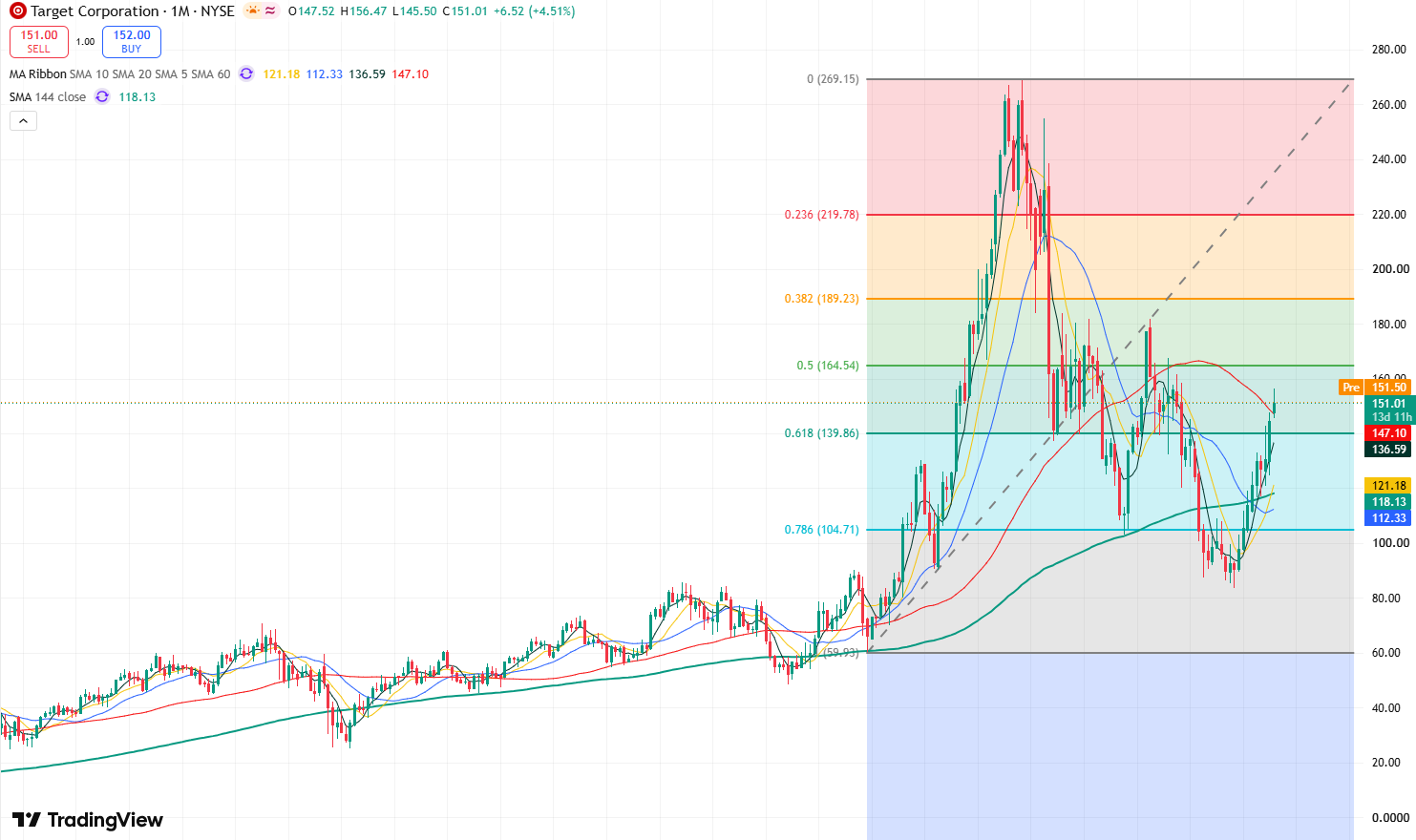
TGT stock monthly chart, Source: TradingView
Can Target's Sales Recovery Continue?
For the second-quarter earnings report, the market's primary focus is whether Target can sustain its first-quarter sales improvement.
Target's Q1 net sales reached $25.4 billion, up 6.7% year-over-year, with comparable sales growing 5.6%, significantly beating market expectations. Among them, comparable store sales grew 4.7%, digital channel comparable sales increased 8.9%, and more importantly, customer traffic grew 4.4% year-over-year. Sales across all six core merchandise categories achieved year-over-year growth during the quarter.
In the past, one of the core issues Target faced was not that consumers had completely stopped spending, but rather that its competitiveness in apparel, home goods, and other discretionary items had declined, putting pressure on customer traffic and same-store sales. Therefore, the 4.4% traffic growth in the first quarter was seen by the market as a key signal of operational improvement.
For the second quarter, the market expects comparable sales growth of approximately 2.6%. Although significantly lower than the first quarter's 5.6%, reaching this level would mark Target's second consecutive quarter of positive comparable sales growth.
For TGT's stock price, if comparable sales exceed 2.6% while customer traffic continues to grow, it will further demonstrate that the first-quarter recovery was not a one-off event, potentially supporting upward revisions to full-year revenue expectations. Conversely, if comparable sales fall back near zero growth, especially if customer traffic drops significantly, the market may again question the sustainability of Target's business recovery. Given that TGT has risen over 50% year-to-date, stock price pressure from weaker-than-expected sales could be more pronounced than at the start of the year.
Can Target's Profit Margins Improve?
The second focus of this earnings report lies in profit margins.
Target's first-quarter gross margin reached 29.0%, up from 28.2% in the same period last year, primarily benefiting from improved supply chain productivity, growth in non-merchandise revenue such as advertising, and reduced promotional discounts. However, higher product costs offset part of the improvement. Meanwhile, the adjusted operating margin was 4.5%, up from an adjusted 3.7% in the same period last year.
One aspect worthy of attention is the high-margin non-merchandise business. First-quarter non-merchandise revenue—including Roundel advertising, Target Circle 360 memberships, and the Target Plus marketplace—grew nearly 25%; same-day delivery grew by over 27%. These businesses typically do not carry the same inventory and logistics costs as traditional retail merchandise; therefore, if their growth rate continues to outpace merchandise sales, it will help improve the overall profitability structure.
However, Target still faces rising labor costs, marketing investments, and product costs. The company's first-quarter SG&A expense ratio reached 21.9%, up from an adjusted 21.7% in the same period last year, which included increased store staff hours, training, compensation, and marketing expenses.
Therefore, whether second-quarter EPS can meet or exceed market expectations of $2.31, while gross margin and operating margin continue to improve, will directly influence the market's judgment on the quality of Target's recovery.
If profit margins continue to expand alongside sales growth, it indicates that previous investments in store operations and the supply chain are paying off, which is relatively favorable for TGT's valuation; if revenue beats expectations but profit margins decline, the stock price reaction may remain weak.
Will Target Raise Full-Year Guidance Again? It Could Be the Stock's Biggest Catalyst
The variable with the greatest impact on the stock price in this earnings report will likely be the full-year performance guidance.
In March this year, Target initially projected fiscal 2026 net sales growth of about 2% and full-year EPS of $7.50 to $8.50. However, after its first-quarter results beat expectations, the company raised its full-year net sales growth forecast to about 4%, while projecting full-year EPS to be near the high end of the previous $7.50–$8.50 range and expecting operating margin to increase by more than 20 basis points from the adjusted 4.6% in 2025.
If second-quarter results continue to exceed expectations and Target raises its full-year sales or EPS guidance again, it will provide the market with clearer evidence that the company is recovering from its 2025 operational trough. In this scenario, TGT's stock price could move closer toward Wall Street's recently raised price targets.
Oppenheimer recently sharply raised its price target on Target from $140 to $170, citing improvements across multiple categories such as beauty, food, and beverage, as well as store execution; UBS raised its price target to $166.
However, it is worth noting that among the 10 analysts tracked by Visible Alpha, currently only 3 give Target a "Buy" rating, and the average price target of about $145 is already below its recent stock price of around $151. This indicates that Wall Street has not reached a full consensus on Target's recovery.
Recommended Articles


