


Elon Musk's Tesla Is Ending Sweden's Longest Strike by Buying Out Every Worker Still on It
Key Points
IF Metall said Thursday it is calling off its nearly three-year strike against Tesla, effective Aug. 19.
Tesla offered severance to every remaining striking member rather than sign a collective agreement.
Tesla's Swedish vehicle registrations fell 67% in 2025, to 7,252.
- These 10 stocks could mint the next wave of millionaires ›
The longest labor conflict in modern Swedish history is ending, and Tesla (NASDAQ: TSLA) won it without signing a collective agreement. Swedish union IF Metall said Thursday that it will call off its strike against the electric-car maker on Aug. 19. The walkout reached day 1,021 this week -- about 130 Tesla mechanics across seven workshops were covered when the strike began on Oct. 27, 2023, demanding the collective agreement that covers most Swedish workers.
The strike isn't ending because either side gave in at the bargaining table. By the union's own account, Tesla offered severance packages to every remaining striking member, and enough of them accepted that IF Metall has no striking members left to represent.
Missed Nvidia in 2009? This Rare Signal Is Flashing Again. In 2009, a "Double Down" signal flashed for a little-known chipmaker called Nvidia. For the first time in years, that same "Total Conviction" signal is flashing for a company 1/100th the size of Nvidia. Continue »
The sympathy actions that spread across the Nordics end with it. Dockworkers had blocked Sweden-bound Tesla cars in Denmark, Norway, and Finland, the postal service stopped delivering license plates for new Teslas, and electricians refused Tesla work.
For nearly three years, Tesla absorbed all of that rather than sign.
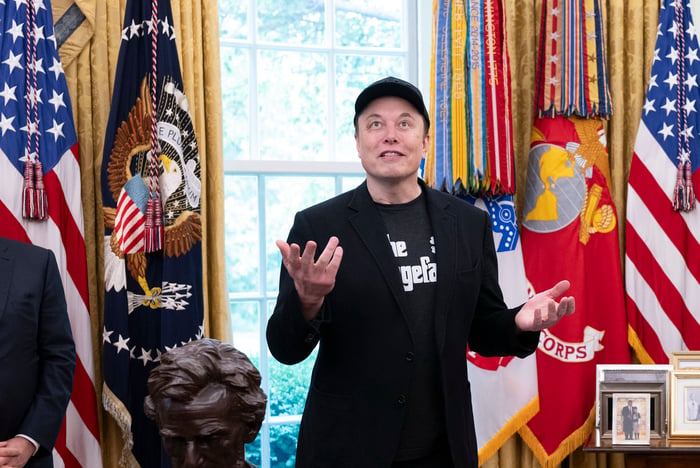
Elon Musk. Image source: The White House.
An unusual ending
Sweden was a strange place for Tesla to dig in. The company has no factory there. The dispute covered mechanics who service its cars, so the direct cost of meeting the union's demands would have been small.
But I'd argue the agreement itself was the stake. Tesla has never signed a collective agreement with IF Metall, and conceding one in Sweden could have handed organizers elsewhere in Europe a working template.
So the company took the harder route. It rerouted cars around the port blockades, and it went to court where it could. Eventually, it paid the last strikers to leave. The union's core issue, as it acknowledged in ending the fight, remains unresolved.
Neither side has said what the buyouts cost. Whatever the figure, it's small. The strike began with about 130 mechanics, and Tesla generated $28.2 billion of revenue in the second quarter alone.
Why the line matters more now
Tesla's willingness to spend nearly three years defending its labor model arguably makes more financial sense today than when the strike began. The company's profitability has thinned dramatically.
In the second quarter, Tesla's revenue rose 26% year over year to $28.2 billion, and it delivered a second-quarter record of 480,126 vehicles, up 25%.
But its operating margin collapsed to 1.4% from 4.1% a year earlier, as operating expenses jumped 47% year over year and lower average selling prices, mix included, pulled profitability down. Net income fell 5% to $1.11 billion. Free cash flow swung to negative $1.1 billion, too.
Capital expenditures soared 142% to $5.79 billion, part of a plan to spend more than $25 billion this year on artificial intelligence (AI) infrastructure and new manufacturing capacity.
A company running margins that thin, while spending that heavily, can't easily absorb a structurally higher cost base. Collective agreements tend to raise labor costs and slow workforce changes. And that's exactly the flexibility Tesla is leaning on as it retools factories for its Optimus robot and Cybercab programs. Holding the line in Sweden preserved that flexibility across its European operations.
The fight wasn't free
Still, the victory came with a visible cost in the market where Tesla fought.
The company registered 21,894 vehicles in Sweden in 2024, when the Model Y was the country's best-selling car. In 2025, registrations collapsed 67% to 7,252. Electrek, which has covered the strike closely, attributes the drop more to political backlash against CEO Elon Musk than to the labor dispute itself. But the two overlapped, and together they turned one of Tesla's stronger European markets into an afterthought.
However the blame gets divided, the pattern should concern shareholders -- Tesla spent nearly three years fighting 130 mechanics while its brand deteriorated in the one market where the fight played out.
Ultimately, Tesla kept the labor cost structure it wanted, in a period when its 1.4% operating margin gives it little room for anything else. That flexibility is worth a lot to a company remaking itself around robots and AI. But Sweden was a small market and a small workforce. A similar challenge in a bigger European market, with more workers involved, could cost far more than 1,021 days and a round of severance packages -- and Germany, where Tesla actually builds cars, is the market where that test would matter most.
Don’t miss this second chance at a potentially lucrative opportunity
Ever feel like you missed the boat in buying the most successful stocks? Then you’ll want to hear this.
On rare occasions, our expert team of analysts issues a “Double Down” stock recommendation for companies that they think are about to pop. If you’re worried you’ve already missed your chance to invest, now is the best time to buy before it’s too late. And the numbers speak for themselves:
- Nvidia: if you invested $1,000 when we doubled down in 2009, you’d have $584,715!*
- Apple: if you invested $1,000 when we doubled down in 2008, you’d have $58,358!*
- Netflix: if you invested $1,000 when we doubled down in 2004, you’d have $421,511!*
Right now, we’re issuing “Double Down” alerts for three incredible companies, available when you join Stock Advisor, and there may not be another chance like this anytime soon.
See the 3 stocks »
*Stock Advisor returns as of August 15, 2026.
Daniel Sparks has clients with positions in Tesla. The Motley Fool has positions in and recommends Tesla. The Motley Fool has a disclosure policy.
Recommended Articles


