


Oracle Stock Forecast: ORCL Faces Layoffs, $70B Capex and Rising Debt
TradingKey - Oracle shares (NYSE: ORCL) have now climbed back to around Wednesday’s opening level as the stock attempts to recover after Tuesday’s 3.7% drop to $145.48. The rebound comes only weeks after Oracle hit a fresh 52-week low following a roughly 57% decline over the past 10 months. Most of the recent shift is linked to the possibility of more job cuts. Wall Street seemed to be interpreting the cuts as a way to manage expenses, not a clear indication of loan problems.
New Layoffs Are Coming Ahead of Q2
A Business Insider report based on an internal document indicates that Oracle is preparing for a new wave of job cuts. Managers are being asked to identify staff who might be impacted before the start of the fiscal second quarter on September 1. Oracle hasn't revealed a company-wide target, but some teams may see double-digit percentage reductions.
The new cuts follow a challenging fiscal 2026, in which Oracle's headcount was reduced to about 141,000 from 154,000. The company has also mentioned in a regulatory filing that the use of AI has led to, and can lead to, cuts in workforce.
The Productivity Math Behind the Cuts
Oracle is cutting down on staff but making up for it with rising revenue. Fiscal 2026 revenue rose by 17.4% to $67.4 billion, and revenue per employee rose by about 35%, to $478,000 from $354,000 a year ago. This productivity improvement is a big part of the bull case story in the layoff. If Oracle can keep the cuts targeted, it might make its operations more efficient and maintain margins without slowing down its massive AI infrastructure expansion.
Capex Is Outpacing Cash Flow
The larger issue is spending. In fiscal 2026, Oracle expenditures on infrastructure were $55.7 billion and the company recently directed towards approximately $70 billion of net capital expenditures for the current fiscal year. Despite an operating cash flow record high of $32 billion, free cash flow dipped into the red at negative $23.7 billion. The cost of the workforce transition is also increasing. Severe and restructuring expenses rose to $1.84 billion from $374 million the previous year, further burdening Oracle's significant infrastructure investments.
A $40 Billion Funding Gap Still Needs Filling
Oracle needs additional funding to cover the gap. The company plans to raise around $40 billion during the current fiscal year through a combination of debt and equity. This includes a $20 billion at-the-market stock program that raises the potential for dilution to existing shareholders.
Last year, Oracle issued its $43 billion in debt and $5 billion in equity. Meanwhile, S&P Global has lowered the company's credit rating to BBB-, just one level above speculative grade. The total debt now stands at approximately $130 billion.
Backlog Keeps Climbing, But So Does Customer Concentration
All this spending hides a solid growth story. Oracle's remaining performance commitments jumped to $638 billion, up 363%. The backlog is cited as a sign of healthy and persistent demand for AI. Oracle Cloud Infrastructure sales increased by 77% over the year. About $75 billion of that backlog is locked up in prepaid agreements or in customer-provided infrastructure, helping to defray some of the capital risk on Oracle's balance sheet.
But there's a significant risk of concentration. Oracle has more than $300 billion of the backlog tied up with OpenAI, which puts the company at an increased risk. DA Davidson's Gil Luria believes the market is currently assigning a negative value to that relationship. CLSA also initiated its coverage with a Hold rating and a $145 target price, noting that debt-backed growth in AI was one of the main risks.
Wall Street Remains Split
Opinion on Oracle's future is divided. UBS' Karl Keirstead and BofA's Tal Liani are also upbeat, projecting $245 and $240 targets, respectively. John Difucci at Guggenheim has a more ambitious $400 target.
The consensus price target for Wall Street is $252.87, with estimates from $110 to $400. The general sentiment is positive but the spread between the individual targets is unusually large. But the overall sentiment on the stock is positive, and the recent insider sales of $63.7 million and declines in large institutional ownership have contributed to a cautious atmosphere surrounding the stock.
Oracle Analyst Targets and What to Watch Next
Technically, recent close at $145.48 was unable to break back to near $149.21, the 50-day EMA. The price is currently above the 200-day EMA at $174.71. So far, the move appears to be a short-term recovery in a larger downtrend.
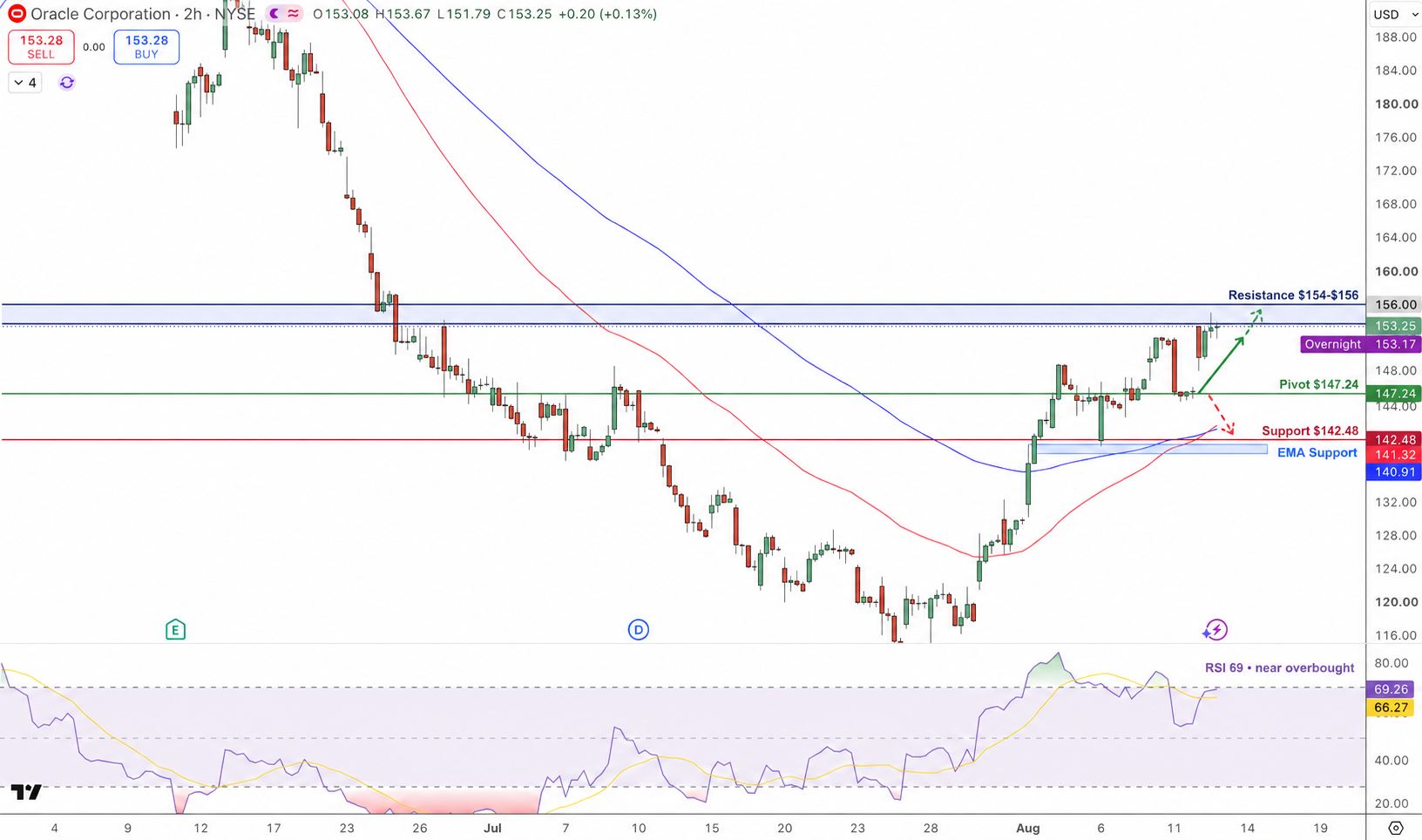
Oracle Price Chart - Source: Tradingview
The daily pivot is the first level to watch at $147.24. A higher close would help the recovery move forward and set up $150.23 and $151.99. However, when Oracle drops below the pivot, there is support at $142.48. If it breaks below, the recovery pattern would become less solid and the lower limit of the wide Bollinger envelope, around $108.74, would be in play.
Short FAQs
1. Why is Oracle stock under pressure?
Oracle faces concerns over heavy AI infrastructure spending, negative free cash flow, rising debt, potential dilution and customer concentration.
2. What are the key levels to watch for ORCL stock?
The $147.24 pivot is the immediate level to watch. Above it, $150.23 and $151.99 are potential targets, while $142.48 is the key downside support.
The Bottom Line
Oracle's AI opportunity remains significant, but the company is taking on substantial costs to capture that growth. New layoffs could improve efficiency, while its expanding backlog and Cloud Infrastructure business support the long-term story. However, negative free cash flow, rising debt, potential shareholder dilution and heavy reliance on OpenAI create meaningful risks. For now, investors will focus on the $147.24 pivot and upcoming earnings, particularly revenue growth, capital spending and funding plans.
Recommended Articles


