


RKLB Stock Forecast: Revenue Hits Record High but Shares Fall 7% Post-Market; Can It Still Rise?
TradingKey - As of August 10 ET, Rocket Lab (RKLB) reported its second-quarter financial results after hours. Although revenue hit a record high and its order backlog expanded further, a loss per share of 8 cents, wider than the expected 6 cents, along with uncertainty surrounding the inaugural flight of its Neutron rocket this year, drove RKLB's stock down by more than 7% at one point in after-hours trading.
Why Is RKLB Stock Falling?
RKLB's post-earnings stock pressure was not due to weak earnings performance. On the contrary, the company's second-quarter revenue reached $234 million, up 62% year-over-year to a record high, slightly exceeding market expectations of about $231.6 million. Meanwhile, the company's net loss narrowed to $49.3 million from $66.4 million in the same period last year, translating to a loss per share of $0.08.
On the business front, RKLB's growth was primarily driven by Space Systems. Second-quarter product revenue reached approximately $181 million, nearly doubling from the same period last year, indicating that satellite manufacturing, satellite components, and government space projects are becoming major revenue sources for the company.
Orders also maintained growth. As of the end of the quarter, the company's backlog reached a record $2.36 billion, up 137% year-over-year. New contracts added during and after the second quarter exceeded $1 billion, including a $266 million HASTE contract with the U.S. Space Force and an approximately $397 million Flatellite satellite project. These orders enhance RKLB's revenue visibility over the coming quarters.
In addition, the company expects third-quarter revenue to be $250 million to $265 million, with a midpoint guidance of approximately $257.5 million, higher than the market's previous expectation of about $238.5 million. In other words, judging from revenue, backlog, and next-quarter guidance, overall growth was maintained in this earnings report.
The main reason RKLB's stock came under pressure after the earnings release lies in the progress toward the Neutron rocket's maiden launch within the year.
RKLB CEO Peter Beck stated that the company plans to move Neutron to the launchpad in the fourth quarter, but the window to complete the inaugural launch in 2026 is narrowing. Compared with the market's previous focus on a fourth-quarter maiden flight target, this statement increased the possibility that Neutron's maiden flight could be delayed to 2027.
The importance of Neutron lies in whether it enables RKLB to expand from the small rocket market where Electron operates into the medium-lift launch vehicle market. If it can reliably execute missions in the future, the company will have opportunities to compete for larger commercial satellite, U.S. defense, and satellite constellation launch contracts. Therefore, changes in Neutron's commercialization timeline directly impact market forecasts for RKLB's future revenue scale.
On the other hand, RKLB has yet to achieve GAAP profitability. Although the second-quarter loss narrowed year-over-year, continuous investment is still required for Neutron R&D, production facilities, and other space infrastructure projects.
Can RKLB Shares Keep Rising?
Judging from earnings data, whether RKLB's stock price can continue to rise in the future depends first on whether its current $2.36 billion order backlog can be steadily converted into revenue.
Compared to its past reliance primarily on the Electron launch business, RKLB has now formed a business structure of "launch services + space systems." In particular, the steady increase in U.S. government and defense contracts has significantly enlarged the size of individual contracts for the company.
Another key variable for whether RKLB's stock price can rise is Neutron. Electron has already proven that RKLB possesses the capability to execute commercial launch missions reliably, but the market size for small rockets is limited. Neutron targets the larger medium-lift rocket market; once it completes its maiden flight and achieves stable commercial operations, the scale of launch missions the company can serve will expand significantly.
On the earnings call, Peter Beck emphasized that rather than simply pursuing a maiden flight date, the company is more focused on whether Neutron can establish a stable and reliable launch cadence after its first launch. Therefore, if Neutron is only slightly delayed beyond late 2026 while subsequent testing, production, and customer orders progress normally, the impact on long-term commercial value may be relatively limited; if the timeline continues to be pushed back, it could affect market forecasts for 2027–2028 revenue.
It is worth noting that the medium- to long-term support for RJLB's stock price still comes from the Space Systems business. Rocket Lab is expanding its revenue sources through satellite manufacturing, components, optical communications, and government space projects, making its future growth no longer entirely dependent on rocket launch frequency. The company's latest announced strategic transactions also further reflect its expansion toward becoming an integrated space infrastructure company.
Therefore, RKLB's stock price still possesses fundamental conditions for medium- to long-term gains. If revenue continues to maintain high growth over the next few quarters while Neutron completes key tests and confirms a maiden flight date, the stock price is expected to regain upward momentum.
RKLB Stock Technical Analysis
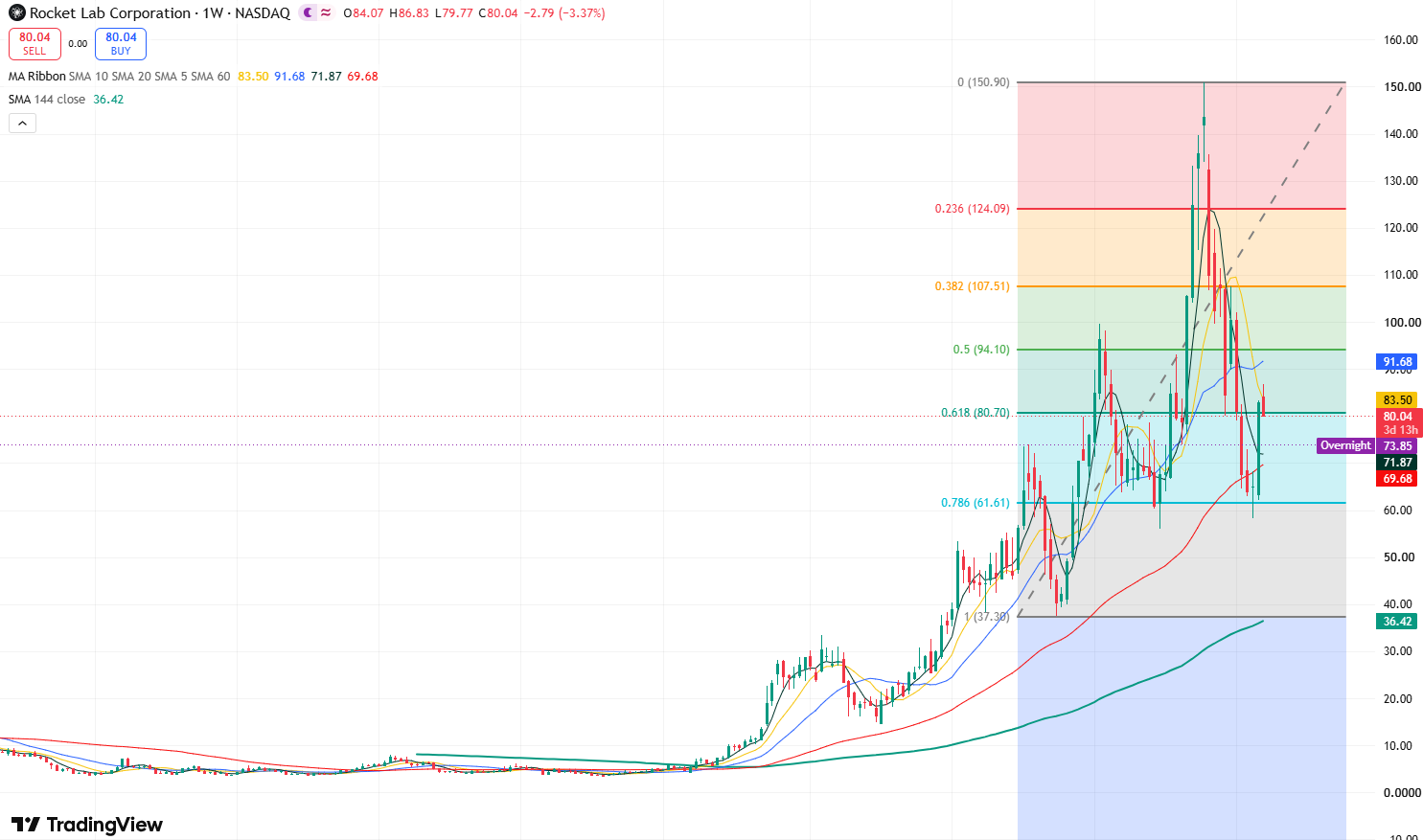
RKLB weekly stock price chart, Source: TradingView
Looking at RKLB's weekly stock price chart, the share price has continued to pull back after hitting an all-time high of $151, nearly erasing all gains from March to May, indicating that short-term market sentiment leans bearish. Meanwhile, as the candlestick action broke below support at the 60-week moving average, bearish momentum in the market was further amplified.
On the upside, the primary resistance above is near the rebound high of $86.83 on August 10. If the stock price can break above and hold steady over this level, upside room toward the $100 mark will open up. Further up, it may test the rebound high of $107.60 set on July 1. Only after the stock price breaks above $107.60 is it expected to return to an uptrend.
On the downside, the primary support level below is near $60. If this level fails to hold, the stock price may fall further toward the $50 mark, and further down, it could test the support level at $37.30.
Recommended Articles


