


Musk Spends $119 Billion to Launch Terafab Construction: Can Tesla and SpaceX Achieve Chip Autonomy?
TradingKey - On August 6 local time, SpaceX ( SPCX) officially confirmed that Tesla ( TSLA) and SpaceX will jointly build the Terafab super chip factory in Grimes County, Texas, US. This means that the long-planned Terafab has finally moved from concept to the actual investment phase.
According to information released by SpaceX, the initial investment scale of the project is $16.8 billion, and the overall investment may further increase in the future as expansion progresses. Project documents disclosed in May this year showed that the potential investment ceiling for the multi-phase construction of Terafab could reach $119 billion.
What attracts the most attention about Terafab is not just the investment amount, but its massive planned scale, with manufacturing space expected to exceed 100 million square feet, or approximately 9.3 million square meters. According to Musk, this factory could eventually become one of 'the largest and most valuable structures on Earth'.
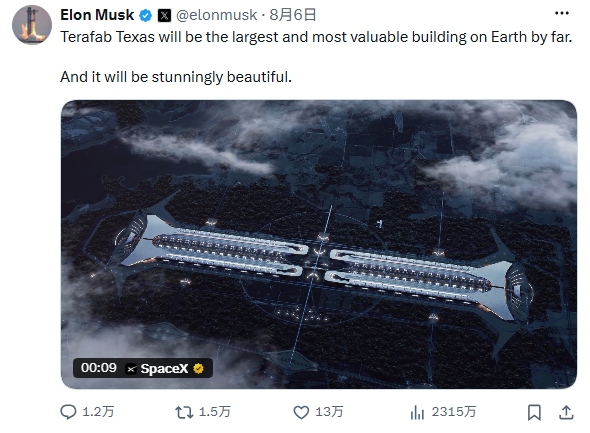
Source: X
More importantly, Terafab is not a single fab in the traditional sense. According to the currently announced plans, it will concentrate advanced logic chips, memory chips, packaging, and testing into the same system, with the goal of establishing a highly vertically integrated chip production base.
Why Elon Musk Is Pushing the Terafab Manufacturing Plan
The core reason behind Terafab is the rapidly growing demand for computing power from Tesla and SpaceX, coupled with Musk's belief that the existing chip supply system will struggle to meet future needs.
Tesla is expanding its Optimus humanoid robot and autonomous driving businesses, while new projects such as the Cybercab also require massive computing resources. Meanwhile, SpaceX plans to continue developing its satellite internet business and explore deploying data centers in space. As these ventures advance simultaneously, demand for processors, memory chips, and AI computing power is expected to continue rising.
Musk has previously emphasized on multiple occasions that chip supply has become a key factor limiting the expansion of related businesses, and that rather than relying on external suppliers over the long term, it is better to increase supply certainty by building in-house production capabilities.
SpaceX positions this project as infrastructure bridging current global chip supply capabilities with future computing demands. Under the ultimate blueprint, Terafab's targeted annual computing capacity will exceed 1 terawatt, or 1,000 gigawatts.
In terms of allocation, Musk previously estimated that about one-quarter of the computing capacity produced by Terafab would serve Tesla, including projects such as Optimus and Cybercab, with the remainder primarily dedicated to SpaceX's AI spacecraft and space data centers.
This indicates that Terafab is not merely aimed at lowering chip procurement costs, but is an attempt to establish a long-term, stable computing power supply system for Musk's various AI projects starting from the chip manufacturing stage.
Terafab Set to Start Production in 2027 With Initial $16.8 Billion Investment
Based on information disclosed so far, Terafab is a large-scale construction project that will take multiple years to progress. SpaceX and Tesla have confirmed an initial investment of $16.8 billion, while the previously disclosed $119 billion represents the potential investment ceiling for future multi-phase expansions of the project, rather than a one-time capital commitment.
After the project site was confirmed in Grimes County, Texas, SpaceX also reached agreements with the local government regarding investment and employment. The company has committed to investing at least $5 billion by 2030 and plans to create thousands of jobs.
The project is expected to begin early production as early as 2027 and gradually ramp up capacity around 2028. Texas has also provided policy support, including a $30 million enterprise fund grant.
Meanwhile, Intel has also been brought into the Terafab cooperation framework. Previous market reports indicated that Intel would participate in the project and play a role in advanced manufacturing processes. For Intel, this could also represent an opportunity to find new growth areas for its foundry business.
In the short term, however, this gigafactory is unlikely to quickly reshape global chip supply and demand. The actual production capacity the project can ultimately reach will still depend on factors such as the supply of advanced equipment, process node selection, and mass-production yields.
Can Musk’s Terafab Chip Factory Truly Materialize?
From a strategic perspective, Terafab aligns with Musk's ongoing push to strengthen vertical integration in recent years.
Tesla hopes to expand its AI business through self-developed chips and robotics, while SpaceX is advancing satellite internet, AI spacecraft, and future space data centers. With multiple businesses entering the high-computing-power phase simultaneously, chips are gradually shifting from a standard supply chain component to a strategic resource within Musk's ecosystem.
If Terafab eventually achieves successful mass production, Tesla and SpaceX will gain greater chip supply autonomy, while also potentially linking chip manufacturing, storage, packaging, and computing infrastructure to form a more complete AI hardware ecosystem.
But this is precisely where Terafab's real challenge lies. Building an ultra-large-scale chip factory does not equate to possessing stable advanced-process capacity; capital investment, equipment supply, process capabilities, yield improvement, as well as energy and water resource security, will all determine whether the project can ultimately meet expectations.
Therefore, the key focus right now should not be the potential investment ceiling of $119 billion, but rather whether the initial $16.8 billion in funding can push the project to break ground as scheduled, and whether Terafab can truly establish mass production capabilities over the next two to three years.
Recommended Articles


