


AMD Q2 2026: Record $11.5B Revenue, Data Center Up 107%, Stock Pulls Back to $485
TradingKey - AMD(AMD) ’s Q2 2026 results published August 4 have created conditions to strengthen competitive positioning against Nvidia in the AI marketplace. AMD stated annual quarter revenue was $11.536 billion, representing an increase of 50% after a year. AMD reported Q2 2026 datacenter revenue of $6.7 billion (+107% YoY), constituting 58% of total revenue, and AMD reported an increase of $1.66 in earnings per share (estimates shorter than reported) for Q2 2026, prompting a positive revision to revenue guidance for Q3 and for the full year.
Due to the reported results, the price per share for AMD on the report date increased to $518.58 (+7%), however, the next day the price decreased -7%. Early August AMD price per share was reported in the $480s to $490s, forming a symmetrical triangle, indicating either an upcoming price correction, or an upcoming price increase.
The Numbers Were Genuinely Strong
AMD’s Q2 2026 results were positive. AMD reported $11.536 billion in revenue (45% increase YoY, exceeding analyst expectations, and 13% greater than Q1), $1.38 in earnings per share (reported in GAAP, +156% YoY), and $1.66 in earnings per share (reported in non-GAAP, greater than $1.62 expected). AMD’s Q2 revenue was reported as $2.3 billion in net income and $2.0 billion (in GAAP) and $3.1 billion (in non-GAAP) operating income, with free cash flow totaling $1.56 billion. As of the end of Q2 2026, AMD’s cash, cash equivalents, and short-term investments totaled $13.1 billion.
Data Center Is the Story
The acceleration in Data Centers is why this quarter was strong, rather than the company just having another strong quarter. Revenue from Data Centers hit $6.7 million, up 107% year on year and 16% from the previous quarter. Data Centers made up 58% of total revenue, up from 42% one year prior. Demand for AMD’s EPYC server processors and Instinct GPUs, both of which support AI, has been driving growth. The company estimated that Data Center revenues would increase 80% in the 2nd half of 2026 and would more than double in 2027. Management also revealed the Helios rack scale AI system, which will be sold starting in Q4 and will have an estimated $5-$5.5 million price tag for each rack, and that the company has already started sending out the first systems in Q3.
Client and Gaming Offset by New Drivers
The remainder of the business showed mixed results. Client segment sales increased by 23% to $3.1 billion, attributed to the sales of Ryzen processors for personal computers and laptops. Gaming sales went down by 31% to $779 million with lower demand for semi-custom and discrete graphics processors. The Embedded segment went up by 19% to $977 million. Overall, the remaining Non-Data-Center segments of the business grew slightly, supporting about 42% of total sales, with Data Center growth balancing the discrepancy.
Guidance Raised, But Valuation Looms Large
Management made significant positive adjustments to forecasts. For the third quarter, AMD is projecting revenue to be $13.0 billion, +/- $300 million, reflecting year-on-year growth of about 41% and about 13% growth over the second quarter of 2023. Third quarter Non-GAAP gross margin is forecasted at 56%. For full-year 2026, AMD is projecting growth of greater than 35% with accelerated growth in Data Center in the second half of the year, and revised growth projections place the AI accelerator market at about $1.4 trillion by 2030 (previously $500 billion) with a 45%+ annually compounded growth rate and the server CPU market at about $220 billion with 50%+ annual growth rate.
Why the Stock Fell After the Beat
The initial rise for AMD of 7% on August 4 was understandable due to the 50% revenue beat, a data center business that doubled, and good guidance. Strong quarterly results normally lead to increased stock prices, however, the market was less optimistic on August 5, and the stock price fell approximately 7% to below $485. AMD investors were considering three risks. First, AMD trades at 48 times its forward earnings and with a 50% growth rate, earnings would be respected, but AMD remains a very expensive company.
Second, AMD's gross margins are 56% and are below gross margins of the past and below AMD's past margins. This shows that AMD is in the early stages of monetizing its AI infrastructure. Third, AMD's operating expenses are increasing by 40% year over year, which is impacting gross margins negatively, and will continue to impact margins, even with revenue growth. AMD investors likely profit took because there are diminishing returns rather than a negative stance on quarterly performance.
AMD Price Outlook; the Technical Challenge Ahead
Typically, symmetrical triangles occur when the support and resistance lines converge. In this case, AMD closed at $518.58 on August 4 and dropped below $490 on August 5. Currently, AMD support is estimated to be in the $485-488 range. The 50 period EMA is $496.79, and the 100 period EMA is $503.52, both above the current price. After the surge and drop, the RSI is resting around ~49, showing neutral momentum. Based on the triangle, resistance is in the $496-503 range, and support is also in the $496-503 range.
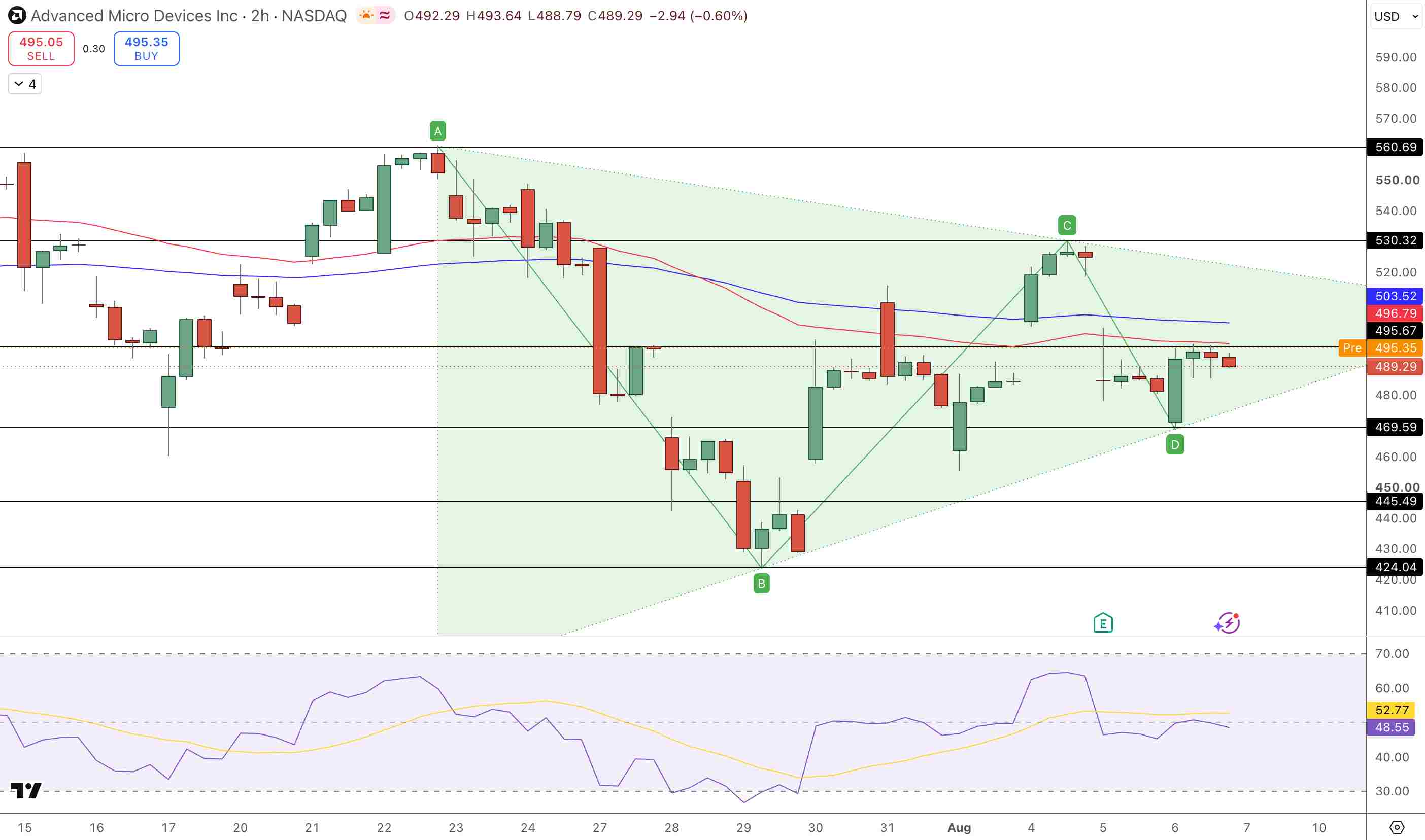
AMD Price Chart - Source: Tradingview
Resistance at $503.52 will likely target the $530 and $560 price areas if a breakout occurs. If AMD breaks support at ~$469–470, price targets would likely be $445 and $424, indicating a bearish market. For Sunday’s readers, the symmetrical triangle indicates that if the price breaks out above the triangle, a bullish market will likely continue; if prices fall below the triangle, a larger bearish market will continue.
Key Levels
- Resistance: $496.79 (50 EMA), $503.52 (100 EMA), $530.32, $560.69
- Support: $469.59, $445.49, $424.04
- Triangle resistance: $496–503 (descending)
- Triangle support: $469–475 (rising)
- RSI: 49, neutral
- Current price: $485–488 (mid-triangle)
Why did AMD stock fall if it beat earnings?
AMD beat on revenue, earnings, and guidance, but the stock fell 7% on August 5 due to valuation concerns. After trading at 48x forward earnings, the stock lost momentum, following the earnings report and subsequently declining gross margins at 56% (operating costs started increasing too).
Is AMD stock a buy at $485?
That depends on you. AMD's market share in AI is not set to grow. The backlog, the Helios system and the Data Center guidance are promising. The stock is set for a downturn if it doesn't perform and growth estimates surpass 50% (current valuations are very optimistic). The stock is in a symmetrical triangle -- above $503.52 favors another leg higher, below $469.59 signals further weakness. For tactical traders, it is reasonable to wait for the triangle to break. This is NOT financial advice.
Bottom Line
AMD's fundamentals remained strong in the second quarter, and there are positive signs regarding data-center growth. The stock pulling back 7% after an initial surge of 7% is profit-taking, which is expected, and should not be interpreted as a reversal of the bull case. The technical case is guided by the symmetrical triangle and will either break up toward $530 - $560, should $503.52 be crossed, or break down, should $470 be crossed, and set support for further selling.
For our regular Sunday readers, management executed Q2 well, and assuming growth remains, we think the valuation is relatively fair. The selling pressure indicates we are waiting for more information, and the triangle is likely the best indicator of our value. The break will provide more information.
Recommended Articles


