


GameStop Shares Slump Over 14% to Lowest Since August 2024 as $1.4 Billion Stock-for-Debt Swap Raises Dilution Risk
TradingKey - On August 3 Eastern Time, GameStop ( GME) shares fell over 14%, hitting a near two-year low.
GameStop reportedly announced that it has reached agreements with certain convertible bondholders to exchange approximately $1.4 billion of outstanding convertible bonds for Class A common stock, relieving the company of a major long-term debt burden. However, this move may dilute the equity of existing shareholders.
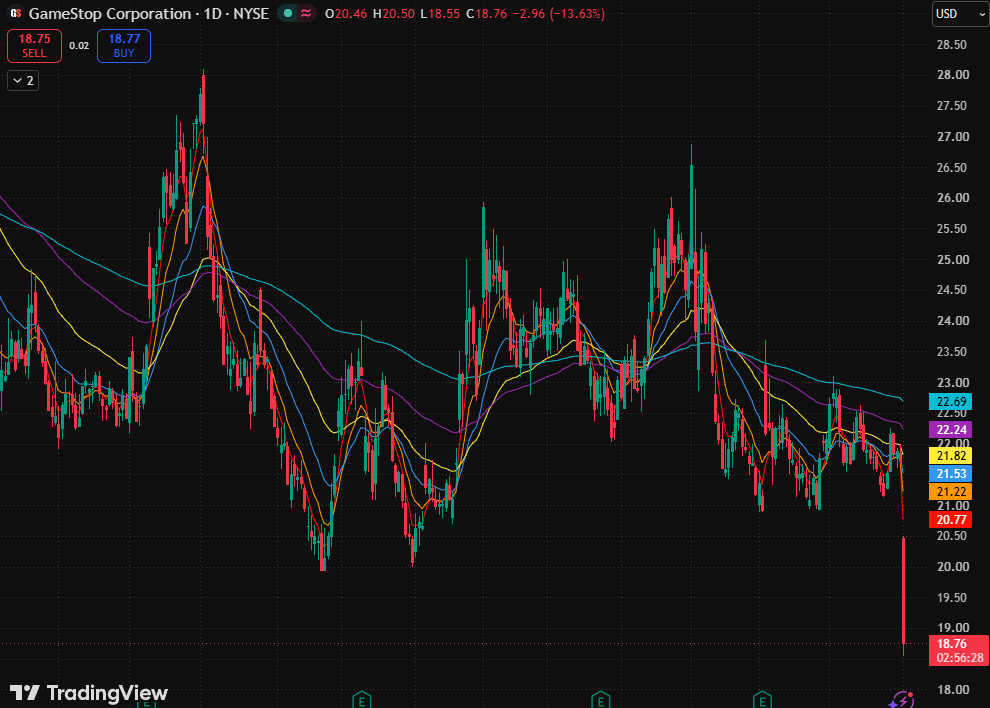
GameStop price chart, Source: TradingView
The exchange involves approximately $400 million of 0% convertible bonds due in 2030 and approximately $1 billion of 0% convertible bonds due in 2032. The transaction does not involve any cash payments; GameStop will issue Class A common stock directly to the respective creditors to exchange and retire the aforementioned bonds.
Upon completion of the transaction, GameStop's long-term debt is expected to decrease by approximately $1.4 billion. Specifically, the remaining balance of the 2030 convertible bonds will drop to approximately $1.1 billion, while the remaining balance of the 2032 convertible bonds will stand at approximately $1.7 billion. The company emphasized that this deleveraging does not involve any cash and will not generate new cash proceeds for the company.
Under the arrangement, the final number of shares to be issued will be based on the average trading price over 35 consecutive trading days starting on August 3, 2026, with a price floor per share established to mitigate dilution risks associated with an excessively low exchange price. The transaction is expected to close on or around September 23, 2026, subject to customary closing conditions.
Notably, bondholders participating in the exchange may buy or sell GameStop stock or use derivatives to hedge their related positions in the future. Such transactions could amplify short-term trading volatility and introduce some uncertainty to GME's stock price.
Recommended Articles


