


USD/CHF Price Forecast: Technical outlook stays constructive above 0.8000
- USD/CHF extends gains as softer Swiss inflation and a modest recovery in the Greenback support the pair.
- The pair retests the 21-day SMA, while holding above the 50-day and 100-day SMAs.
- Neutral RSI and a negative MACD point to steady, rather than strong, upside momentum.
USD/CHF edges higher on Monday as softer Swiss inflation data and a modest recovery in the US Dollar (USD) weigh on the Swiss Franc (CHF). At the time of writing, the pair trades around 0.8109, up 0.38% on the day.
Franc under pressure as muted Swiss inflation keeps SNB on hold
Strategists at Brown Brothers Harriman highlight that "Swiss July CPI stays muted," with inflation data underscoring the lack of price pressures in the economy. They note that, "in line with consensus, headline CPI printed at 0.4% y/y vs. 0.5% in June while core CPI remained at 0.3% y/y for a fourth straight month."
Against this backdrop, BBH concludes that the "bottom line: the SNB has plenty of room to keep rates at 0.00% for some time, which is an ongoing drag for CHF," adding that the Franc is currently "the worst performing G10 currency so far this quarter."
On the US side, the Greenback shows signs of stabilization following last week’s sell-off, triggered by coordinated intervention from Washington and Tokyo to counter excessive weakness in the Japanese Yen (JPY). Stronger-than-expected US ISM Manufacturing Purchasing Managers Index (PMI) data lends some support to the Greenback.
The US Dollar Index (DXY), which tracks the Greenback’s value against a basket of six major currencies, trades around 99.96, rebounding from an intraday low of 99.42, its weakest level since June 15.
Technical analysis
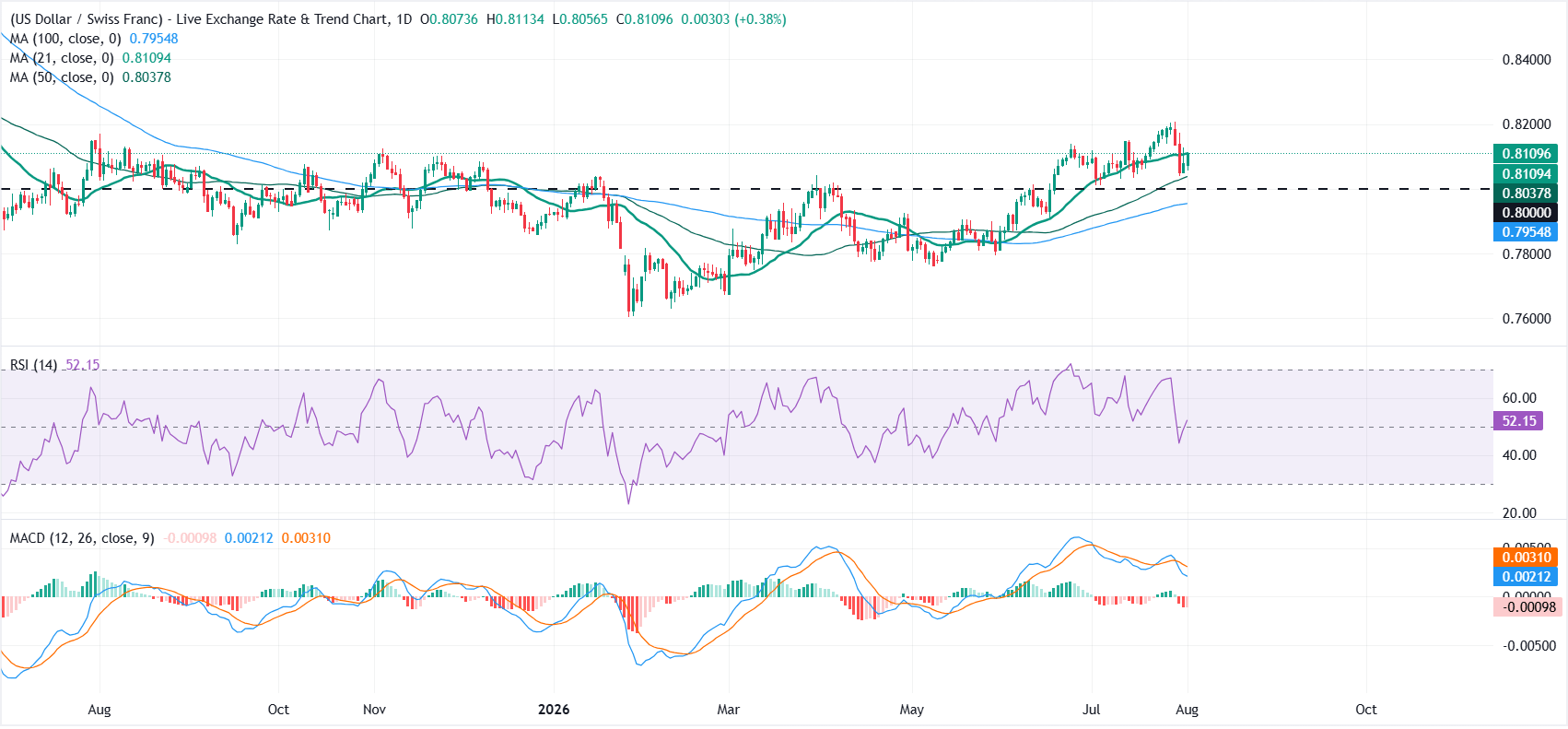
On the daily chart, USD/CHF retests the 21-day Simple Moving Average (SMA) near 0.8110 after slipping below it last week. The pair is above the 50-day and 100-day SMAs, keeping the broader outlook mildly constructive.
Momentum is mixed, with the Relative Strength Index (14) hovering near a neutral 52.5 and the Moving Average Convergence Divergence (MACD) still in negative territory, which suggests upside may be steady rather than explosive in the near term.
On the upside, a daily close above the 21-day SMA would bring the psychological 0.8200 level back into focus. A decisive break above this area could open the door to additional gains.
On the downside, immediate support is seen at the 21-day SMA around 0.8110, followed by the 50-day SMA at 0.8038, ahead of the horizontal support near 0.8000 and the 100-day SMA at 0.7955.
As long as USD/CHF holds above this layered demand zone, the pair would likely continue to trade with a mild bullish bias, with any decisive break below 0.8000 needed to weaken the broader constructive tone and expose deeper retracements.
(The technical analysis of this story was written with the help of an AI tool. Know more.)
SNB FAQs
The Swiss National Bank (SNB) is the country’s central bank. As an independent central bank, its mandate is to ensure price stability in the medium and long term. To ensure price stability, the SNB aims to maintain appropriate monetary conditions, which are determined by the interest rate level and exchange rates. For the SNB, price stability means a rise in the Swiss Consumer Price Index (CPI) of less than 2% per year.
The Swiss National Bank (SNB) Governing Board decides the appropriate level of its policy rate according to its price stability objective. When inflation is above target or forecasted to be above target in the foreseeable future, the bank will attempt to tame excessive price growth by raising its policy rate. Higher interest rates are generally positive for the Swiss Franc (CHF) as they lead to higher yields, making the country a more attractive place for investors. On the contrary, lower interest rates tend to weaken CHF.
Yes. The Swiss National Bank (SNB) has regularly intervened in the foreign exchange market in order to avoid the Swiss Franc (CHF) appreciating too much against other currencies. A strong CHF hurts the competitiveness of the country’s powerful export sector. Between 2011 and 2015, the SNB implemented a peg to the Euro to limit the CHF advance against it. The bank intervenes in the market using its hefty foreign exchange reserves, usually by buying foreign currencies such as the US Dollar or the Euro. During episodes of high inflation, particularly due to energy, the SNB refrains from intervening markets as a strong CHF makes energy imports cheaper, cushioning the price shock for Swiss households and businesses.
The SNB meets once a quarter – in March, June, September and December – to conduct its monetary policy assessment. Each of these assessments results in a monetary policy decision and the publication of a medium-term inflation forecast.
Recommended Articles


