


US Dollar Index Price Forecast: Decline to accelerate below 99.40
- The US Dollar Index recovers slightly to near 99.70 after a significant decline on Friday.
- Traders price out hawkish Fed bets after weak US NFP data.
- Investors await the US CPI data for fresh cues regarding the Fed’s monetary policy outlook.
The US Dollar (USD) edges up against its peers on Monday after a vertical decline on Friday. At press time, the US Dollar Index (DXY), which gauges the Greenback’s value against six major currencies, trades marginally higher to near 99.70.
Financial markets doubt the recovery in the US Dollar as traders have priced out the possibility of a Federal Reserve (Fed) interest rate hike in the September policy meeting, following the release of the weak United States (US) Nonfarm Payrolls (NFP) data for July on Friday.
Fed repricing gathers pace as ING doubles down on Dollar bearishness
Strategists at ING reiterate that their long-held call for no further Fed hikes this year was always going to be stress-tested into the 16 September FOMC. They note that, at the start of August, this view was set to face “five major tests before the 16 September FOMC: two jobs reports, two CPI reports and Jackson Hole,” and caution that if those events had failed to trigger a dovish shift in market expectations, “pricing a September hike above 50% could itself have materially increased the risk of a hike, if only to avoid another bond sell-off on meeting day.”
The first of those tests “arrived on Friday and came through clearly dovish and dollar-negative.” ING highlights, citing James Knightley, that “the -20k payroll print was not the only concern,” with “more than 100k of downward revisions” leaving “average payroll growth at just 20k over the past three months, with health and social care still doing most of the heavy lifting.”
Against that backdrop, ING says “our dovish Fed call is strengthening, and so is our bearish bias on the dollar.” They point out that “despite Friday’s repricing, 11bp are still priced in for September, 28bp for December and 40bp for April,” arguing that “there remains ample room for dovish repricing to harm the dollar if we are right about the Fed.”
Meanwhile, investors shift their focus to the US Consumer Price Index (CPI) data for July, which will be released on Wednesday.
Regarding the US CPI data, strategists at ING expect the upcoming US inflation data to provide another dovish signal for the Fed, albeit in a more measured fashion than last week’s weak payrolls report. They write that they “expect the second test, Wednesday's July CPI release, to send a similar, albeit less dramatic, message,” and forecast “headline CPI at 0.1% month-on-month versus 0.2% consensus, and core CPI at 0.2%, in line with consensus.” In their view, such an outcome would support further dovish repricing of Fed expectations and remain consistent with their bearish stance on the Dollar.
US Dollar Index Technical Analysis
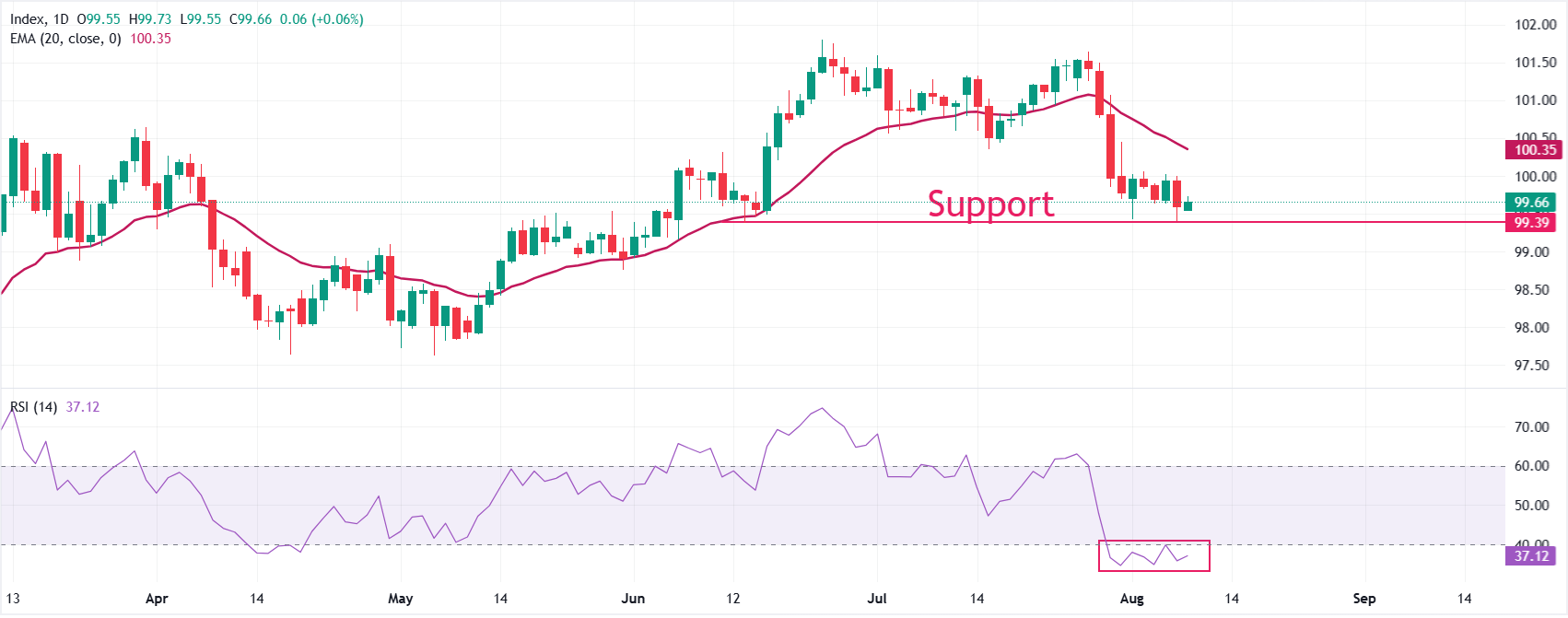
The Dollar Index Spot trades at around 99.70, holding a near-term bearish bias as price holds beneath the 20-day Exponential Moving Average (EMA) at 100.35, keeping the recent decline intact and suggesting rallies are likely to meet supply near that dynamic barrier.
The 14-day Relative Strength Index (RSI) hovers near 37, indicating weak momentum but not yet oversold, which hints that downside pressure persists while leaving room for further losses before exhaustion signals emerge.
On the topside, initial resistance is defined by the 20-day EMA at 100.35, and a daily close above this level would be needed to ease the immediate bearish tone and open the way for a more sustained recovery. Looking down, the US Dollar Index could witness an acceleration in the downside pressure if it drops below the June 15 low at 99.38. Below 99.38, the 99.00 level would be the key support.
(The technical analysis of this story was written with the help of an AI tool. Know more.)
US Dollar FAQs
The US Dollar (USD) is the official currency of the United States of America, and the ‘de facto’ currency of a significant number of other countries where it is found in circulation alongside local notes. It is the most heavily traded currency in the world, accounting for over 88% of all global foreign exchange turnover, or an average of $6.6 trillion in transactions per day, according to data from 2022. Following the second world war, the USD took over from the British Pound as the world’s reserve currency. For most of its history, the US Dollar was backed by Gold, until the Bretton Woods Agreement in 1971 when the Gold Standard went away.
The most important single factor impacting on the value of the US Dollar is monetary policy, which is shaped by the Federal Reserve (Fed). The Fed has two mandates: to achieve price stability (control inflation) and foster full employment. Its primary tool to achieve these two goals is by adjusting interest rates. When prices are rising too quickly and inflation is above the Fed’s 2% target, the Fed will raise rates, which helps the USD value. When inflation falls below 2% or the Unemployment Rate is too high, the Fed may lower interest rates, which weighs on the Greenback.
In extreme situations, the Federal Reserve can also print more Dollars and enact quantitative easing (QE). QE is the process by which the Fed substantially increases the flow of credit in a stuck financial system. It is a non-standard policy measure used when credit has dried up because banks will not lend to each other (out of the fear of counterparty default). It is a last resort when simply lowering interest rates is unlikely to achieve the necessary result. It was the Fed’s weapon of choice to combat the credit crunch that occurred during the Great Financial Crisis in 2008. It involves the Fed printing more Dollars and using them to buy US government bonds predominantly from financial institutions. QE usually leads to a weaker US Dollar.
Quantitative tightening (QT) is the reverse process whereby the Federal Reserve stops buying bonds from financial institutions and does not reinvest the principal from the bonds it holds maturing in new purchases. It is usually positive for the US Dollar.
Recommended Articles


