


House advances crypto tax bill that ties digital assets to traditional tax rules
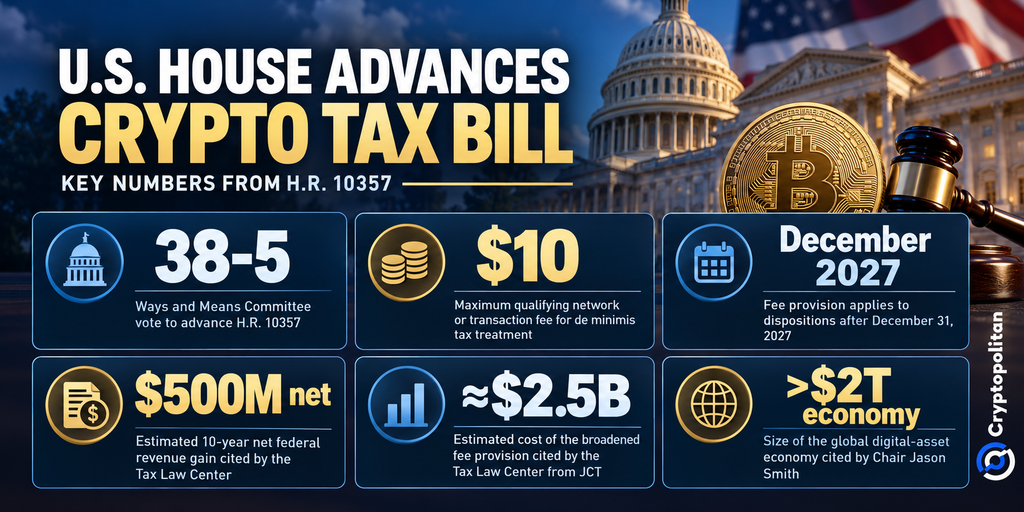
The House Ways and Means Committee moved forward a bill on tax for digital assets on Wednesday (September 16), which was designed to minimize the tax liability for small transactions involving cryptocurrencies, while subjecting digital assets to numerous anti-abuse regulations already used for traditional financial instruments. With a vote of 38-5, the committee passed the H.R. 10357 bill, which is known as the Digital Asset Tax Certainty Act and will now be reviewed by the full House, making it the first federal tax framework for cryptocurrencies to get through a congressional committee.
For crypto holders, traders, miners, and businesses, the piece of legislation offers more than just tax relief. It cuts down on the friction in terms of routine transactions, while also extending the wash-sale, constructive-sale, and certain other traditional regulations to digital assets. This development happened just a day after the Senate was unable to pass the Clarity Act.
The 38-5 vote and what it sends forward
Ways and Means Committee Chairman Jason Smith claimed that the markup is “a historic day for this Committee” and “the first-ever tax framework for digital assets” after over a year of bipartisan collaboration.
The package combines proposals from June that relate to paperwork relief, mining and staking, charitable giving, accounting rules, and anti-abuse measures. Furthermore, it extends wash-sale and constructive-sale rules to digital assets, along with lending and mark-to-market accounting rules.
A $10 threshold, not a blanket exemption
Users would not recognize a gain or loss when paying qualifying network or transaction fees of $10 or less. The exemption has limits and would apply to dispositions after December 31, 2027, according to the bill text.
The NYU Tax Law Center observed that the September versions had expanded the proposal presented in June by moving from blockchain network fees to brokerage, trading and liquidity fees. It explained that this expansion might be the reason the Joint Committee on Taxation estimated the provision at about $2.5 billion compared to about $1.66 billion in June.
Additionally, the bill obliges the Treasury Department to establish within one year the Digital Asset Voluntary Disclosure Program, allowing eligible taxpayers to modify their past returns and pay dues, interest, and penalties.
Mining and staking got no deferral this time
One important change relates to mining and staking. An earlier version of the proposal allowed taxpayers to delay their income from rewards. This option is no longer available in the current proposal. The bill establishes any rewards as taxable income but does not answer questions regarding when that income should be recognized, a problem emphasized in the analysis carried out by the NYU Tax Law Center.
As Rep. Steven Horsford explained, the bill “establishes ordinary income treatment, but leaves that timing question unresolved.” Furthermore, it states that certain types of investment trusts can stake virtual assets without compromising their tax status as a result of this activity alone.
What it costs, and who calls it a giveaway
JCT estimates show revenue gains and losses across the package. The Tax Law Center puts the overall result at about $500 million in net federal revenue over 10 years, including roughly $2 billion in lost revenue from reversing a gambling-loss deduction limit.
Rep. Lloyd Doggett criticized the measure as one that “bestows billions in tax breaks for the crypto industry.” The Tax Foundation takes a different policy approach, arguing that reform should aim for neutrality — neither favoring nor penalizing digital assets relative to other investments.
The American Bankers Association also welcomed adjustments made during the committee process, particularly changes affecting the treatment of financial institutions.
Whether clearer rules move institutions is the open question
Smith linked the measure to keeping the United States “the crypto capital of the world,” citing a global digital-asset economy worth more than $2 trillion.
Globally, crypto tax reporting is tightening. PwC’s global crypto tax report tracks the widening use of reporting frameworks, while the OECD is moving jurisdictions toward implementation of its Crypto-Asset Reporting Framework.
For markets, the bigger question is therefore not the $10 exemption itself but whether clearer U.S. rules reduce compliance uncertainty for exchanges, funds and cross-border investors. Any effect on liquidity or institutional activity remains uncertain, particularly while mining and staking tax timing is unresolved.
Cryptopolitan reported in January that Bitcoin groups had already urged Congress to extend everyday-use tax relief beyond stablecoins to Bitcoin and other major network tokens.
With the House heading toward its pre-election recess, further action is more likely later in the congressional session, leaving the bill’s next stage — and any Senate response — for the months ahead.
TLDR
It matters to crypto users, exchanges, and institutions weighing U.S. tax certainty against tightening global reporting standards, though the measure now waits for the lame-duck session.
Don’t just read crypto news. Understand it. Subscribe to our newsletter. It's free.
Recommended Articles


