


Indian Rupee fails to continue winning streak against US Dollar on Thursday
- The Indian Rupee falls back against the US Dollar after hitting a fresh almost seven-week high.
- Rising foreign inflows, RBI’s new measures and active intervention are likely to continue lending support to INR.
- Investors await flash India-US PMI data for October.
The Indian Rupee (INR) struggles to extend its winning streak for the eighth trading day against the US Dollar (USD). The USD/INR pair rebounds to near 94.78 after attracting signfiicant bids at around the seven-week low of 97.33. However, a spree of tailwinds are expected to continue lending support to the Indian currency.
Why INR’s outlook still seems bullish?
Plenty of tailwinds, including active intervention by the Reserve Bank of India (RBI) through spot and Non-Deliverable Forwards (NDFs) markets on several occasions, fresh measures announced to curb US Dollar’s demand and a significant inflow of foreign funds for the Jio Platforms Initial Public Offering (IPO) are fueling the rally in the Indian currency.
DBS Group Research highlights that the Reserve Bank of India has rolled out a “multi-layered defence strategy to support the rupee this year,” combining “outright intervention in spot/forwards, regulatory action, liquidity steps, administrative measures and moves to curb import-related dollar demand.” According to DBS, the authorities “are likely not done yet and remain ready to take further action, as required,” with RBI Governor Malhotra underlining the central bank’s resolve in a recent Moneycontrol interview on 13 October, stressing that “The RBI is determined to do whatever is necessary to ensure orderly movement in the foreign exchange market.”
Meanwhile, Reliance Industries-backed Jio Platforms has launched its ₹30,213 crore IPO on October 21, 2026, which will remain open until October 23, according to Groww.
India-US flash PMI data awaited
Investors keenly await the preliminary private sector Purchasing Managers’ Index (PMI) data of October for both India and the US, which is scheduled for Friday.
The US S&P Global PMI report will likely show that the overall business activity expanded again, but at a moderate pace.
USD/INR Technical Analysis
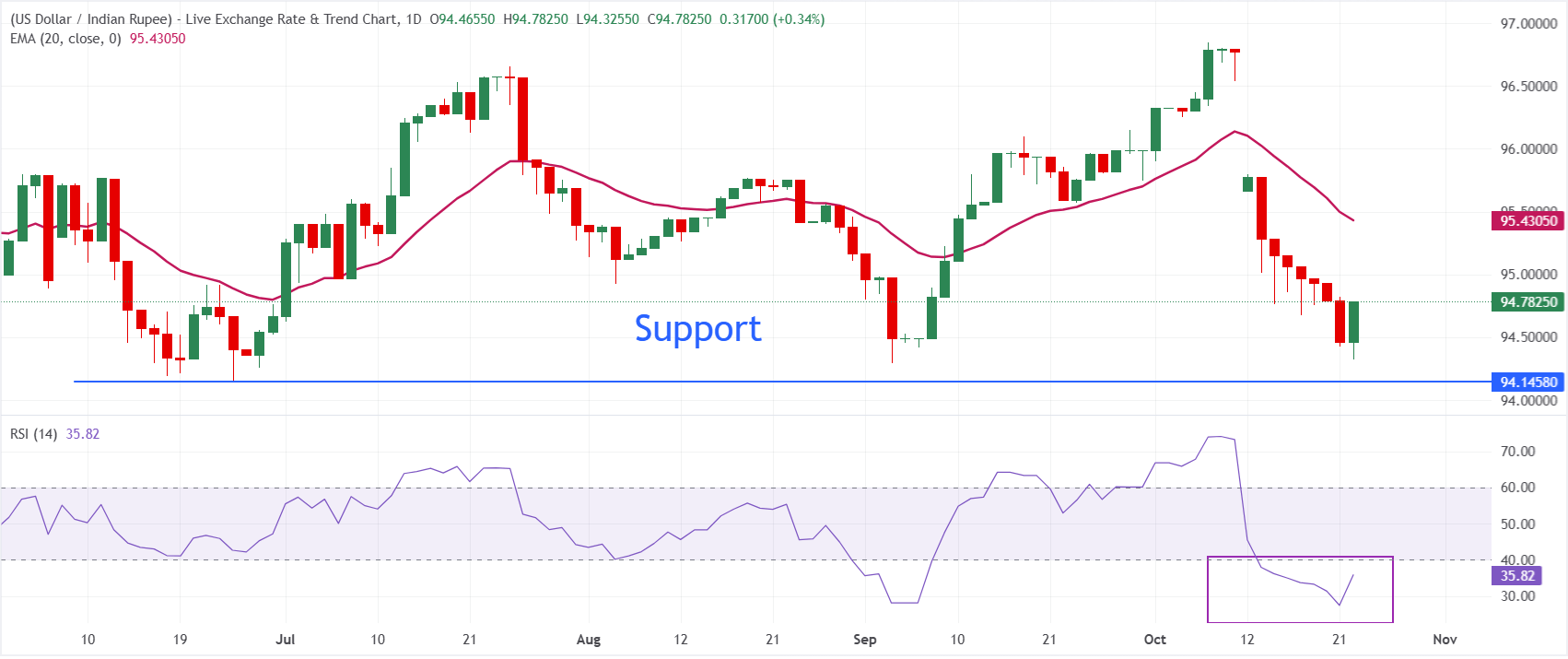
In the daily chart, USD/INR trades at 94.78, keeping a bearish near-term tone as it holds below the 20-day Exponential Moving Average (EMA) at 95.43. The moving average now acts as immediate dynamic resistance, suggesting rallies are likely to be sold while price remains capped beneath this gauge.
The Relative Strength Index (RSI) at 35.62 sits near oversold territory, hinting that downside momentum is stretched but not yet signaling a confirmed reversal.
On the topside, initial resistance is located at the 20-day EMA around 95.43, and a daily close above this level would be needed to ease the current bearish pressure and open the door to a corrective rebound. Looking down, the June 25 low at 94.15 is the key support level.
(The technical analysis of this story was written with the help of an AI tool. Know more.)
Indian Rupee FAQs
The Indian Rupee (INR) is one of the most sensitive currencies to external factors. The price of Crude Oil (the country is highly dependent on imported Oil), the value of the US Dollar – most trade is conducted in USD – and the level of foreign investment, are all influential. Direct intervention by the Reserve Bank of India (RBI) in FX markets to keep the exchange rate stable, as well as the level of interest rates set by the RBI, are further major influencing factors on the Rupee.
The Reserve Bank of India (RBI) actively intervenes in forex markets to maintain a stable exchange rate, to help facilitate trade. In addition, the RBI tries to maintain the inflation rate at its 4% target by adjusting interest rates. Higher interest rates usually strengthen the Rupee. This is due to the role of the ‘carry trade’ in which investors borrow in countries with lower interest rates so as to place their money in countries’ offering relatively higher interest rates and profit from the difference.
Macroeconomic factors that influence the value of the Rupee include inflation, interest rates, the economic growth rate (GDP), the balance of trade, and inflows from foreign investment. A higher growth rate can lead to more overseas investment, pushing up demand for the Rupee. A less negative balance of trade will eventually lead to a stronger Rupee. Higher interest rates, especially real rates (interest rates less inflation) are also positive for the Rupee. A risk-on environment can lead to greater inflows of Foreign Direct and Indirect Investment (FDI and FII), which also benefit the Rupee.
Higher inflation, particularly, if it is comparatively higher than India’s peers, is generally negative for the currency as it reflects devaluation through oversupply. Inflation also increases the cost of exports, leading to more Rupees being sold to purchase foreign imports, which is Rupee-negative. At the same time, higher inflation usually leads to the Reserve Bank of India (RBI) raising interest rates and this can be positive for the Rupee, due to increased demand from international investors. The opposite effect is true of lower inflation.
Recommended Articles


