


Indian Rupee ticks up on possible RBI’s intervention
- The Indian Rupee rebounds slightly against the US Dollar after hitting a fresh three-week low near 95.85.
- US-Iran ceasefire expiration has boosted oil prices.
- Investors shift their focus to the FOMC minutes.
The Indian Rupee (INR) edges up against the US Dollar (USD) on Tuesday. The USD/INR ticks lower to near 95.67 after refreshing the three-week high at 95.85 in the opening session. The Indian currency has gained slight strength due to potential Reserve Bank of India’s (RBI) intervention.
According to a Reuters report, the RBI likely intervened in the foreign exchange market for an eighth consecutive session on Tuesday, four traders told Reuters, as elevated oil prices kept up pressure on the South Asian currency. Traders also said that state-run banks were spotted offering dollars, most likely on behalf of the RBI.
Oil prices rally as US-Iran ceasefire expires
In the early session on Tuesday, the MCX Crude Oil contract expiring on August 19 trades 1.1% higher to near Rs. 8,150, the highest level seen in two weeks.
Currencies from economies, such as India, which rely heavily on oil imports to meet their energy needs, tend to underperform in a high-oil-price environment.
Energy prices have rallied further as United States (US) President Donald Trump said on Monday that he is not interested in renewing the expiring agreement with Iran, according to a Bloomberg report. This has prompted fears that Iran and the US could restart military attacks against each other, a scenario that could escalate concerns regarding a prolonged energy supply disruption. Trump added that the US still has leverage over Iran, citing the US naval blockade on Iranian seaports.
US FOMC minutes awaited
Financial markets keenly await the release of the Federal Open Market Committee (FOMC) minutes of the July policy meeting on Wednesday to get fresh cues regarding the US inflation and the economic outlook.
Hints regarding the US interest rate outlook are unlikely as Fed Chairman Kevin Warsh remained committed to “no forward-guidance” on policy rates.
According to the CME FedWatch tool, traders have scaled back the possibility of a Fed interest rate hike at the September meeting.
USD/INR Technical Analysis
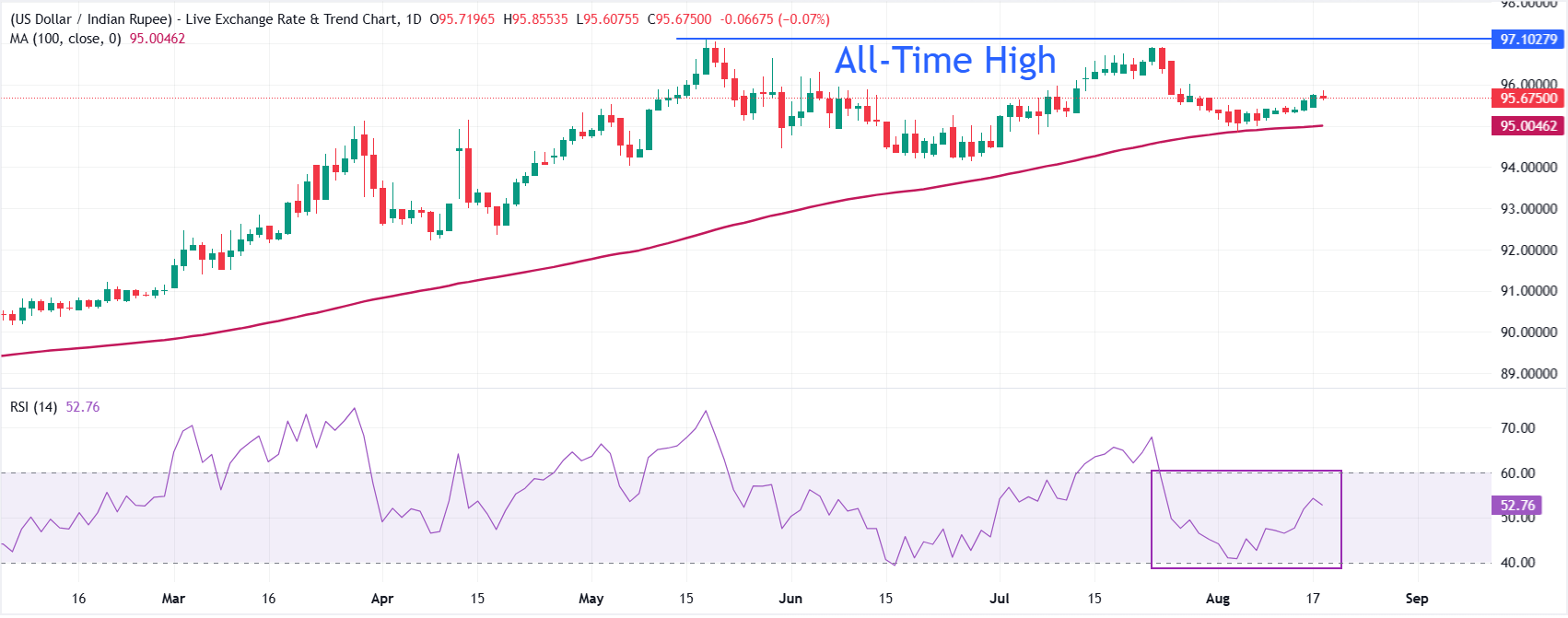
USD/INR trades at 95.67, holding above the 100-day simple moving average (SMA) at 95.0046, keeping the near-term bias moderately bullish as price consolidates near recent highs.
The Relative Strength Index (14) at 52.8 sits just above neutral, hinting at steady but not overstretched upside pressure.
On the downside, immediate support is seen at the 95.67 area, with stronger underlying demand emerging at the 100-day SMA around 95.00, which reinforces the broader upward structure. With no nearby technical resistance levels flagged by the current dataset, traders may watch how price behaves around these supports to gauge whether the pair can extend its grind higher or slip into a deeper corrective phase.
(The technical analysis of this story was written with the help of an AI tool. Know more.)
Indian Rupee FAQs
The Indian Rupee (INR) is one of the most sensitive currencies to external factors. The price of Crude Oil (the country is highly dependent on imported Oil), the value of the US Dollar – most trade is conducted in USD – and the level of foreign investment, are all influential. Direct intervention by the Reserve Bank of India (RBI) in FX markets to keep the exchange rate stable, as well as the level of interest rates set by the RBI, are further major influencing factors on the Rupee.
The Reserve Bank of India (RBI) actively intervenes in forex markets to maintain a stable exchange rate, to help facilitate trade. In addition, the RBI tries to maintain the inflation rate at its 4% target by adjusting interest rates. Higher interest rates usually strengthen the Rupee. This is due to the role of the ‘carry trade’ in which investors borrow in countries with lower interest rates so as to place their money in countries’ offering relatively higher interest rates and profit from the difference.
Macroeconomic factors that influence the value of the Rupee include inflation, interest rates, the economic growth rate (GDP), the balance of trade, and inflows from foreign investment. A higher growth rate can lead to more overseas investment, pushing up demand for the Rupee. A less negative balance of trade will eventually lead to a stronger Rupee. Higher interest rates, especially real rates (interest rates less inflation) are also positive for the Rupee. A risk-on environment can lead to greater inflows of Foreign Direct and Indirect Investment (FDI and FII), which also benefit the Rupee.
Higher inflation, particularly, if it is comparatively higher than India’s peers, is generally negative for the currency as it reflects devaluation through oversupply. Inflation also increases the cost of exports, leading to more Rupees being sold to purchase foreign imports, which is Rupee-negative. At the same time, higher inflation usually leads to the Reserve Bank of India (RBI) raising interest rates and this can be positive for the Rupee, due to increased demand from international investors. The opposite effect is true of lower inflation.
Recommended Articles


