

Japanese Yen holds steady as BoJ rate hike bets offset weak data; USD/JPY seems vulnerable
- The Japanese Yen retains bullish bias as BoJ rate hike bets offset dismal Household Spending data.
- Dovish Fed expectations fail to assist the USD in attracting buyers and keep a lid on the USD/JPY pair.
- Traders keenly await the US PCE Price Index for Fed rate-cut cues and a fresh directional impetus.
The Japanese Yen (JPY) holds steady during the Asian session on Friday and reacts little to the unimpressive data, which showed that Japan's Household Spending unexpectedly fell at the fastest pace in nearly two years in October. Bank of Japan (BoJ) Governor Kazuo Ueda earlier this week lifted market expectations for an imminent interest rate hike as early as this month. Furthermore, a reflationary push by new Prime Minister Sanae Takaichi keeps Japanese government bonds (JGB) yields elevated and continues to underpin the lower-yielding JPY.
Apart from this, a cautious mood around the equity markets is seen as another factor that benefits the JPY's relative safe-haven status. The US Dollar (USD), on the other hand, struggles to capitalize on the overnight bounce from its lowest level since late October amid the growing acceptance that the US Federal Reserve (Fed) will lower borrowing costs next week. This keeps the USD/JPY pair depressed near a three-week low, touched on Thursday, and backs the case for an extension of the recent decline witnessed over the past two weeks or so.
Japanese Yen shrugs off dismal macro data amid hawkish BoJ expectations
- Data published by Japan's Internal Affairs Ministry showed this Friday that Household Spending fell 2.9% YoY in October 2025, missing market expectations for a 1.0% rise and reversing a 1.8% gain in the prior month. This also marked the first decline since April and the fastest pace of fall since January 2024, raising concerns about the economic outlook.
- The Japanese Yen, however, remains on the front foot amid prospects for further Bank of Japan tightening. In fact, BoJ Governor Kazuo Ueda said on Monday that the central bank would consider the pros and cons of raising the policy rate at the December 18-19 meeting. This was seen as the clearest hint so far of an impending rate hike and underpins the JPY.
- Adding to this, Japanese Prime Minister Sanae Takaichi's massive spending plan, to be funded by new debt issuance, has been a key factor behind the recent sharp rise in government bond yields over the past month. The yield on the benchmark 10-year JGB surged to its strongest level since 2007 on Thursday, while the 20-year reached a level not seen since 1999.
- Furthermore, the 30-year JGB yield hit a record high, resulting in a further narrowing of the rate differential between Japan and other major economies. This raises the risk of the carry trade unwinding and further benefits the JPY. However, rising bond yields mean higher borrowing costs, which fuel concerns about Japan's fiscal situation and keep a lid on the JPY gains.
- The US Dollar staged a modest recovery from a six-week trough on Thursday and drew support from a duo of upbeat US labor market reports. In fact, Global outplacement firm Challenger, Gray & Christmas said that planned job cuts declined 53% to 71,321 in November, from 153,074 in the previous month, which was the highest for an October month since 2003.
- Adding to this, the US Labour Department reported that the number of Americans filing new applications for unemployment benefits decreased by 27,000 to 191,000 in the week ended November 29. This marked the lowest level in more than three years, which eased fears of a sharp deterioration in labor market conditions and prompted some USD short-covering.
- Despite the supportive data, the USD struggles to attract any follow-through buying amid the growing acceptance that the Federal Reserve will lower borrowing costs again at next week's policy meeting. This fails to assist the USD/JPY pair in registering any meaningful recovery from a nearly three-week low set on Thursday and backs the case for further losses.
- Traders, however, seem reluctant and opt to wait for the release of the US Personal Consumption Expenditure (PCE) Price Index before placing fresh directional bets. The crucial inflation data will play a key role in influencing expectations about the Fed's rate-cut path, which, in turn, will drive the USD and provide some meaningful impetus to the USD/JPY pair.
USD/JPY remains vulnerable while below the 100-hour SMA hurdle, around 155.40
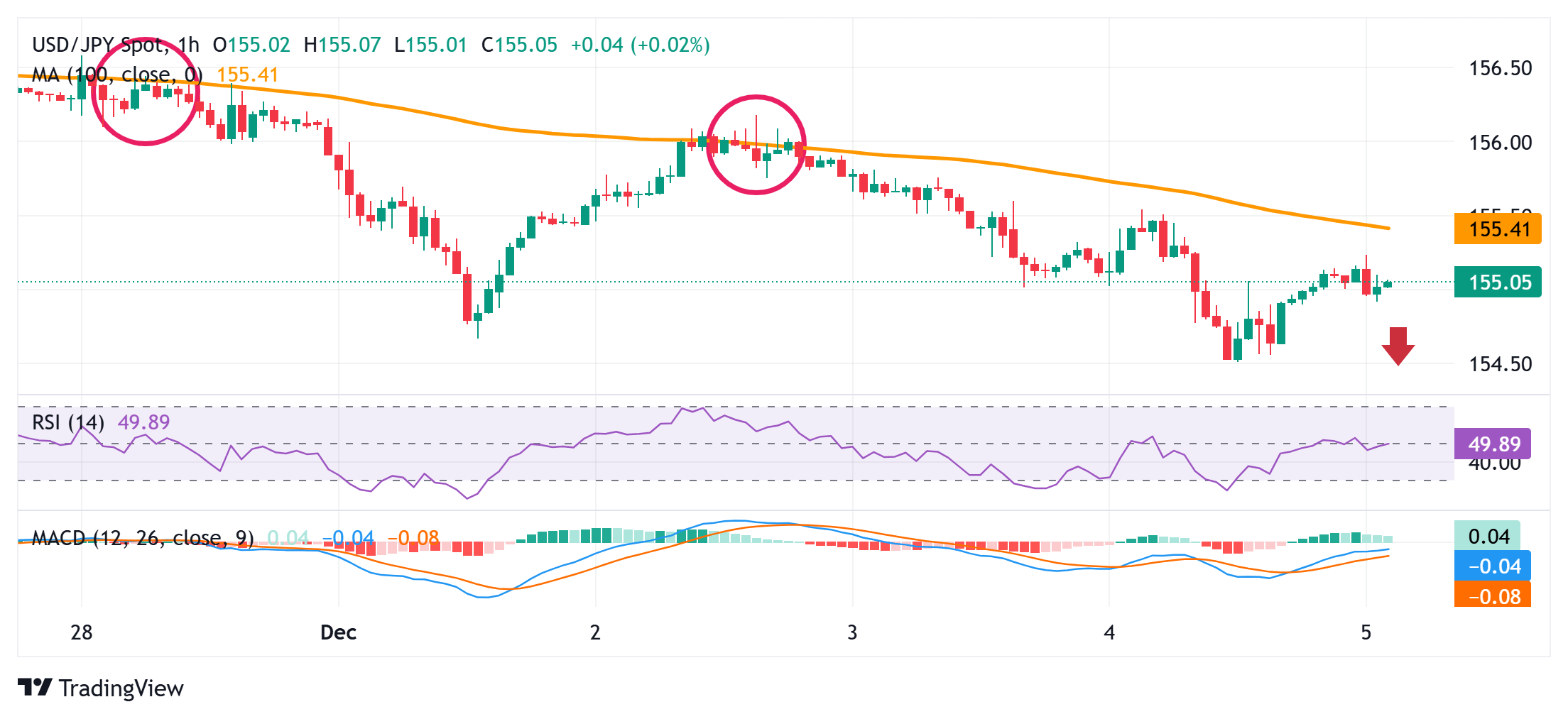
The recent repeated failures to move back above the 100-hour Simple Moving Average (SMA) and the overnight breakdown below the 155.00 psychological mark favor the USD/JPY bears. Furthermore, technical indicators on hourly charts are holding in negative territory and back the case for a further depreciating move, though neutral oscillators on the daily chart warrant some caution. Hence, any further intraday slide could find some support near the overnight swing low, around mid-154.00s, below which spot prices could accelerate the downfall towards the 154.00 round figure.
On the flip side, any meaningful recovery attempt is likely to confront a stiff barrier near the 155.40 region, or the 100-hour SMA. A sustained strength beyond might trigger a short-covering move and allow the USD/JPY pair to reclaim the 156.00 mark. Some follow-through buying should pave the way for a further move up to the next relevant hurdle near the 156.60-156.65 region en route to the 157.00 round figure.
Economic Indicator
Overall Household Spending (YoY)
The Overall Household Spending released by the Ministry of Internal Affairs and Communications is an indicator that measures the total expenditure by households. The level of spending can be used as an indicator of consumer optimism. It is also considered as a measure of economic growth. A high reading is positive (or Bullish) for the JPY, while a low reading is negative (or bearish).
Read more.Last release: Thu Dec 04, 2025 23:30
Frequency: Monthly
Actual: -2.9%
Consensus: 1%
Previous: 1.8%
Source: Ministry of Economy, Trade and Industry of Japan
추천 기사


