

Pound Sterling holds gains on growing Fed rate cut bets, extending UK budget-relief rally
- The Pound Sterling continues to outperform its major currency peers since the UK budget announcement.
- Goldman Sachs expects the Sterling’s rally to be short-lived due to dovish BoE expectations.
- Weak US labor market conditions bolster the case for an interest rate cut by the Fed next week.
The Pound Sterling (GBP) holds onto Wednesday’s gains against its major currency peers on Thursday, extending its rally since the announcement of the United Kingdom (UK) budget on November 26.
Market experts broadly believe that the absence of any major tax burden on households, and the Labour Party keeping its self-imposed rule of avoiding fresh borrowings for day-to-day spending, has helped the British currency to come out of its recent weakness.
However, analysts at Goldman Sachs expect the relief rally to be short-lived amid concerns over the UK’s economic outlook and expectations of faster-than-expected monetary easing by the Bank of England (BoE).
“From here, we continue to think the softening trend in UK data and the prospects for faster-than-expected BoE easing remain key to further Sterling underperformance,” the analysts said.
The BoE is expected to reduce its interest rates by 25 basis points (bps) to 3.75% in the monetary policy announcement on December 18 as UK job market conditions continue to deteriorate further.
Contrary to market expectations, BoE rate-setting member Megan Greene said earlier this week that she would support interest rate cuts only if labour market and consumption deteriorate further.
Daily digest market movers: Pound Sterling holds onto gains against US Dollar
- The Pound Sterling clings to gains near its over-a-month high around 1.3350 against the US Dollar (USD) during the European trading session on Thursday. The GBP/USD pair demonstrates strength as the Pound Sterling continues to outperform since the budget announcement last week and the US Dollar remains on back foot amid reinforced dovish Federal Reserve (Fed) expectations.
- At the time of writing, the US Dollar Index (DXY), which tracks the Greenback’s value against six major currencies, hovers around its fresh monthly low at 98.80 posted on Wednesday.
- According to the CME FedWatch tool, the probability of the Fed cutting interest rates by 25 basis points (bps) to 3.50%-3.75% in the December policy meeting is at 89%, above the 83% seen a week ago.
- Traders are confident that the Fed will cut interest rates next week as the United States (US) labor market conditions continue to deteriorate, partly due to the growing Artificial Intelligence (AI) usage globally.
- The US ADP showed on Wednesday that 32K jobs were shed by private employers in November, missing estimates of a 5K gain. Signs of weakening labour demand usually lead to a less restrictive monetary policy by the Fed.
- Meanwhile, the US ISM Services PMI unexpectedly rose to 52.6 in November, while it was expected to drop to 52.1 from the prior reading of 52.4.
- Going forward, investors will focus on the preliminary Michigan Consumer Sentiment Index and consumer inflation expectations data for December, which will be released on Friday. On the same day, the US Personal Consumption Expenditure Price Index (PCE) data for September will also be released. However, its impact might be insignificant on expectations towards the US interest rate outlook as the data is delayed and refers to September.
Technical Analysis: GBP/USD refreshes monthly high near 1.3350
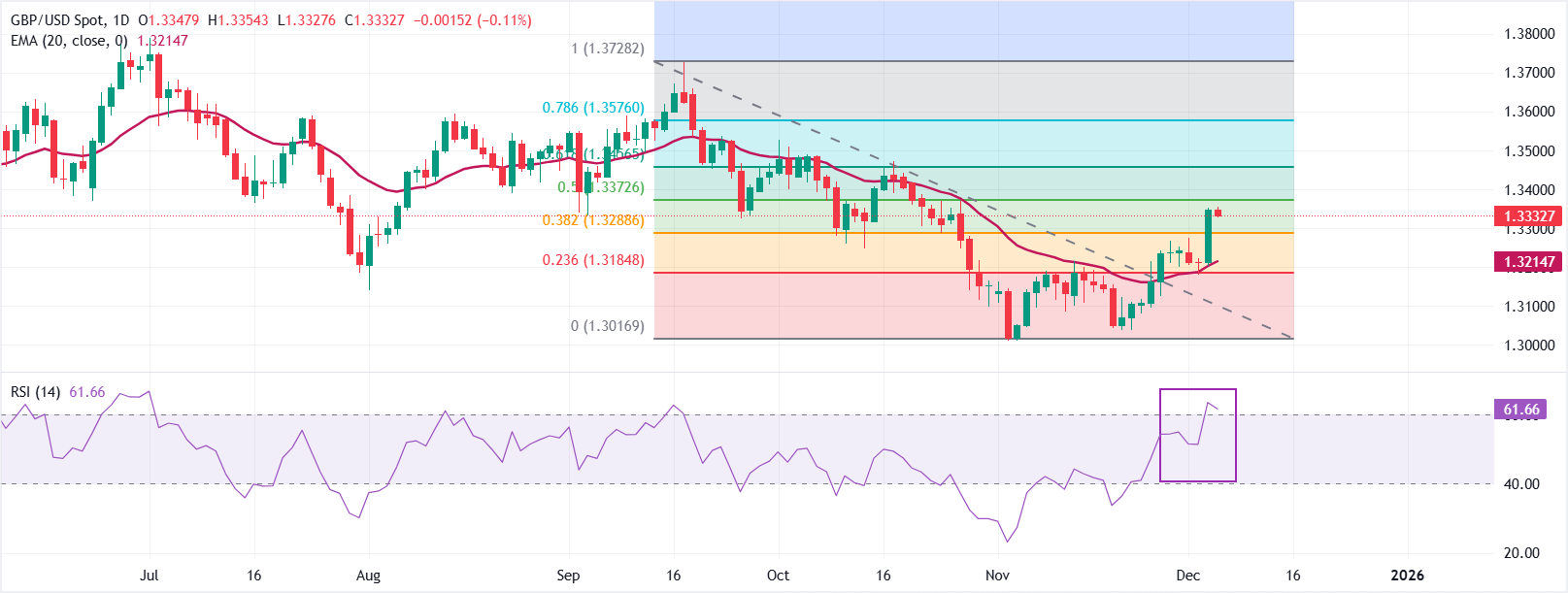
The Pound Sterling trades close to its monthly high near 1.3350 posted on Wednesday. The pair holds above a rising 20-day Exponential Moving Average (EMA) at 1.3215, maintaining a positive near-term bias. The 20-day EMA has sloped higher in recent sessions and dips remain shallow.
The RSI at 61 (bullish) confirms improving momentum. Measured from the 1.3728 high to the 1.3017 low, the 50% retracement at 1.3373 caps the immediate upside, while a pullback would target the 38.2% retracement at 1.3289.
Momentum remains supportive while price stays above the rising average. A daily close above the 50% retracement would reinforce the bullish tone and open room for continuation towards the October 17 high of 1.3471. Conversely, failure to breach that barrier would keep the pair consolidating, with pullbacks leaning toward the 38.2% area and trend support.
(The technical analysis of this story was written with the help of an AI tool)
Pound Sterling FAQs
The Pound Sterling (GBP) is the oldest currency in the world (886 AD) and the official currency of the United Kingdom. It is the fourth most traded unit for foreign exchange (FX) in the world, accounting for 12% of all transactions, averaging $630 billion a day, according to 2022 data. Its key trading pairs are GBP/USD, also known as ‘Cable’, which accounts for 11% of FX, GBP/JPY, or the ‘Dragon’ as it is known by traders (3%), and EUR/GBP (2%). The Pound Sterling is issued by the Bank of England (BoE).
The single most important factor influencing the value of the Pound Sterling is monetary policy decided by the Bank of England. The BoE bases its decisions on whether it has achieved its primary goal of “price stability” – a steady inflation rate of around 2%. Its primary tool for achieving this is the adjustment of interest rates. When inflation is too high, the BoE will try to rein it in by raising interest rates, making it more expensive for people and businesses to access credit. This is generally positive for GBP, as higher interest rates make the UK a more attractive place for global investors to park their money. When inflation falls too low it is a sign economic growth is slowing. In this scenario, the BoE will consider lowering interest rates to cheapen credit so businesses will borrow more to invest in growth-generating projects.
Data releases gauge the health of the economy and can impact the value of the Pound Sterling. Indicators such as GDP, Manufacturing and Services PMIs, and employment can all influence the direction of the GBP. A strong economy is good for Sterling. Not only does it attract more foreign investment but it may encourage the BoE to put up interest rates, which will directly strengthen GBP. Otherwise, if economic data is weak, the Pound Sterling is likely to fall.
Another significant data release for the Pound Sterling is the Trade Balance. This indicator measures the difference between what a country earns from its exports and what it spends on imports over a given period. If a country produces highly sought-after exports, its currency will benefit purely from the extra demand created from foreign buyers seeking to purchase these goods. Therefore, a positive net Trade Balance strengthens a currency and vice versa for a negative balance.
추천 기사


