


Tech Leaders Want Jensen Huang to Return to Nvidia. Here’s What That Would Mean for the Stock Price.
Key Points
Investigations are ongoing into Jensen Huang’s relationship with a woman U.S. intelligence calls a Chinese spy.
Huang, Nvidia’s founder, transformed the company into an AI giant and led explosive gains in revenue.
- Motley Fool Issues Rare "Total Conviction" Buy Alert ›
Jensen Huang shocked the market last week when he stepped down from his position as chief executive officer at one of the world's most famous companies, Nvidia (NASDAQ:NVDA). His move followed allegations of affairs that arose just days earlier. Though some investors predicted a possible resignation, it still seemed somewhat surprising, as Huang founded the company more than 30 years ago and led its spectacular success story.
Today, however, some tech leaders and general Huang supporters aren't ready to say goodbye to Huang. In fact, they are fighting for him to come back. A petition for that purpose has drawn more than 176,000 signatures, including more than 92,000 shareholders and several big names in technology, such as Space Exploration Technologies and Tesla chief Elon Musk, and Shopify CEO Tobias Lütke.
Missed Nvidia in 2009? This Rare Signal Is Flashing Again. In 2009, a "Double Down" signal flashed for a little-known chipmaker called Nvidia. For the first time in years, that same "Total Conviction" signal is flashing for a company 1/100th the size of Nvidia. Continue »
Let's consider if a Jensen Huang return really could happen -- and find out what such an event could mean for the stock price.
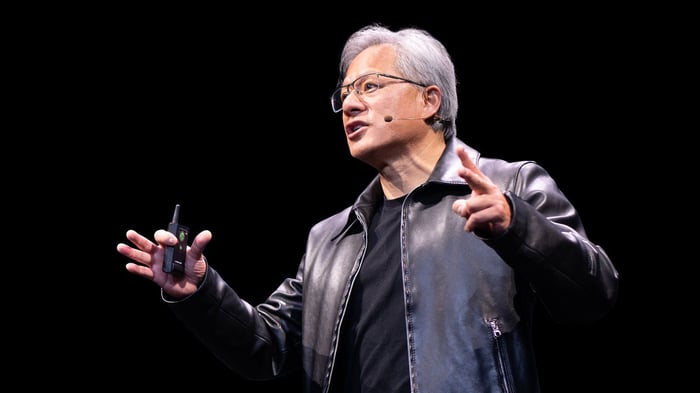
Jensen Huang. Image source: Nvidia.
Allegations and an investigation
First, a quick note about Nvidia's recent turmoil. Huang stepped down last week following allegations of an affair with a person U.S. intelligence calls a Chinese spy and allegations of a separate affair with an Nvidia executive. Nvidia's board opened an investigation into the former, but remained supportive of Huang. The company then met to discuss the company's future after reports of the second alleged affair emerged -- and Huang's resignation followed.
Nvidia named chief financial officer, Colette Kress, to take on the role of CEO on an interim basis while a search is conducted for a permanent replacement.
CEOs are always key to a company, but Nvidia's Huang had taken that importance to a new level. Sporting a leather jacket and speaking about AI in a comfortable, engaging manner, Huang reached superstar status -- and followed through on this by guiding the company along the path of explosive growth.
Huang's decisions helped Nvidia become the world's AI chip leader and maintain the position even as competition intensified. A visionary, Huang always seemed a step ahead and wisely broadened Nvidia's presence across the AI movement through partnerships and acquisitions -- the latest being the decision to buy open-source AI platform Hugging Face. Huang also maintained solid relationships with tech leaders across the AI spectrum.
So, it's not too surprising that many tech leaders wish to bring him back. And the performance of Nvidia in recent years makes it understandable that shareholders and others also support Huang.
Could Jensen Huang return to Nvidia?
But could Huang really come back? Anything is possible. But here, certain elements make it complicated. Nvidia's board continues to investigate allegations about Huang's relationship with Alice Huang (not a relative), whom U.S. intelligence says is a spy. Three House of Representatives committees summoned Jensen Huang for a closed-door interview, and a Senate committee is calling on him to testify to address national security concerns, according to CNN. Even with great public support, it would seem unlikely that Nvidia's board would accept Huang's return while such investigations and interviews are ongoing.
But if Huang returned, would it really be good for the stock? The stock could pop initially, but with the potential of new details turning up as investigations proceed, investors might be jittery. So I wouldn't expect the stock to soar as it did in the past. The entire market community would be more focused on eventual elements emerging from these investigations and potential legal complications than on the company's path.
Dan Ives of Yorkville Ives put it well in his post on X: "The old Jensen with the black leather jacket and rock star persona is gone for good."
So, though the loss of Huang at Nvidia's helm represents a sad and difficult moment, his return might not be the key to boosting the stock. At this point, the best thing for Nvidia is stability and visibility -- and interim chief Colette Kress may be the best person to provide that right now.
Should you buy stock in Nvidia right now?
Before you buy stock in Nvidia, consider this:
The Motley Fool Stock Advisor analyst team just identified what they believe are the 10 best stocks for investors to buy now… and Nvidia wasn’t one of them. The 10 stocks that made the cut could produce monster returns in the coming years.
Consider when Netflix made this list on December 17, 2004... if you invested $1,000 at the time of our recommendation, you’d have $335,171!* Or when Nvidia made this list on April 15, 2005... if you invested $1,000 at the time of our recommendation, you’d have $1,000,640!*
Now, it’s worth noting Stock Advisor’s total average return is 823% — a market-crushing outperformance compared to 208% for the S&P 500. Don't miss the latest top 10 list, available with Stock Advisor, and join an investing community built by individual investors for individual investors.
See the 10 stocks »
*Stock Advisor returns as of November 16, 2026.
Adria Cimino has positions in Tesla. The Motley Fool has positions in and recommends Nvidia, Shopify, Space Exploration Technologies, and Tesla. The Motley Fool has a disclosure policy.
Recommended Articles


