


Australian Dollar hits ten-month low before RBA minutes and jobs data
- AUD/USD falls a fifth straight session to a ten-month low near 0.6750.
- China's October retail sales and factory output both miss forecasts.
- RBA minutes are due Tuesday, and October jobs figures follow Thursday.
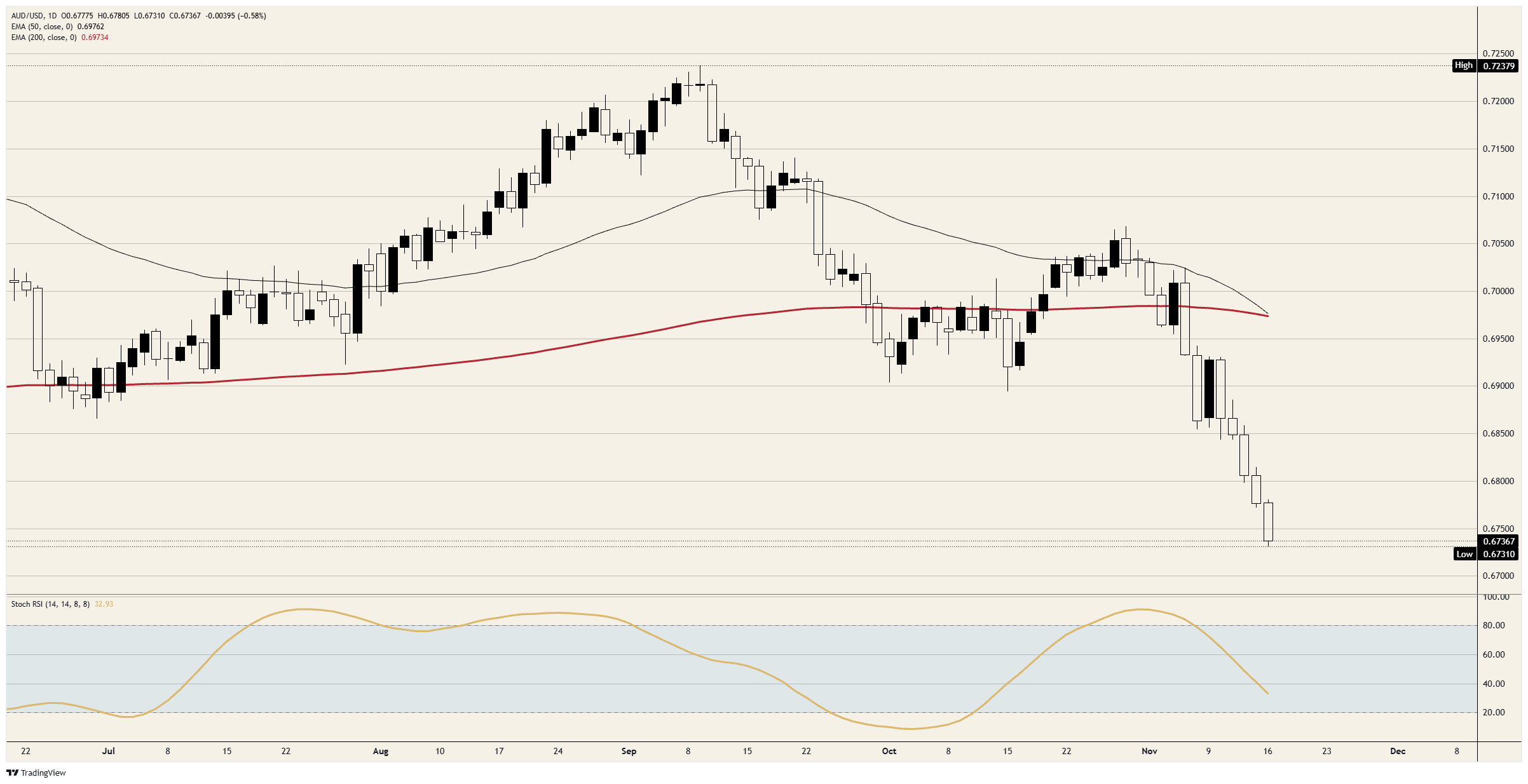
China's October retail sales and industrial output both missed forecasts on Monday, and the Australian Dollar was the weakest major currency on the day. AUD/USD has fallen five sessions in a row and nine of the last eleven, and it's trading just under 0.6750, a ten-month low. The Reserve Bank of Australia (RBA) releases the minutes of its November meeting on Tuesday.
China's retail sales rose 0.4% in October from a year earlier, below the 0.8% forecast, and industrial output rose 4.8% against 5.3%. Fixed-asset investment for January to October fell 8.1%. Australia sells China its Iron Ore and Coal, so each miss lowers the demand traders expect for Australian exports and the currency used to buy them.
The RBA raised its cash rate earlier in November on a 6-3 vote and dropped its guidance on further increases, which traders read as a pause. The Fed is going the other way, with a December hike fully priced. A sell-off in US technology stocks added to the fall, since AUD/USD tends to drop when stocks do.
On the calendar
RBA Governor Bullock speaks at 00:00 GMT on Tuesday, and the minutes of the November meeting follow at 00:30 GMT. The third-quarter Wage Price Index is due at 00:30 GMT on Wednesday, forecast up 0.9% after 0.8%. October employment follows at 00:30 GMT on Thursday, forecast up 25.2K after a 39.3K fall, with the jobless rate forecast at 4.7% again.
All three feed the RBA's next decision after a split vote, the Australian side of the rate gap with the US. October US retail sales come out at 13:30 GMT on Tuesday, and the minutes of the Fed's last meeting at 19:00 GMT on Wednesday.
On the charts
AUD/USD has dropped from an October 28 high just above 0.7050 to its lowest on a chart reaching back to late June. A falling 50-day Exponential Moving Average (EMA) has dropped to meet the 200-day EMA just below 0.7000, and AUD/USD has been under both since November 5. Every low AUD/USD set from July to October is now above it.
AUD/USD daily chart
Australian Dollar FAQs
One of the most significant factors for the Australian Dollar (AUD) is the level of interest rates set by the Reserve Bank of Australia (RBA). Because Australia is a resource-rich country another key driver is the price of its biggest export, Iron Ore. The health of the Chinese economy, its largest trading partner, is a factor, as well as inflation in Australia, its growth rate and Trade Balance. Market sentiment – whether investors are taking on more risky assets (risk-on) or seeking safe-havens (risk-off) – is also a factor, with risk-on positive for AUD.
The Reserve Bank of Australia (RBA) influences the Australian Dollar (AUD) by setting the level of interest rates that Australian banks can lend to each other. This influences the level of interest rates in the economy as a whole. The main goal of the RBA is to maintain a stable inflation rate of 2-3% by adjusting interest rates up or down. Relatively high interest rates compared to other major central banks support the AUD, and the opposite for relatively low. The RBA can also use quantitative easing and tightening to influence credit conditions, with the former AUD-negative and the latter AUD-positive.
China is Australia’s largest trading partner so the health of the Chinese economy is a major influence on the value of the Australian Dollar (AUD). When the Chinese economy is doing well it purchases more raw materials, goods and services from Australia, lifting demand for the AUD, and pushing up its value. The opposite is the case when the Chinese economy is not growing as fast as expected. Positive or negative surprises in Chinese growth data, therefore, often have a direct impact on the Australian Dollar and its pairs.
Iron Ore is Australia’s largest export, accounting for $118 billion a year according to data from 2021, with China as its primary destination. The price of Iron Ore, therefore, can be a driver of the Australian Dollar. Generally, if the price of Iron Ore rises, AUD also goes up, as aggregate demand for the currency increases. The opposite is the case if the price of Iron Ore falls. Higher Iron Ore prices also tend to result in a greater likelihood of a positive Trade Balance for Australia, which is also positive of the AUD.
The Trade Balance, which is the difference between what a country earns from its exports versus what it pays for its imports, is another factor that can influence the value of the Australian Dollar. If Australia produces highly sought after exports, then its currency will gain in value purely from the surplus demand created from foreign buyers seeking to purchase its exports versus what it spends to purchase imports. Therefore, a positive net Trade Balance strengthens the AUD, with the opposite effect if the Trade Balance is negative.
Recommended Articles


