

Nasdaq Returns to Correction Territory, Poised to Challenge 27,000 Again by End of 2026

Source Tradingkey

TradingKey - The Nasdaq has fallen into correction territory for the second time and could remain stuck in a tug-of-war within a wide 24,000–27,000 trading range through the end of 2026.

After weathering a sharp drop in early November, the Nasdaq Composite Index officially confirmed its entry into correction territory. The index is currently consolidating between 25,100 and 25,200, hovering around 25,136.27. Looking ahead to 2027, the Nasdaq is expected to continue fluctuating at elevated levels and digesting market positioning within a wide range of 24,000–27,000.

In late May 2026, the Nasdaq breached 27,000 points before pulling back continuously to near 24,000 by late July. After carving out an interim bottom, the index rebounded strongly, topping 27,000 again on October 5 to set a new record high. However, it subsequently retreated, falling back to near 24,000 on November 5.

The Nasdaq's persistent fluctuations within the wide 24,000–27,000 range since May without achieving a sustained directional breakout reflect a prolonged tug-of-war in the U.S. tech sector between tightening macroeconomic liquidity and the tangible realization of AI fundamentals.

Since this summer, sticky U.S. inflation and resilient employment data have prompted the Federal Reserve (Fed) to turn more cautious on monetary policy, even facing renewed rate-hike expectations in the autumn. Consequently, the 10-year U.S. Treasury yield has remained anchored at an elevated level of around 5.1%. Meanwhile, the Nasdaq is heavily concentrated in growth stocks and tech giants that rely on distant future cash flows. With risk-free rates sustained above 5%, the discount rate demanded by the market has risen sharply, putting persistent pressure on high-P/E tech stocks and leaving the index without the macroeconomic liquidity needed for an unconstrained rally.

In 2026, aggregate capital expenditures by global cloud and AI giants continued to reach record highs, approaching $800 billion for the full year. However, the market debate has shifted from whether computing power demand is sufficient to when these massive investments will translate into tangible, sustainable operating profits. Whenever Big Tech earnings show expanding capex alongside friction in near-term monetization, concerns over AI overinvestment resurface, directly triggering corrections in core chip and computing stocks and preventing the Nasdaq from breaking above the 27,000 resistance zone.

Currently, market attention is focused on Fed testimony and the December FOMC meeting outlook regarding how AI investment impacts short-term inflation and the path of interest rates. Only if the 10-year Treasury yield retreats from its 5.1% high will valuation multiples for high-valuation growth stocks find breathing room. However, the current situation offers little cause for optimism, capping their upside potential.

In addition, the market is closely watching Nvidia's (NVDA) latest quarterly report and revenue guidance for the first quarter of 2027, which will directly verify whether cloud giants' computing procurement demand is experiencing a marginal slowdown. If the numbers beat expectations, the Nasdaq could form a double bottom near 25,000 points and test 26,500 points on the upside; conversely, if guidance is conservative, the broader market may further test support at 24,000–24,500 points.
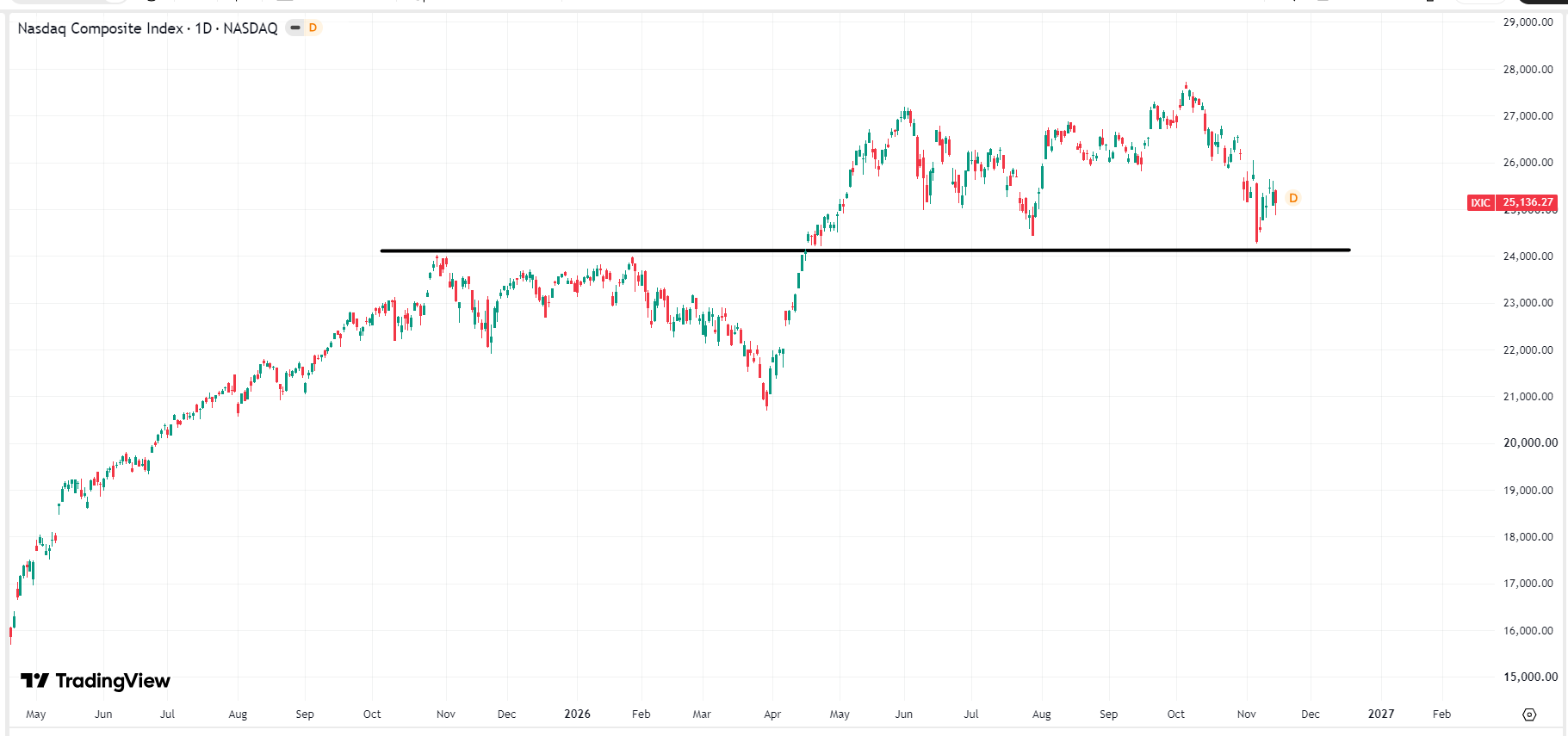
nasdaq-36a508b2f9c743b98d2ea85859bd74cfNasdaq Index chart, Source: TradingView

Disclaimer: For information purposes only. Past performance is not indicative of future results.
placeholder
Nvidia slid 7.7% after hours while AMD and Broadcom rose — the AI trade changed hands, it didn't breakNvidia closed Wednesday at 173.73, up 2.87%, then fell as much as 8.1% to 159.44 after reports that its board was preparing for a possible leadership change. The same session, the Philadelphia Semiconductor Index rose 5.7% with all 30 components higher, CoreWeave jumped 24.7% on 168% revenue growth, and Micron added 11.9%. If AI demand were being repriced, AMD and Broadcom would not be bid. This is a governance discount on one name, and 204.54 — the 200-day average — is the level that settles it.
Author  Irene Q.
Nov 12, Thu
Nvidia closed Wednesday at 173.73, up 2.87%, then fell as much as 8.1% to 159.44 after reports that its board was preparing for a possible leadership change. The same session, the Philadelphia Semiconductor Index rose 5.7% with all 30 components higher, CoreWeave jumped 24.7% on 168% revenue growth, and Micron added 11.9%. If AI demand were being repriced, AMD and Broadcom would not be bid. This is a governance discount on one name, and 204.54 — the 200-day average — is the level that settles it.
placeholder
Gold hit a one-year low while central banks bought 321 tonnes — the sellers were never the ones you thinkSpot gold closed at 3,876 on Thursday, down 2.8% and its lowest close in more than a year, with an intraday low near 3,852. The dollar is at a 19-month high of 103.21 and the 10-year yield is at 5.10%, so the price move is easy to explain. What is harder to explain is who sold: central banks bought 321 tonnes in Q3, the PBoC added for a 24th straight month, ETF holdings are near a record 4,256 tonnes, and roughly 95% of the futures selling came from non-reportable and sovereign-type accounts rather than hedge funds. This piece separates the two books that have to balance.
Author  Irene Q.
Nov 13, Fri
Spot gold closed at 3,876 on Thursday, down 2.8% and its lowest close in more than a year, with an intraday low near 3,852. The dollar is at a 19-month high of 103.21 and the 10-year yield is at 5.10%, so the price move is easy to explain. What is harder to explain is who sold: central banks bought 321 tonnes in Q3, the PBoC added for a 24th straight month, ETF holdings are near a record 4,256 tonnes, and roughly 95% of the futures selling came from non-reportable and sovereign-type accounts rather than hedge funds. This piece separates the two books that have to balance.
placeholder
Brent rose 3.3% and US crude stocks built 4.66 million barrels in the same weekBrent January settled at 95.82, up 3.3%, and WTI at 88.74, up 2.55%, after the US signalled it would not pursue a deal with Iran and attacks on Gulf shipping continued. In the same week, EIA data showed US crude inventories rising 4.657 million barrels against expectations of a 1.1 million draw, with gasoline up another 1.799 million. OPEC output also rebounded 1.96 million barrels a day to 27.16 million in October, led by Saudi Arabia at 10.56 million. This piece separates the geopolitical premium from the physical balance and lays out where each side of the trade is anchored.
Author  Irene Q.
Nov 13, Fri
Brent January settled at 95.82, up 3.3%, and WTI at 88.74, up 2.55%, after the US signalled it would not pursue a deal with Iran and attacks on Gulf shipping continued. In the same week, EIA data showed US crude inventories rising 4.657 million barrels against expectations of a 1.1 million draw, with gasoline up another 1.799 million. OPEC output also rebounded 1.96 million barrels a day to 27.16 million in October, led by Saudi Arabia at 10.56 million. This piece separates the geopolitical premium from the physical balance and lays out where each side of the trade is anchored.
placeholder
Anthropic is six times oversubscribed at $1.4 trillion while Nvidia is down 32% — the AI trade has two pricesAnthropic lists on Nasdaq as ANT on Thursday at $70 ~ $78 a share, raising up to $64.4 billion at a target valuation near $1.4 trillion, and the book is reportedly six times covered. In the same six weeks, Nvidia has fallen 32% and the QQQ is 10.9% below its October peak. Private capital and public markets are marking the same AI complex at two very different prices. This piece separates the two books: what the S-1 shows, who is anchoring the $26 billion private placement, and what Thursday's debut would have to do to change the public tape.
Author  Irene Q.
6 hours ago
Anthropic lists on Nasdaq as ANT on Thursday at $70 ~ $78 a share, raising up to $64.4 billion at a target valuation near $1.4 trillion, and the book is reportedly six times covered. In the same six weeks, Nvidia has fallen 32% and the QQQ is 10.9% below its October peak. Private capital and public markets are marking the same AI complex at two very different prices. This piece separates the two books: what the S-1 shows, who is anchoring the $26 billion private placement, and what Thursday's debut would have to do to change the public tape.
placeholder
Gold Price Analysis Today | Forex Gold Analysis | XAU/USD Analysis - November 16, 2026Get the latest gold price analysis, forex gold insights, and XAU/USD analysis for November 16, 2026. Read on for the details.
Author  Mitrade
6 hours ago
Get the latest gold price analysis, forex gold insights, and XAU/USD analysis for November 16, 2026. Read on for the details.
goTop
quote