


These 5 Gold Mining Stocks Give You a Different Way to Own Gold
Key Points
Central banks have more than doubled their annual gold purchases since 2022 amid rising geopolitical tensions.
Gold miners offer investors exposure to rising gold prices, and each one has unique strengths and weaknesses.
Newmont and Agnico are large-scale producers; Barrick and Kinross offer greater upside to rising prices.
- Motley Fool Issues Rare "Total Conviction" Buy Alert ›
Gold has long been a go-to asset when uncertainty rises, and Newmont (NYSE: NEM), Agnico Eagle Mines (NYSE: AEM), Barrick Mining (NYSE: B), Kinross Gold (NYSE: KGC), and Wheaton Precious Metals (NYSE: WPM) are five gold mining stocks that give you a different way to own gold.
Following Russia's invasion of Ukraine in 2022, the G7, European Union, and other partner nations froze Russian sovereign foreign reserves. Since then, central banks have been adding gold rapidly. Central banks were previously averaging about 500 tons of gold purchased per year.
Missed Nvidia in 2009? This Rare Signal Is Flashing Again. In 2009, a "Double Down" signal flashed for a little-known chipmaker called Nvidia. For the first time in years, that same "Total Conviction" signal is flashing for a company 1/100th the size of Nvidia. Continue »
In recent years, those purchases have doubled as some of the world's central banks de-dollarize and seek diversification away from U.S. Treasuries and other sovereign debt.
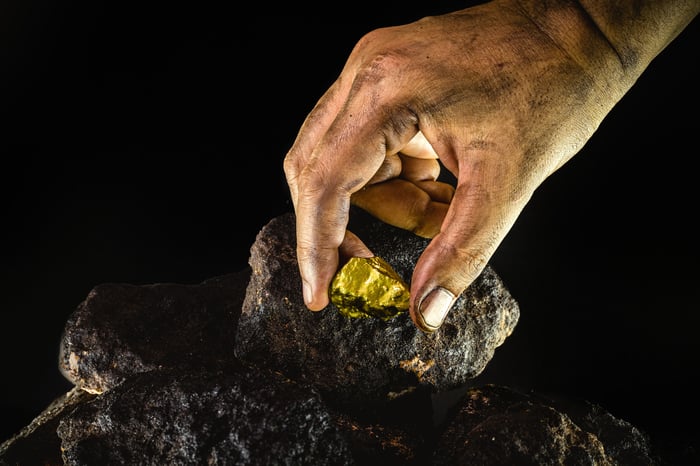
Image source: Getty Images.
U.S. deficits continue to expand, year-over-year inflation, as measured by the Consumer Price Index (CPI), remains above 3%, and geopolitical tensions remain elevated. Right now, gold is priced near $4,100 an ounce, and JPMorgan Chase researchers project it could reach $6,300 by next year. Here's why these five gold stocks could be smart additions to your portfolio today.
Newmont is the world's largest gold producer
Newmont is a behemoth in the gold mining world and the largest company by production, reserves, and market capitalization. The company operates across North America, South America, Australia, and West Africa, and its scale and diversified portfolio help ensure that no single mine failure or regional crisis significantly impacts the business.
Newmont is a massive company, and its inclusion in the S&P 500 index makes it a popular gold-mining stock among mutual funds, wealth managers, and macro hedge funds. The company is also a major copper producer. For investors seeking broad diversification, Newmont's massive scale makes it a popular choice, though upside could be more limited than more nimble or leveraged operators.
Agnico Eagle is a low-cost operator with high-quality assets
Agnico Eagle Mines isn't as spread out across the globe as Newmont. Instead, it focuses heavily on the Abitibi gold belt in Canada where roughly 86% of its total gold production takes place. By clustering operations in Canada, Agnico can share processing, infrastructure, power grids, and its labor force, which helps keep its all-in sustaining costs (AISC) relatively low.
In addition, Canada has some of the highest-grade Archean greenstone gold systems in the world, meaning Agnico produces more ounces per ton of rock. Because Agnico focuses primarily on Tier-1 assets, the stock often trades at a slight premium to peers like Newmont and Barrick, as it doesn't face the same geopolitical risks.
Barrick trades at a lower valuation and has a growing copper business
Barrick Mining is another major gold miner that rebranded itself from Barrick Gold to better reflect its expansion into copper. The company owns high-grade, low-cost gold systems worldwide, along with major copper assets in Zambia, Saudi Arabia, and South America, as well as a large open-pit copper-and-gold development in Pakistan.
Barrick tends to trade at a lower multiple than Agnico and Newmont. Its lower multiple largely reflects its heightened exposure to less stable geographic regions. While Agnico operates mainly in Canada, roughly half of Barrick's operations and growth pipeline is in developing or volatile nations that face political and regional risks.
The company trades at a lower valuation and is a solid choice for value investors who believe the stock can rerate higher. It also provides exposure to both gold and copper, giving investors upside exposure to growing demand for these metals.
Kinross provides high-beta exposure to gold prices
Kinross Gold operates across North America, South America, and Africa, and offers investors more volatile exposure, or higher beta, to rising gold prices. That's because the company has historically operated with a narrower profit margin per ounce, magnifying moves in gold and making Kinross a higher-leverage play to capitalize on higher gold prices but also riskier if gold prices pull back.
Wheaton benefits from rising prices without bearing inflation risk
Wheaton Precious Metals is a unique play on precious metals. That's because the company doesn't own or operate mines itself. Instead, it provides capital to mining companies to help fund mine construction. In return, the company has the right to purchase a percentage of the mine's future gold, silver, or cobalt at a predetermined cash price.
Known as a streaming or royalty business model, Wheaton doesn't bear the costs of owning a mine, such as labor, equipment, or fuel. As a result, the company benefits from 100% of the upside when precious metal prices rise. This makes Wheaton Precious Metals a solid gold stock for investors seeking exposure to rising gold prices while mitigating the inflation effects gold miners face.
Should you buy stock in Newmont right now?
Before you buy stock in Newmont, consider this:
The Motley Fool Stock Advisor analyst team just identified what they believe are the 10 best stocks for investors to buy now… and Newmont wasn’t one of them. The 10 stocks that made the cut could produce monster returns in the coming years.
Consider when Netflix made this list on December 17, 2004... if you invested $1,000 at the time of our recommendation, you’d have $341,157!* Or when Nvidia made this list on April 15, 2005... if you invested $1,000 at the time of our recommendation, you’d have $1,037,753!*
Now, it’s worth noting Stock Advisor’s total average return is 834% — a market-crushing outperformance compared to 207% for the S&P 500. Don't miss the latest top 10 list, available with Stock Advisor, and join an investing community built by individual investors for individual investors.
See the 10 stocks »
*Stock Advisor returns as of November 11, 2026.
JPMorgan Chase is an advertising partner of Motley Fool Money. Courtney Carlsen has positions in JPMorgan Chase and Wheaton Precious Metals. The Motley Fool has positions in and recommends JPMorgan Chase. The Motley Fool has a disclosure policy.
Recommended Articles


