


Warren Buffett's Instructions for His Wife's Inheritance Are 90% Stocks and 10% Bonds. Here's How That Mix Has Done Since 2000.
Key Points
Buffett's 2013 shareholder letter says a bequest for his wife's benefit goes 90% into a low-cost S&P 500 index fund.
Since 2000, that mix has grown $100,000 into around $727,000, compared with about $819,000 in the index.
The mix beat the index in just six calendar years, all down years for the market.
- 10 stocks we like better than Vanguard S&P 500 ETF ›
The Vanguard S&P 500 ETF (NYSEMKT:VOO) dropped over 4% on Nov. 5, and as of this writing it trades around 4% under its 52-week high of $718.47. A day like that can have anyone wondering how much money belongs someplace safer.
Warren Buffett, the former CEO of Berkshire Hathaway, answered that for one pool of money years ago. In his 2013 shareholder letter, he said a bequest in his will sends cash to a trustee for his wife's benefit.
Missed AI’s "Act 1"? Act 2 Could Be 15x Bigger. Most investors think they missed the AI boat because they didn't buy Nvidia in 2005. But according to our analysts, we’re only at the end of "Act 1"—the R&D phase. "Act 2" is the global rollout. Continue »
"Put 10% of the cash in short-term government bonds and 90% in a very low-cost S&P 500 index fund," Buffett wrote. He suggested Vanguard's fund.
That letter is over 12 years old, but he repeated the plan at Berkshire's 2021 annual meeting, and I couldn't find a change to it since. The instruction also doesn't mention timing or valuation, which makes it simple to test.
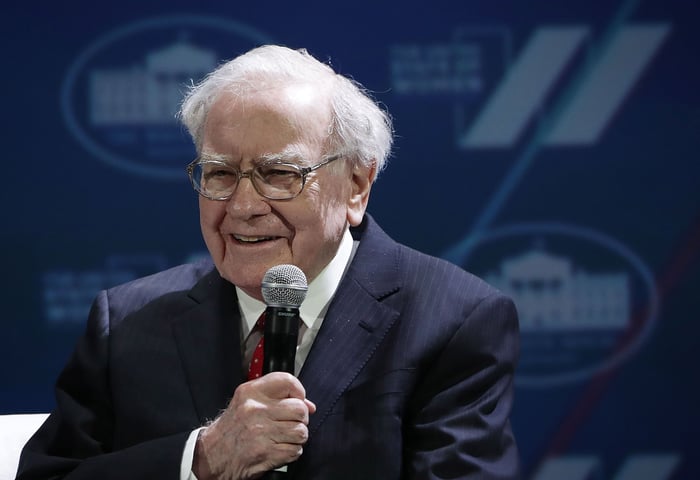
Warren Buffett. Image source: Getty Images.
The index won on total return
Vanguard's S&P 500 ETF didn't start trading until September 2010, so I used the S&P 500 (SNPINDEX:^GSPC) as a stand-in, with dividends reinvested and no fees. The ETF charges 0.03% a year. For the other 10%, I used three-month Treasury bill rates, accrued daily. And because Buffett didn't say if the trustee should rebalance, I assumed the money gets reset to 90/10 every January.
A $100,000 stake in the S&P 500 on the last trading day of 1999 would have grown to around $819,000 by Nov. 6, or about 8.15% a year. The mix would have hit around $727,000, or about 7.67% a year. The yearly gap was under half a percentage point, but over nearly 27 years it came to around $92,000.
Drop the January reset, and the mix would be worth about $754,000. But Treasury bills would be only around 2% of it now, which isn't Buffett's split anymore.
Notably, the mix beat the index in exactly six calendar years -- the six years the index dropped.
Six down years
The biggest gap was in 2008, when the index lost 37% and the mix lost 33.2%. In 2002, the index fell 22.1% versus 19.7% for the mix. In 2022, it was 18.1% versus 16.1%. And the three milder years looked much the same. The index's losses in 2000, 2001, and 2018 (9.1%, 11.9%, and 4.4%) came to 7.6%, 10.3%, and 3.7% for the mix.
Put another way, the mix's losses were around 10% to 16% lower. This helps. But it's about what you'd expect from taking a tenth of the money out of stocks.
From October 2007 to March 2009, the index lost 55.3% from peak to low, and the mix still fell 50.7%.
Nor did the mix recover much quicker. It hit its old high in March 2012, around three weeks before the index did. The gap after the dot-com crash was about three weeks, too.
The mix did finish ahead in the first full decade, though. By the end of 2009, $100,000 had become around $96,000 in the mix and about $91,000 in the index. The index has pulled away since.
What does the 10% buy?
In that letter, Buffett didn't say the mix would beat the index. He wrote that he expected the trust's results to be "superior to those attained by most investors" who "employ high-fee managers."
Of course, a trust also exists to pay someone. I think this is arguably the best case for the 10%, because money in Treasury bills doesn't drop with stocks and can help cover spending in a tough year.
The numbers back that up, to a point. With a fixed $4,000 taken out every January from 2001, the index still ended ahead, at around $206,000 against about $194,000 for the mix. At $5,000 a year, the order flipped. The index portfolio was down to around $53,000, but the mix still had about $60,000.
In the end, I think Buffett's mix has done about what it should have. It lagged the index in every year the market gained, and it still lost around a third of its value in 2008. For a buy-and-hold investor letting the money sit for decades, owning just the index would have been the better call since 2000.
But for money that needs to keep paying someone through a crash, giving up around half a percentage point a year looks like a fair price to me. Granted, this was one man's plan for one trust, and this test covers just one stretch of market history.
Should you buy stock in Vanguard S&P 500 ETF right now?
Before you buy stock in Vanguard S&P 500 ETF, consider this:
The Motley Fool Stock Advisor analyst team just identified what they believe are the 10 best stocks for investors to buy now… and Vanguard S&P 500 ETF wasn’t one of them. The 10 stocks that made the cut could produce monster returns in the coming years.
Consider when Netflix made this list on December 17, 2004... if you invested $1,000 at the time of our recommendation, you’d have $341,966!* Or when Nvidia made this list on April 15, 2005... if you invested $1,000 at the time of our recommendation, you’d have $1,146,819!*
Now, it’s worth noting Stock Advisor’s total average return is 852% — a market-crushing outperformance compared to 203% for the S&P 500. Don't miss the latest top 10 list, available with Stock Advisor, and join an investing community built by individual investors for individual investors.
See the 10 stocks »
*Stock Advisor returns as of November 10, 2026.
Daniel Sparks and his clients have positions in Berkshire Hathaway. The Motley Fool has positions in and recommends Berkshire Hathaway and Vanguard S&P 500 ETF. The Motley Fool has a disclosure policy.
Recommended Articles


