


Not Bloom Energy. Not Vistra. This AI Power Stock Just Posted a 96% Jump in Orders.
Key Points
AI data centers are consuming more electricity than utility companies are able to reliably deliver.
Data center owners/operators are taking power production into their own hands.
Demand for this company’s tech is apt to remain robust regardless of the AI industry’s likely future.
- Motley Fool Issues Rare "Total Conviction" Buy Alert ›
Anyone keeping their finger on the pulse of the power shortage that's crimping the proliferation of AI data centers has probably heard of Vistra and Bloom Energy.
Vistra is the utility outfit working directly with Meta Platforms and Amazon to power some of their facilities, while Bloom makes and markets equipment that turns natural gas or hydrogen directly into electricity. It sold over $1.0 billion worth of this tech last quarter alone, up 15% year over year.
Missed Nvidia in 2009? This Rare Signal Is Flashing Again. In 2009, a "Double Down" signal flashed for a little-known chipmaker called Nvidia. For the first time in years, that same "Total Conviction" signal is flashing for a company 1/100th the size of Nvidia. Continue »
A major beneficiary of the artificial intelligence revolution is obscured by these obvious names, however. That's GE Vernova (NYSE: GEV), which recently reported a 96% year-over-year increase in orders for power-generating equipment. Here's a closer look.
The swell is building
Yes, this company is an offshoot of the iconic industrial conglomerate General Electric, which completed a breakup into more manageable pieces back in 2024. GE Vernova is its old power arm, which makes wind turbines, utility-scale grid equipment, hydropower solutions, some nuclear power tech, and, perhaps most importantly of late, natural gas turbines.
And business is good. Its third-quarter top line of $12.6 billion was up 18% (organically) year over year, extending and accelerating a growth trend that's been in place since 2024. Electrification sales technically grew the fastest, but orders for power hardware grew the most.
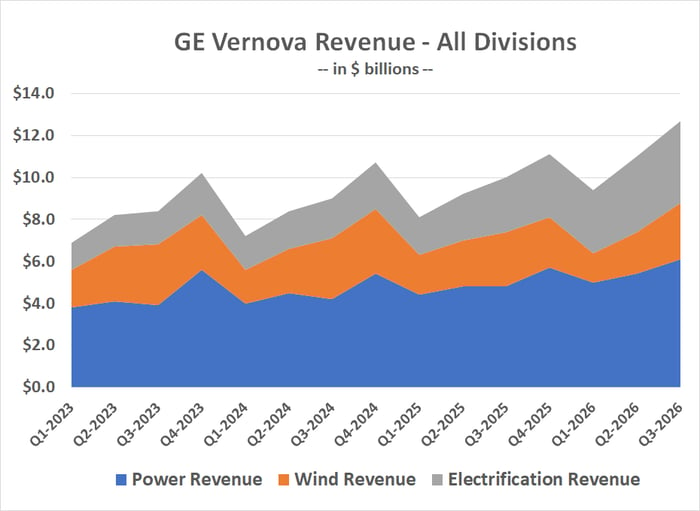
Data source: GE Vernova. Chart by author.
The real story here, though, is how much future business has already been lined up. Led by orders for power equipment, the company's total orders soared by 96% to $29 billion in Q3, inflating GE Vernova's total backlog to $197 billion. That's a little more than four years' worth of revenue at its current annual revenue run rate.
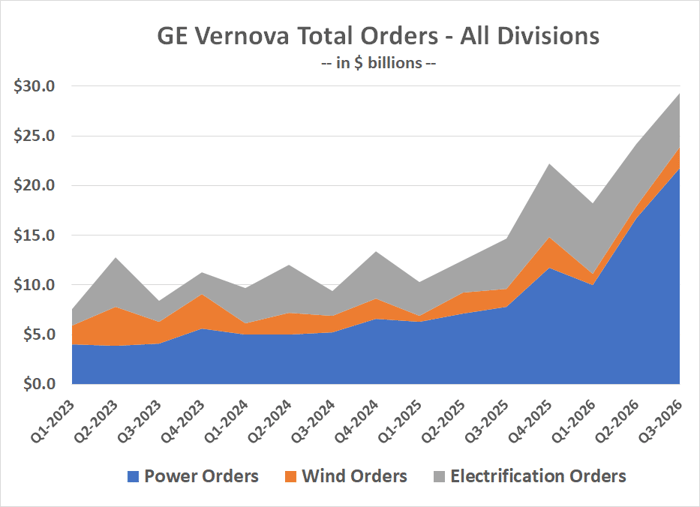
Data source: GE Vernova. Chart by author.
The company expects this backlog to exceed $200 billion by the end of this year, even as it delivers tech to fulfill some of these orders during the quarter currently underway. The analyst community believes GE Vernova will report fourth-quarter sales of $14 million sometime in January, up 28% from last year's Q4 revenue.
Don't panic just because everyone else did
The proverbial 800-pound gorilla in the room is last Wednesday's plunge in shares of GE Vernova, Vistra, Bloom Energy, and plenty of other names in the power production business following the midterm elections, which gave Democrats impending control of the U.S. Senate and House of Representatives. Investors appear to believe that the future political landscape could stymie the expansion of the AI data center industry's power footprint. And perhaps it will.
This extreme sell-off is arguably more of a buying opportunity than an omen, though. GE Vernova's energy businesses are largely environmentally friendly or improve power efficiency or both. Recent election results will have little actual impact on the company's business, and they could actually expand demand for its solutions.
Much of its power business isn't vulnerable to a meltdown of the artificial intelligence industry, either. As it noted during its Q3 earnings conference call, only 20% of these customers are data center customers. The other 80% are traditional customers -- like utility companies -- that need this equipment regardless of the economic or political backdrop.
Should you buy stock in GE Vernova right now?
Before you buy stock in GE Vernova, consider this:
The Motley Fool Stock Advisor analyst team just identified what they believe are the 10 best stocks for investors to buy now… and GE Vernova wasn’t one of them. The 10 stocks that made the cut could produce monster returns in the coming years.
Consider when Netflix made this list on December 17, 2004... if you invested $1,000 at the time of our recommendation, you’d have $341,966!* Or when Nvidia made this list on April 15, 2005... if you invested $1,000 at the time of our recommendation, you’d have $1,146,819!*
Now, it’s worth noting Stock Advisor’s total average return is 852% — a market-crushing outperformance compared to 203% for the S&P 500. Don't miss the latest top 10 list, available with Stock Advisor, and join an investing community built by individual investors for individual investors.
See the 10 stocks »
*Stock Advisor returns as of November 8, 2026.
James Brumley has no position in any of the stocks mentioned. The Motley Fool has positions in and recommends Amazon, Bloom Energy, GE Vernova, Meta Platforms, and Vistra. The Motley Fool has a disclosure policy.
Recommended Articles


