


Which of These 5 Cannabis Stocks Has the Strongest Balance Sheet?
Key Points
Cronos leads with approximately $827 million in financial reserves.
SNDL carries no debt and generates positive free cash flow.
Tilray's revenue growth hasn't eliminated its cash flow challenges.
- 10 stocks we like better than Cronos Group ›
Tilray Brands (NASDAQ: TLRY), Canopy Growth (NASDAQ: CGC), Cronos Group (NASDAQ: CRON), SNDL (NASDAQ: SNDL), and Aurora Cannabis (NASDAQ: ACB) have all had their share of financial challenges. But some are in much better shape than others. In an industry where marijuana companies have spent years burning through cash, issuing new shares, and struggling to turn a profit, a strong balance sheet matters.
So which of these five cannabis stocks is in the best financial position? Let's look at the numbers.
Missed AI’s "Act 1"? Act 2 Could Be 15x Bigger. Most investors think they missed the AI boat because they didn't buy Nvidia in 2005. But according to our analysts, we’re only at the end of "Act 1"—the R&D phase. "Act 2" is the global rollout. Continue »
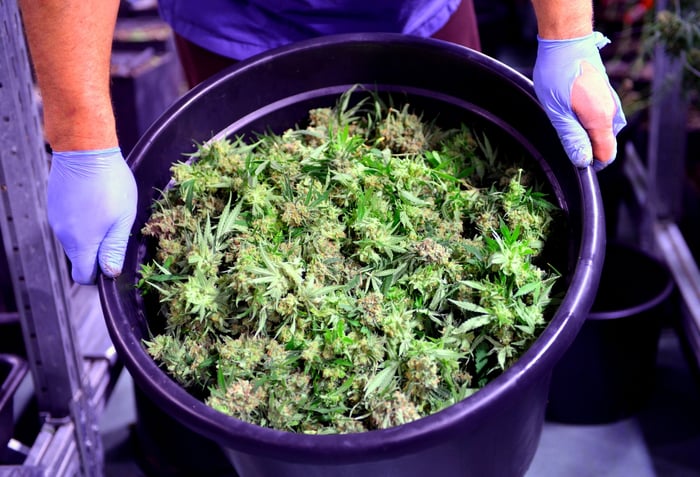
Image source: Getty Images.
Tilray has made progress, but cash flow remains a problem
Tilray reported approximately $221.4 million in cash, restricted cash, and marketable securities at the end of first-quarter 2027. It also had $376.9 million in working capital.
The company has been cleaning up its balance sheet, too. In its first fiscal quarter, Tilray reduced its long-term convertible debt by about $79.5 million. Indeed, this was encouraging news, but the company still carries roughly $118 million in long-term debt. While quarterly revenue jumped 23% to $257.1 million, Tilray still reported a $40 million net loss and negative free cash flow of $27.4 million.
The company does have plenty of opportunities across cannabis, beverages, and pharmaceutical distribution. But until it can consistently generate positive cash flow, its balance sheet remains vulnerable.
Canopy Growth still has some financial baggage
Canopy Growth has spent years trying to get its finances under control. As of June 30, 2026, the company had $241.4 million in cash and cash equivalents, down from $261.6 million just three months earlier. It also carried approximately $172.3 million in debt. Granted, there has been some improvement. Fiscal first-quarter revenue increased 13% to $58.2 million, while its net loss narrowed to $10.5 million from $32.2 million a year earlier.
To be sure, Canopy isn't facing an immediate cash crisis. But with that much debt still on the books, it has less financial flexibility than some of its competitors.
SNDL has no outstanding debt
As of Sept. 30, 2026, SNDL reported $440.1 million in unrestricted cash, marketable securities, and investments, including investments in other businesses. That's a significant financial cushion. Also worth noting: SNDL generated a record $14.2 million in free cash flow in the third quarter, up 19.5% from a year earlier. Adjusted operating income also turned positive at $3.7 million.Those are definitely encouraging numbers, but there are also some weaknesses.
Quarterly revenue declined 2.5%, and SNDL recorded a $37 million noncash goodwill impairment. Nevertheless, SNDL is debt-free, and its improving cash flow makes it one of the industry's financially stronger companies.
Aurora Cannabis has a respectable financial cushion
At the end of June 2026, the company reported $49.4 million in cash and $21.9 million in short-term investments. It also held $35 million in restricted cash while working capital stood at approximately $228.2 million.That's a reasonable cushion, particularly for a company that's been focusing more heavily on medical cannabis and international markets. But Aurora's latest quarterly results weren't particularly impressive.
Revenue declined to $48.2 million from $52.8 million a year earlier. Adjusted EBITDA remained positive at $2.5 million, but free cash flow was negative $4.1 million. Don't get me wrong. Aurora isn't in terrible financial shape, but its readily available cash reserves are considerably smaller than those of Cronos.
Cronos is sitting on a mountain of cash
Cronos Group still has the strongest balance sheet of these five cannabis companies. As of Sept. 30, 2026, the company reported approximately $841 million in combined cash, restricted cash, short-term investments, and longer-term interest-bearing deposits, with no significant debt burden. That's up from approximately $827 million at the end of June, giving Cronos a lot of financial flexibility to expand its operations, pursue acquisitions, and weather challenges in the cannabis industry.
Its operating performance is also improving. According to its Nov. 5 earnings release, Q3 revenue jumped 75% year over year to $63.5 million, while adjusted EBITDA surged 201% to $17.1 million. Gross profit also increased 76% to $32.3 million, reflecting stronger cannabis sales in Canada and international markets, particularly Germany.
Cronos takes the top spot
Of these five cannabis companies, Cronos Group has the strongest balance sheet. Its approximately $841 million in cash and interest-bearing investments, limited debt exposure, and improving operating performance put it ahead of the competition.
SNDL comes in a close second, thanks to its debt-free balance sheet and positive free cash flow. Tilray and Canopy still have work to do, and Aurora has a respectable but smaller liquidity cushion.
Now, does that mean Cronos is automatically the best cannabis stock to buy? Not necessarily. A strong balance sheet doesn't guarantee strong revenue growth, profitability, or attractive shareholder returns. But it does give a company more room to maneuver when business conditions deteriorate. Considering how much money cannabis companies have burned through over the years, that's an advantage I wouldn't underestimate.
Should you buy stock in Cronos Group right now?
Before you buy stock in Cronos Group, consider this:
The Motley Fool Stock Advisor analyst team just identified what they believe are the 10 best stocks for investors to buy now… and Cronos Group wasn’t one of them. The 10 stocks that made the cut could produce monster returns in the coming years.
Consider when Netflix made this list on December 17, 2004... if you invested $1,000 at the time of our recommendation, you’d have $341,966!* Or when Nvidia made this list on April 15, 2005... if you invested $1,000 at the time of our recommendation, you’d have $1,146,819!*
Now, it’s worth noting Stock Advisor’s total average return is 852% — a market-crushing outperformance compared to 203% for the S&P 500. Don't miss the latest top 10 list, available with Stock Advisor, and join an investing community built by individual investors for individual investors.
See the 10 stocks »
*Stock Advisor returns as of November 8, 2026.
Jeff Siegel has no position in any of the stocks mentioned. The Motley Fool has positions in and recommends Cronos Group. The Motley Fool recommends SNDL and Tilray Brands. The Motley Fool has a disclosure policy.
Recommended Articles


