


Did Apple Just Get a Boost From Democrats? Data Center Moratoriums Could Benefit the iPhone Maker
Key Points
AI's demand for memory chips has put pressure on consumer electronics device makers like Apple.
Apple warned that its gross margin will contract next quarter and remain under pressure next year.
Reduced demand could help ease pricing in the near term, but investors should focus on Apple's long-term potential.
- Motley Fool Issues Rare "Total Conviction" Buy Alert ›
Apple (NASDAQ: AAPL) issued a warning to investors when it shared its fourth-quarter earnings results at the start of November. Its huge profit margin on device sales could head in the wrong direction for the foreseeable future. The culprit: memory chips.
Memory chip pricing has soared over the past few quarters, driven by growth in AI data center spending. AI accelerator chips get packaged alongside high-bandwidth memory chips, which are effectively stacks of standard DRAM memory chips -- the same types of chips found in Apple's iPhone and MacBook, among other devices. Demand for those chips, while supply remains limited, has led to massive price increases, and Apple is finally starting to feel the pain.
Missed AI’s "Act 1"? Act 2 Could Be 15x Bigger. Most investors think they missed the AI boat because they didn't buy Nvidia in 2005. But according to our analysts, we’re only at the end of "Act 1"—the R&D phase. "Act 2" is the global rollout. Continue »
The recent election, however, could provide some relief for Apple, given the growing potential for Democrats to impose AI data center moratoriums across the country.
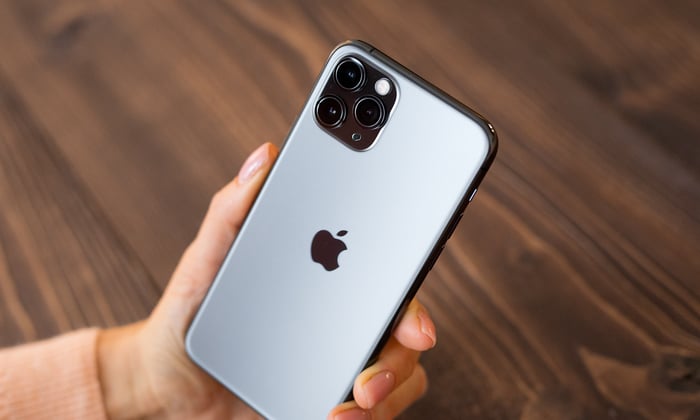
Image source: Getty Images.
Delays in data centers could open up more supply for Apple
Democrats took control of both the House and the Senate in this year's midterm election, paving the way for more federal regulation and policies that could curb the growth of AI. The more immediate impact, however, could come at the state level. Four of the biggest states for AI data center developments -- Texas, Ohio, Georgia, and Arizona -- will have Democratic governors once they're sworn in in January.
Many of those governors have announced plans to increase oversight and regulation of new data center construction (Texas did so even before Tuesday's election), aiming to mitigate any negative impacts on citizens. Venture Capitalist Brad Gerstner suggested that 25% to 35% of next year's data center build-out could be at risk of delays as a result of new governments across the country.
That could provide some relief for Apple. If data centers aren't going under construction, that means there's no place to put new server racks, and less demand for high-bandwidth memory chips. Reduced demand should put downward pressure on prices, limiting the impact of memory chip pricing on Apple's gross margin.
Apple management danced around whether it had already locked in pricing for some memory supply. All three major memory chipmakers, Micron, SK Hynix, and Samsung, have shifted to signing long-term agreements to establish pricing ranges and provide more confidence in building new capacity. While that caps their near-term upside, it protects them from a major price collapse as they work to increase the total supply of memory chips.
Management did reveal that it increased purchase commitments by $33 billion last quarter, but not all of that is necessarily related to memory chips. Still, reports indicate that Apple did sign long-term agreements for at least some memory chip supply to ensure it would have enough chips to meet its expected device demand.
Take the long view
In the grand scheme of things, the memory crunch could play only a minor role in Apple's long-term earnings growth. Supply and demand will eventually reach equilibrium again, and Apple should see its component prices and gross margin return to normal levels.
Earlier this year, I wrote that Apple is best positioned among consumer electronics device makers in the face of rising memory prices. It had the option to hold prices steady to grab market share or raise prices to exercise its pricing power. It chose the latter, and amid a supply shortage for its components, that's a smart move. In the long run, the higher prices will stick, but the higher bill of materials won't.
That points to rising gross margin over the long run, even if the short term could see some pressure on its bottom line. The potential relief from a moratorium on data center building is just another bump in that upward trajectory. (In this case, to the positive side).
Investors should remain focused on Apple's fundamentals. Its ability to raise prices, introduce new products on both the high end (iPhone Duo) and low end (MacBook Neo), grow its services business, and effectively keep customers in its ecosystem are the factors driving earnings growth. That should result in sustained free cash flow, most of which it will return to shareholders through buybacks and dividends.
Recent developments sent shares to new all-time highs last week following their post-earnings pullback. There's a reason investors are paying a premium for the stock right now. The future remains bright for the iPhone maker.
Should you buy stock in Apple right now?
Before you buy stock in Apple, consider this:
The Motley Fool Stock Advisor analyst team just identified what they believe are the 10 best stocks for investors to buy now… and Apple wasn’t one of them. The 10 stocks that made the cut could produce monster returns in the coming years.
Consider when Netflix made this list on December 17, 2004... if you invested $1,000 at the time of our recommendation, you’d have $341,966!* Or when Nvidia made this list on April 15, 2005... if you invested $1,000 at the time of our recommendation, you’d have $1,146,819!*
Now, it’s worth noting Stock Advisor’s total average return is 852% — a market-crushing outperformance compared to 203% for the S&P 500. Don't miss the latest top 10 list, available with Stock Advisor, and join an investing community built by individual investors for individual investors.
See the 10 stocks »
*Stock Advisor returns as of November 7, 2026.
Adam Levy has positions in Apple. The Motley Fool has positions in and recommends Apple and Micron Technology. The Motley Fool has a disclosure policy.
Recommended Articles


