


Stock-Split Watch: Is Meta Platforms Next?
Key Points
Meta Platforms is creating new Class C nonvoting shares that effectively create a 2-for-1 stock split.
The split increases the share pool without detracting from Mark Zuckerberg's voting control.
Investors shouldn't buy Meta for a stock split, but its viral Muse app is another story.
- 10 stocks we like better than Meta Platforms ›
Meta Platforms (NASDAQ: META) is officially on board the stock-split train. The artificial intelligence (AI) hyperscaler and social media giant formally announced plans to create a new, nonvoting Class C stock. It will do this via a stock dividend distributed from existing Class A and Class B shares. When the dust settles, the move is effectively a 2-for-1 stock split.
Sorry to ruin the suspense, but yes, Meta is the next big tech company to split its stock. What does that mean for existing shareholders, and does the split make Meta stock a buy now? Here's everything you need to know.
Missed Nvidia in 2009? This Rare Signal Is Flashing Again. In 2009, a "Double Down" signal flashed for a little-known chipmaker called Nvidia. For the first time in years, that same "Total Conviction" signal is flashing for a company 1/100th the size of Nvidia. Continue »

Image source: The Motley Fool.
The ins and outs of Meta's new stock split
Conventional stock splits are similar to slicing a pizza in more ways. The pizza itself remains the same size, but there are more, smaller slices to go around. It works the same for stock splits. The share price and per-share financials fall in proportion to the split ratio.
For instance, suppose you owned a share of company XYZ trading at $100 per share, with earnings per share of $10. Following a 2-for-1 split, you would instead own two shares trading at $50 each, each with earnings per share of $5.
Meta is essentially doing a 2-for-1 stock split by awarding one Class C share to shareholders for each Class A or Class B share they own. The value for Meta here is that this essentially creates a larger pool of stock it can award for stock-based compensation or other purposes, without diluting CEO Mark Zuckerberg's voting control over the company. This will go into effect on Jan. 19, 2027.
Here's the real reason to buy Meta Platforms stock
Remember, stock splits generally don't create value on their own. The pie, or Meta in this case, remains the same size overall. But there are some really good reasons to buy Meta Platforms, or, at the very least, to consider it one of the biggest long-term winners in the AI space.
First, Meta is one of the few AI companies that can internally fund its AI capital expenditures thanks to its massive digital advertising business and social media platforms. Meta is selling bonds to raise capital, but it's a big positive that debt is secondary funding rather than the primary lever.
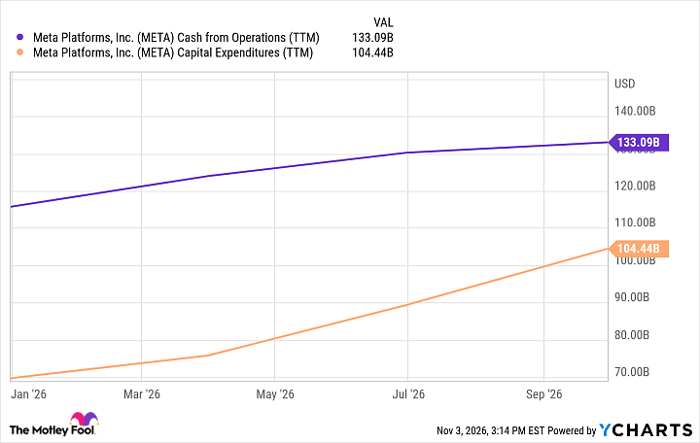
Data by YCharts.
Additionally, Meta may have found the breakthrough AI product it was searching for with Muse, its consumer AI agent app. Muse is always on and can perform tasks for users, including transactions. It went viral shortly after its launch and remains near the top of app stores.
Given Meta's strong finances and blossoming Muse app, it's hard not to like the company's prospects, split or no split.
Should you buy stock in Meta Platforms right now?
Before you buy stock in Meta Platforms, consider this:
The Motley Fool Stock Advisor analyst team just identified what they believe are the 10 best stocks for investors to buy now… and Meta Platforms wasn’t one of them. The 10 stocks that made the cut could produce monster returns in the coming years.
Consider when Netflix made this list on December 17, 2004... if you invested $1,000 at the time of our recommendation, you’d have $358,037!* Or when Nvidia made this list on April 15, 2005... if you invested $1,000 at the time of our recommendation, you’d have $1,229,708!*
Now, it’s worth noting Stock Advisor’s total average return is 897% — a market-crushing outperformance compared to 211% for the S&P 500. Don't miss the latest top 10 list, available with Stock Advisor, and join an investing community built by individual investors for individual investors.
See the 10 stocks »
*Stock Advisor returns as of November 6, 2026.
Justin Pope has positions in Meta Platforms. The Motley Fool has positions in and recommends Meta Platforms. The Motley Fool has a disclosure policy.
Recommended Articles


