


Qualcomm Drops Nearly 12% Pre-Market: Handset Chip Revenue Falls 26%, Profit Under Pressure as SpaceX 5G Deal Fails to Lift Shares
TradingKey - On November 5, Eastern Time, Qualcomm (QCOM) fell nearly 12% in premarket trading. As of press time, the stock was down 11.92% at $152.55.
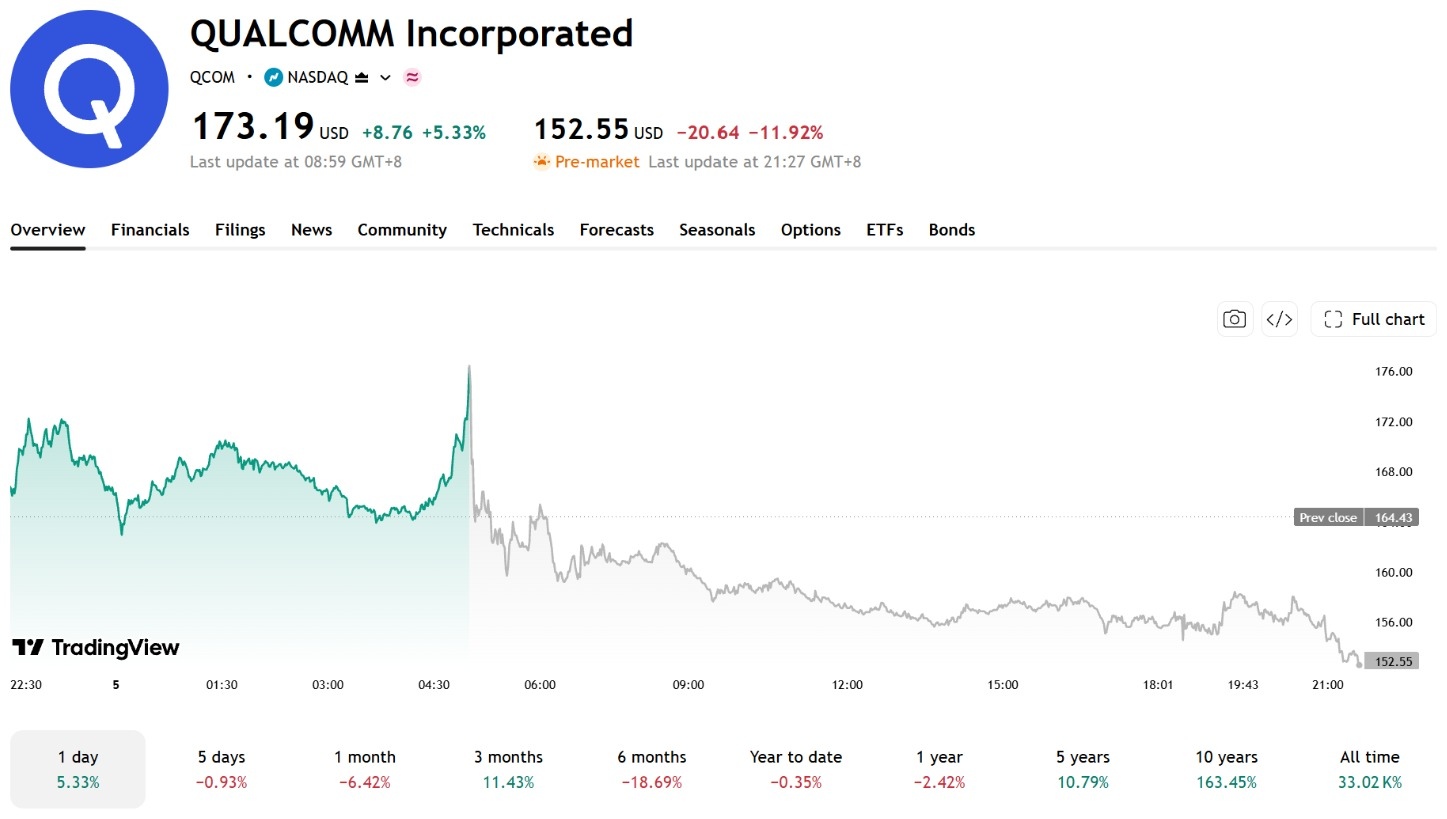
[Source: TradingView]
The company's latest earnings report showed that fourth-quarter handset chip revenue fell 26% year-over-year, as the smartphone business continued to face pressure. Meanwhile, rising memory chip and semiconductor manufacturing costs have brought its next-quarter earnings outlook into focus.
Although Qualcomm announced a multi-year 5G infrastructure partnership with SpaceX (SPCX), the project will not begin deployment until 2027 and is unlikely to contribute significant revenue in the short term.
Smartphone Chip Revenue Falls 26%, Dragging Down Overall Results
After the market close on November 4, Qualcomm reported its fourth-quarter fiscal 2026 financial results. GAAP revenue was $10.322 billion, down 8% year-over-year; non-GAAP revenue was $10.442 billion, down 7% year-over-year, and adjusted earnings per share was $2.17, down 28% year-over-year, slightly beating market expectations of $2.16.
By business segment, QCT handset chip revenue fell 26% year-over-year to $5.137 billion, while total QCT revenue fell 8% year-over-year to $9.015 billion. In comparison, automotive revenue reached $1.99 billion, up 89% year-over-year, setting a quarterly record.
The decline in handset revenue was primarily driven by tight global memory supply and rising prices. Qualcomm management stated that some handset makers consequently adjusted their production schedules and reduced inventory, impacting handset chip shipments.
Meanwhile, Apple's (AAPL) gradual shift to in-house modem chips will also put pressure on Qualcomm's future handset business.
Rising Storage Costs Weigh on Next-Quarter Earnings
Qualcomm stated that the semiconductor industry is facing rising cost pressures across wafer fabrication, assembly, testing, advanced packaging, and memory. The company has raised product prices to counter higher costs, but expects the benefits of these measures will not be fully reflected in QCT gross margin until the second half of fiscal 2027.
For the first quarter of fiscal 2027, Qualcomm expects revenue of $10.4 billion to $11.2 billion and non-GAAP earnings per share of $2.15 to $2.35.
As rising cost pressures have not yet fully eased and it will take time for the benefits of product price hikes to materialize, the market remains concerned about the company's near-term profitability.
SpaceX 5G Partnership Finalized With Limited Near-Term Revenue Contribution
On November 4, Qualcomm announced a multi-year partnership with SpaceX to supply its Dragonwing QRU100 and QDU100 platforms and Layer 1 software for the terrestrial 5G network Starlink Mobile is building in the U.S.
SpaceX plans to begin network deployment in 2027, covering tens of thousands of sites over the coming years. Qualcomm called this the company's largest 5G order to date, though neither party disclosed the contract value.
Elon Musk also publicly expressed his endorsement of Qualcomm's technology. On November 4, responding on X to Qualcomm CEO Cristiano Amon's partnership announcement, he stated: "Qualcomm’s technology is excellent."
Amon subsequently expressed his gratitude and said he looks forward to advancing future technology together.
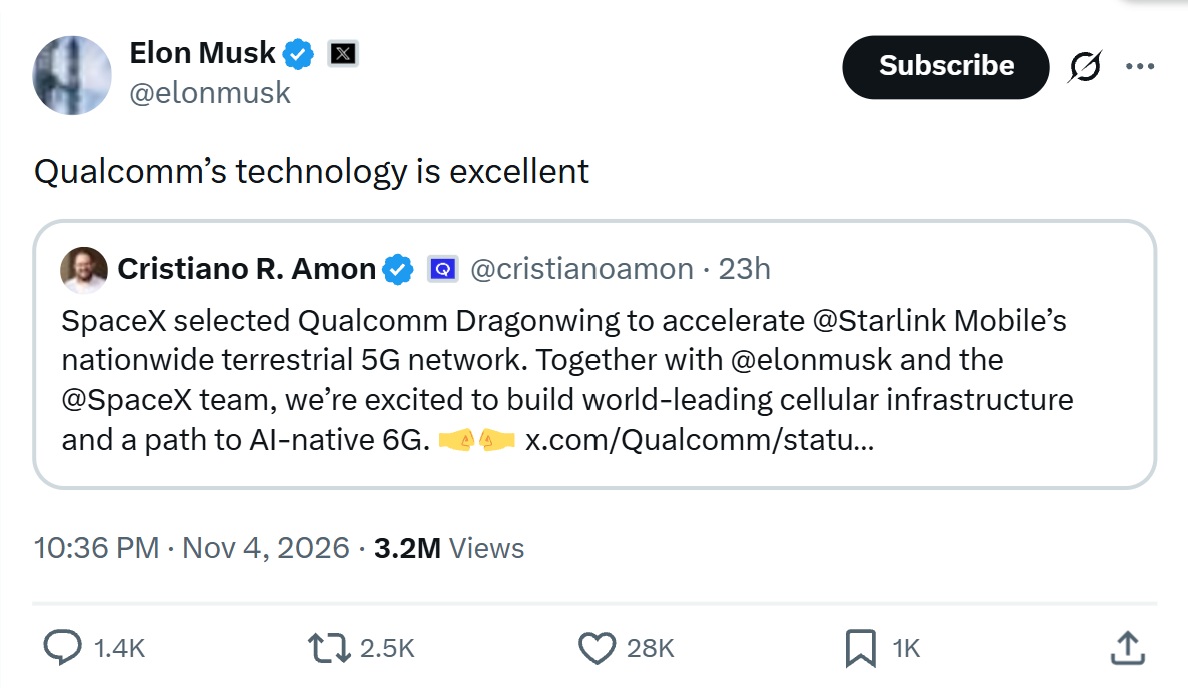
[Source: X]
However, this order is unlikely to generate substantial revenue in the short term. Amon stated during the earnings call that related revenue is expected to begin showing toward the end of fiscal 2027, with more revenue recognized in fiscal 2028. The partnership will also provide Qualcomm with opportunities to participate in future AI-native 6G infrastructure development.
In addition, Qualcomm is accelerating its expansion into the AI data center business. The company has partnered with Amazon AWS on multi-generation custom chips and optical communications technology, and reaffirmed its targets of reaching $5 billion in data center revenue in fiscal 2027 and $15 billion in fiscal 2029.
Meanwhile, the company expects non-handset revenue to grow by more than 60% year-over-year in fiscal 2027.
In the short term, a declining handset chip business and rising costs remain the primary pressures facing Qualcomm. Whether its automotive, AI data center, and communications infrastructure businesses can grow as planned will affect the company's progress in reducing its reliance on the smartphone market.
Recommended Articles


