


Ford's EV Losses Narrowed. Is the Turnaround Fool's Gold?
Key Points
While Ford's Model e division narrowed losses, it's fair to note that margins deteriorated further.
Ford's launch of its midsize electric pickup, the Fathom, will be a big next step for its Model e business.
Ford's break-even target for its Model e business remains at a more distant 2029.
- Motley Fool Issues Rare "Total Conviction" Buy Alert ›
Ford Motor Company (NYSE: F) investors finally have a little less red ink to stare at in the company's electric vehicle (EV) business. Whether that means an EV turnaround is taking shape is another question entirely, and there's a little evidence we'll get to later that could emphasize the turnaround is still down the road.
During the third quarter, Ford's Model e division narrowed its EBIT loss from $1.41 billion to $1.058 billion, a noticeable improvement of roughly 25%. And in raw figures, it's $352 million less in losses, which investors certainly won't complain about.
Missed Nvidia in 2009? This Rare Signal Is Flashing Again. In 2009, a "Double Down" signal flashed for a little-known chipmaker called Nvidia. For the first time in years, that same "Total Conviction" signal is flashing for a company 1/100th the size of Nvidia. Continue »
But before anyone starts polishing the turnaround trophy, there's a catch. Revenue declined even faster, falling 31% to approximately $1.2 billion. The smaller loss is real, but treating it as proof Ford has cracked EV profitability could be fool's gold. Let's dig in and look more closely at Ford's Q3 results.
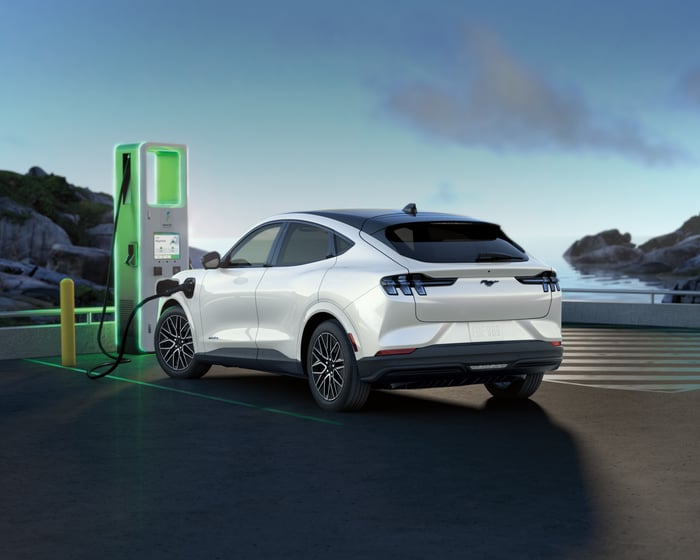
Image source: Ford Motor Company.
Look more closely
Ford attributed its progress to cost reductions and efforts to align its first-generation EV business with demand while investing in future products -- more on the latter, in a moment. For investors, it's pretty simple in that selling more vehicles isn't much of an accomplishment if the effort leaves shareholders with an even bigger financial headache.
In fact, Model e's EBIT margin deteriorated from negative 79.1% to negative 86.5% year over year. In other words, Ford's total Model e losses shrank, but those losses consumed a larger percentage of revenue. The takeaway is that investors shouldn't conflate a smaller total loss with a healthier operating margin or a stronger business segment.
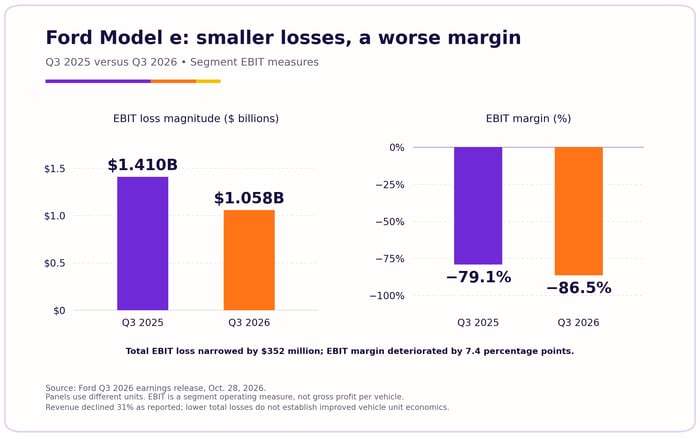
Data source: Ford's Q3 SEC filings. Graphic source: Author used ChatGPT for editing.
The bigger test is coming
For long-term investors, the more important development may be Ford's Fathom midsize electric pickup and the Universal EV platform underpinning it. Ford plans to launch Fathom in the fourth quarter of 2027. The company has announced a starting MSRP of $28,350 for the standard-range version, excluding taxes and fees. The platform also brings a redesigned manufacturing process, including large castings and three vehicle sections assembled separately before joining together. Ford intends that simpler approach to improve cost and quality.
For Ford to compete with EV rivals such as Tesla and Rivian Automotive as it drives toward profitability, an attractive sticker price is only part of the equation. Ford needs to attract EV customers at costs that leave room for profit, which hasn't always been a strength of Detroit automakers producing lower-priced vehicles. It's also partly why Ford has focused more on full-size trucks and SUVs and less on sedans, with the exception of the traditional Mustang, over the past decade.
Another note to remember is that Ford isn't only competing with pure EVs; it arguably has an edge over more traditional rivals such as General Motors when it comes to hybrids. Ford's CEO, Jim Farley, has previously noted that not only are many of its hybrids already profitable, they can even be more profitable than their gasoline-powered counterparts. With the conflict in the Middle East contributing to higher gas prices, more consumers have looked toward hybrids before full EVs.
Patience remains key for investors
Management expects higher expenses in 2027 and sees the next significant profitability improvement likely in the first half of 2028 as the Universal EV platform, and other developments such as Ford Energy, ramp up. Model e breakeven, however, remains a more distant 2029 target. That makes Fathom's launch a milestone and potential production breakthrough, rather than an instant financial boost.
For investors, watch launch readiness, production costs, customer demand, and the eventual margin trend. Today's smaller losses are welcome, but the real prize is Ford proving it can grow an EV business worth growing.
Should you buy stock in Ford Motor Company right now?
Before you buy stock in Ford Motor Company, consider this:
The Motley Fool Stock Advisor analyst team just identified what they believe are the 10 best stocks for investors to buy now… and Ford Motor Company wasn’t one of them. The 10 stocks that made the cut could produce monster returns in the coming years.
Consider when Netflix made this list on December 17, 2004... if you invested $1,000 at the time of our recommendation, you’d have $342,020!* Or when Nvidia made this list on April 15, 2005... if you invested $1,000 at the time of our recommendation, you’d have $1,270,017!*
Now, it’s worth noting Stock Advisor’s total average return is 885% — a market-crushing outperformance compared to 208% for the S&P 500. Don't miss the latest top 10 list, available with Stock Advisor, and join an investing community built by individual investors for individual investors.
See the 10 stocks »
*Stock Advisor returns as of November 4, 2026.
Daniel Miller has positions in Ford Motor Company and General Motors. The Motley Fool has positions in and recommends Tesla. The Motley Fool recommends General Motors. The Motley Fool has a disclosure policy.
Recommended Articles


