


Better AI Semiconductor Monopoly Stock: Taiwan Semiconductor vs. ASML
Key Points
The demand for ASML's machines has increased significantly, as they are used to manufacture advanced chips for AI applications.
TSMC is the world's largest semiconductor foundry, and it has a strong clientele that uses its advanced process nodes to make AI chips.
Both TSMC and ASML look like solid buys right now.
- Motley Fool Issues Rare "Total Conviction" Buy Alert ›
The semiconductor industry has experienced phenomenal growth in recent years, driven primarily by the rapid deployment of data centers capable of handling artificial intelligence (AI) workloads.
The Semiconductor Industry Association (SIA) notes that the semiconductor industry generated $439 billion in revenue in 2020, up 6.5% from the prior year. That figure jumped to $792 billion in 2025, increasing by nearly 26% from 2024. McKinsey estimates that the semiconductor industry could generate a whopping $2.3 trillion in revenue in 2030, well above the $1.6 trillion guidance issued a year ago.
Missed Nvidia in 2009? This Rare Signal Is Flashing Again. In 2009, a "Double Down" signal flashed for a little-known chipmaker called Nvidia. For the first time in years, that same "Total Conviction" signal is flashing for a company 1/100th the size of Nvidia. Continue »
This is great news for Taiwan Semiconductor Manufacturing (NYSE: TSM) and ASML Holding (NASDAQ: ASML), two of the most important companies in the semiconductor ecosystem. Both companies enjoy an almost monopoly like position in their respective semiconductor niches. But if you have to choose one of them for your portfolio right now, which one should it be?
Let's find out.
Image source: The Motley Fool.
TSMC and ASML sit at the top of the semiconductor supply chain
While TSMC is the world's largest semiconductor foundry, manufacturing chips for leading fabless chipmakers and consumer electronics companies, ASML makes the machines that help TSMC manufacture those chips.
ASML's extreme ultraviolet (EUV) lithography machines play a critical role in helping foundries and memory manufacturers make advanced chips based on small process nodes. These EUV machines use light to intricately print billions of transistors on a chip. The higher transistor density makes chips faster and more power-efficient, and chip designers can shrink the size of chips as well.
This explains why AI chip designers, such as Nvidia, Advanced Micro Devices, Broadcom, and others, are designing chips based on process nodes that are 5-nanometer (nm) or smaller. As a result, the demand for ASML's advanced chipmaking equipment has been growing at an incredible pace. The number of new lithography systems sold by ASML jumped by 71% year over year last quarter to 113.
ASML expects robust demand for its machines to continue. It plans to increase the production capacity of EUV machines by 30% next year and aims to expand capacity by more than 30% in 2028. So, ASML's strong growth momentum seems sustainable over the long run. The company's revenue increased by 55% year over year in Q3 to 11.66 billion euros, while net income increased by 133% from the year-ago period.
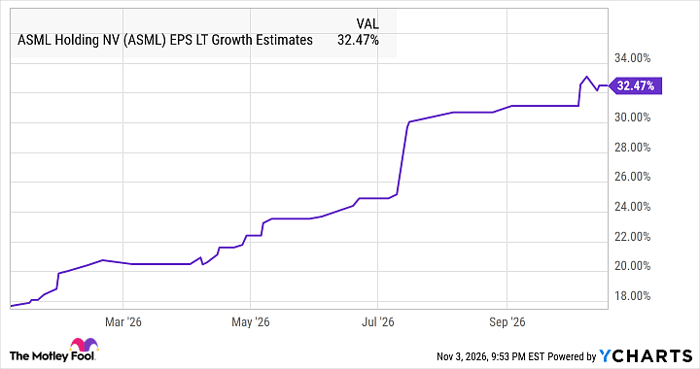
Given that ASML is the only manufacturer of EUV machines capable of producing advanced AI chips, it enjoys robust pricing power. Not surprisingly, ASML could capitalize on the strong demand and limited supply of its machines by raising prices, thereby supporting its earnings growth over the long run. That's why analysts have been becoming bullish about ASML's long-term earnings growth potential.
Data by YCharts
TSMC, on the other hand, is an ASML customer. The Taiwan-based foundry giant recently said it will use ASML's High NA EUV machines to increase the production of advanced chips. Moreover, TSMC sees an increase in the adoption of ASML's High NA EUV machines to meet the growing demand for AI chips.
It is easy to see why that's the case. TSMC gets the majority of its revenue from manufacturing advanced chips for its customers. Specifically, 79% of its revenue came from chips made using the 7nm process node or below in Q3. That was an improvement over the year-ago period's contribution of 74%. So, TSMC is likely to purchase more machines from ASML in the future to support its healthy growth.
TSMC's revenue increased by 41% year over year in Q3 to $46.7 billion. Moreover, the company controls 73% of the global foundry market, according to Counterpoint Research, well ahead of the second-placed company's 7% share. This monopoly like position allows TSMC to raise prices for its advanced chip nodes, especially given solid demand and tight supply.
This is why its net profit margin increased by 5.4 percentage points year over year in the previous quarter, leading to a 69% jump in earnings per share (EPS) to $29.43. So, both ASML and TSMC are clocking solid growth rates, which they can sustain over the long run due to the secular growth opportunity in semiconductors.
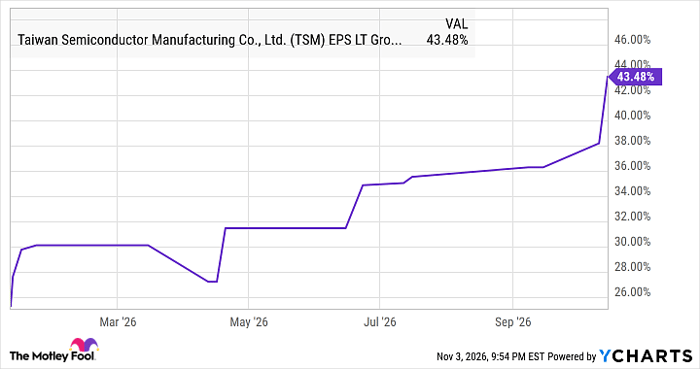
In fact, just like ASML, analysts have increased their long-term growth expectations for TSMC as well.
Data by YCharts
So, which stock should investors buy right now?
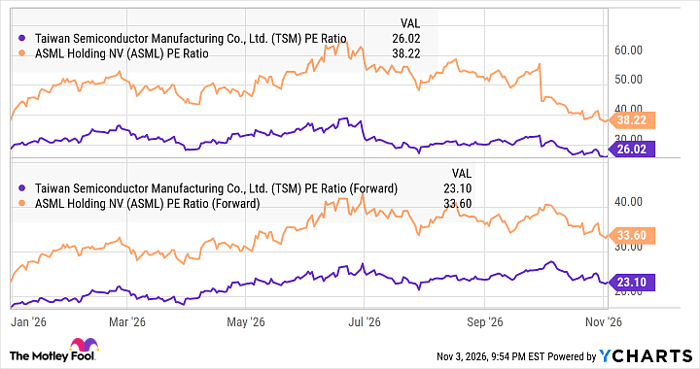
TSMC and ASML's dominant positions in their respective niches make both worth buying right now. However, we saw in the previous section that ASML is currently clocking much faster growth, and it can sustain the same by increasing the production capacity of its advanced EUV machines.
However, investors will have to pay a premium to buy ASML over TSMC.
Data by YCharts
The good part is that ASML can justify its valuation, especially considering its triple-digit earnings growth. However, investors seeking a mix of growth and value can consider buying TSMC. After all, even TSMC is growing at a nice pace, and analysts expect its earnings per share to increase at a 40%-plus rate over the long run.
In the end, investors won't go wrong with either ASML or TSMC, and choosing one of these two AI stocks depends on how much valuation they are willing to pay to make the most of the booming semiconductor industry.
Should you buy stock in ASML right now?
Before you buy stock in ASML, consider this:
The Motley Fool Stock Advisor analyst team just identified what they believe are the 10 best stocks for investors to buy now… and ASML wasn’t one of them. The 10 stocks that made the cut could produce monster returns in the coming years.
Consider when Netflix made this list on December 17, 2004... if you invested $1,000 at the time of our recommendation, you’d have $342,020!* Or when Nvidia made this list on April 15, 2005... if you invested $1,000 at the time of our recommendation, you’d have $1,270,017!*
Now, it’s worth noting Stock Advisor’s total average return is 885% — a market-crushing outperformance compared to 208% for the S&P 500. Don't miss the latest top 10 list, available with Stock Advisor, and join an investing community built by individual investors for individual investors.
See the 10 stocks »
*Stock Advisor returns as of November 4, 2026.
Harsh Chauhan has no position in any of the stocks mentioned. The Motley Fool has positions in and recommends ASML, Advanced Micro Devices, Broadcom, Nvidia, and Taiwan Semiconductor Manufacturing. The Motley Fool has a disclosure policy.
Recommended Articles


