

If a Bear Market Is Coming, Here's Exactly How I'm Preparing My Investment Portfolio

Source The Motley Fool

Key Points

  • Wall Street tends to think short-term, which can lead to excesses I want to avoid.

  • With investors worried about the AI bubble bursting, my focus now is on my investing basics (owning reliable dividend stocks), and yours should be too.

  • Motley Fool Issues Rare "Total Conviction" Buy Alert ›

According to some in the academic world, Wall Street is efficient. If you actually invest, however, you know that investors, as a group, are prone to short-term thinking and a get-rich-quick mentality. That highly irrational approach can lead the market to excesses on both the upside and the downside.

Wall Street has spent years heading higher, driven largely by technology stocks, but now investors are worried that new tech like artificial intelligence (AI) won't live up to expectations. If that's true, a bear market could be on the way. I'm preparing my portfolio by focusing on the same basics I always have: owning reliable dividend-paying stocks.

Missed AI’s "Act 1"? Act 2 Could Be 15x Bigger. Most investors think they missed the AI boat because they didn't buy Nvidia in 2005. But according to our analysts, we’re only at the end of "Act 1"—the R&D phase. "Act 2" is the global rollout. Continue »

A shadow of a bear looming over a person in a suit.

Image source: Getty Images.

I'm conservative by nature

To be honest, technology stocks aren't all that interesting to me. I own IBM (NYSE: IBM) and Texas Instruments (NASDAQ: TXN), both of which are industry bellwethers with impressive dividend track records. However, I bought each one while they were out of favor. The rest of my portfolio is focused on income-oriented sectors with reliable customer bases, such as utilities, real estate investment trusts (REITs), and consumer staples businesses. I own industry leaders like ute Southern Company (NYSE: SO), REIT Realty Income (NYSE: O), and consumer product maker Procter & Gamble (NYSE: PG).

As I look at the market today, fearing a downturn on the horizon, I'm paying extra attention to my core investment tenet: safety first. I don't want to make giant shifts; that's an emotional decision that will likely work against me over the long term. I want to stick to the core, and over the last month it appears that more and more investors are coming around to my conservative way of thinking. As the chart below highlights, the S&P 500 index (SNPINDEX: ^GSPC) has struggled, while utilities and consumer staples stocks have rallied. REITs have treaded water, but continue to provide a well-above-market yield.
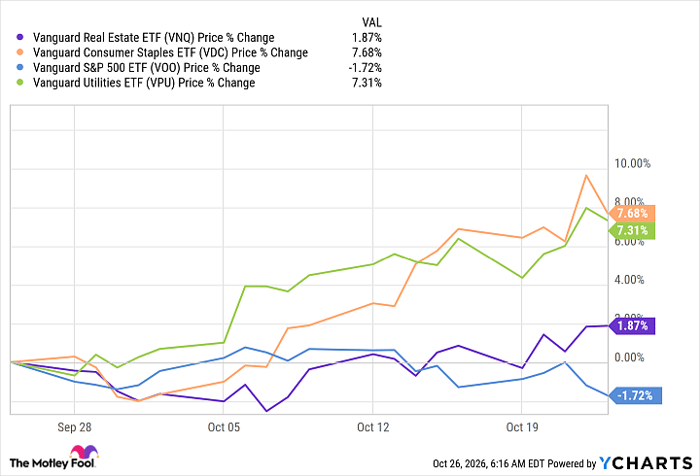
VNQ Chart

VNQ data by YCharts

Sectors go in and out of favor all the time, so I'm not expecting this trend to be permanent. But I consider the shifts taking shape a confirmation of the validity of my long-term approach. That helps me stay the course during periods of volatility.

You can't avoid bear markets

That said, when there's a bear market, everything tends to fall at once. So I know I can't avoid the impact of a deep downturn. However, I can do my best to soften the blow. And that's what sticking to my reliable dividend-paying stocks in boring sectors like utilities, consumer staples, and REITs lets me do.

To be fair, I was reminding myself of my safety-first income focus while I was being left behind during the tech-driven bull market, too. But now, as that bull market seems at risk, it is even more important for me to stick to my core, long-term investing tenets. Which really means that I'm not changing much at all about my portfolio right now. If you invest as I do, you should probably do the same.

Should you buy stock in Realty Income right now?

Before you buy stock in Realty Income, consider this:

The Motley Fool Stock Advisor analyst team just identified what they believe are the 10 best stocks for investors to buy now… and Realty Income wasn’t one of them. The 10 stocks that made the cut could produce monster returns in the coming years.

Consider when Netflix made this list on December 17, 2004... if you invested $1,000 at the time of our recommendation, you’d have $344,608!* Or when Nvidia made this list on April 15, 2005... if you invested $1,000 at the time of our recommendation, you’d have $1,327,222!*

Now, it’s worth noting Stock Advisor’s total average return is 904% — a market-crushing outperformance compared to 211% for the S&P 500. Don't miss the latest top 10 list, available with Stock Advisor, and join an investing community built by individual investors for individual investors.

See the 10 stocks »

*Stock Advisor returns as of October 28, 2026.

Reuben Gregg Brewer has positions in International Business Machines, Procter & Gamble, Realty Income, Southern Company , and Texas Instruments. The Motley Fool has positions in and recommends International Business Machines, Realty Income, and Texas Instruments. The Motley Fool has a disclosure policy.

Disclaimer: For information purposes only. Past performance is not indicative of future results.
placeholder
The Fed will sit still on October 28 — but 100 of 100 economists now expect a December hikeA Reuters poll run October 16-20 found 94 of 100 economists expecting the Fed to hold at 3.75-4.00% on October 28 — and all 100 expecting a hike in December, against less than half a month earlier. The market is close to the same price, with CME FedWatch at roughly 17% for October and 82.8% for December. With the Fed in blackout since October 17, here are the five dates that decide the rest of the year, what each one is priced for, and the two directions each can take.
Author  Irene Q.
Oct 22, Thu
A Reuters poll run October 16-20 found 94 of 100 economists expecting the Fed to hold at 3.75-4.00% on October 28 — and all 100 expecting a hike in December, against less than half a month earlier. The market is close to the same price, with CME FedWatch at roughly 17% for October and 82.8% for December. With the Fed in blackout since October 17, here are the five dates that decide the rest of the year, what each one is priced for, and the two directions each can take.
placeholder
Big Tech's $800 billion AI bill faces its first real test — free cash flow is the judgeAlphabet and Microsoft report after the close on October 28, Amazon on October 29, with hyperscaler AI capex running near $800 billion a year. Meta's negative free cash flow and 9.40% drop on October 22 was the warning; this week's prints decide whether cloud growth and backlog can pay for the buildout. Here are the consensus numbers, the free-cash-flow table and the two-sided test.
Author  Irene Q.
Oct 26, Mon
Alphabet and Microsoft report after the close on October 28, Amazon on October 29, with hyperscaler AI capex running near $800 billion a year. Meta's negative free cash flow and 9.40% drop on October 22 was the warning; this week's prints decide whether cloud growth and backlog can pay for the buildout. Here are the consensus numbers, the free-cash-flow table and the two-sided test.
placeholder
Tesla jumps 5% as Barclays puts a $450 target on the SpaceX merger — the chart was already pointing to 431Tesla closed at $391.62 on October 26, up 5.21%, after Barclays upgraded the stock to Overweight and lifted its target to $450 from $370, citing a sharp inflection in Robotaxi miles and a potential SpaceX merger. The move also completed a double bottom at $345.88 and $349.33, with a neckline at $388.56 and a measured target of $431.24. Here is what the upgrade actually says, why the chart and the analyst now point the same way, and what would break the target.
Author  Irene Q.
Yesterday 05: 30
Tesla closed at $391.62 on October 26, up 5.21%, after Barclays upgraded the stock to Overweight and lifted its target to $450 from $370, citing a sharp inflection in Robotaxi miles and a potential SpaceX merger. The move also completed a double bottom at $345.88 and $349.33, with a neckline at $388.56 and a measured target of $431.24. Here is what the upgrade actually says, why the chart and the analyst now point the same way, and what would break the target.
placeholder
Anthropic files for a $2 trillion IPO — the $80.7 billion loss is the decoy, the $450 billion compute bill is the riskAnthropic publicly filed its S-1 on October 26, revealing $16.29 billion of first-half revenue (+1,304% year over year) and a $80.7 billion net loss — of which $72.4 billion is a non-cash convertible-note charge. The real number is the $450 billion of signed, mostly non-cancelable compute commitments. Here is what the filing says, why NVDA, ARM and MU are the tradeable read-through, and the conditions that decide whether the AI trade passes its first public valuation test.
Author  Irene Q.
Yesterday 06: 02
Anthropic publicly filed its S-1 on October 26, revealing $16.29 billion of first-half revenue (+1,304% year over year) and a $80.7 billion net loss — of which $72.4 billion is a non-cash convertible-note charge. The real number is the $450 billion of signed, mostly non-cancelable compute commitments. Here is what the filing says, why NVDA, ARM and MU are the tradeable read-through, and the conditions that decide whether the AI trade passes its first public valuation test.
placeholder
Fed October Rate Decision Preview: Rate Hike Pause Has Become Consensus, How Will US Stocks, Dollar, and Gold React?The Federal Reserve will announce its October interest rate decision at 14:00 Eastern Time on October 28, and Fed Chair Warsh will hold a press conference at 14:30. Markets currently wide
Author  TradingKey
Yesterday 10: 21
The Federal Reserve will announce its October interest rate decision at 14:00 Eastern Time on October 28, and Fed Chair Warsh will hold a press conference at 14:30. Markets currently wide
goTop
quote