


5 Stocks Poised to Win Big as SpaceX Ramps Up AI Infrastructure
Key Points
Nvidia will see a big win from SpaceX's AI infrastructure spending, as will its HBM supplier, SK Hynix, and interconnect supplier, Amphenol.
Vertiv should benefit from SpaceX citing cooling and power management infrastructure as major bottlenecks.
TSMC will benefit from SpaceX's increased spending in 2027, although the long term is still up in the air.
- 10 stocks we like better than Nvidia ›
Space Exploration Technologies (NASDAQ: SPCX) just upped the ante in the artificial intelligence (AI) infrastructure race, planning to increase its computing capacity by about 10 gigawatts next year, with a moonshot goal of boosting it by 20 gigawatts. That's a huge amount of spending, with Nvidia (NASDAQ: NVDA), SK Hynix (NASDAQ: SKHY), Vertiv (NYSE: VRT), Amphenol (NYSE: APH), and Taiwan Semiconductor Manufacturing (NYSE: TSM) among the biggest beneficiaries.
Let's look at how each of these artificial intelligence stocks could benefit.
Missed AI’s "Act 1"? Act 2 Could Be 15x Bigger. Most investors think they missed the AI boat because they didn't buy Nvidia in 2005. But according to our analysts, we’re only at the end of "Act 1"—the R&D phase. "Act 2" is the global rollout. Continue »
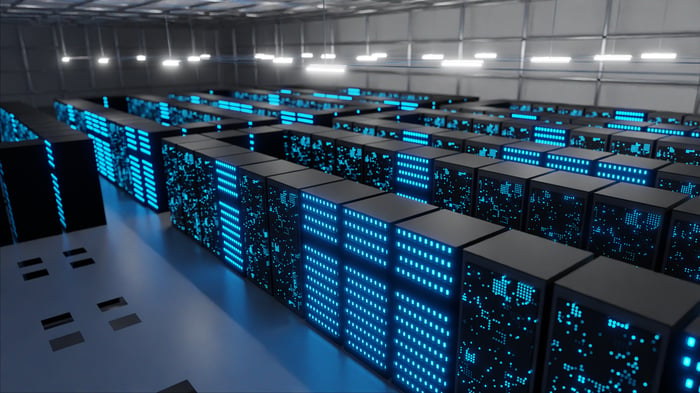
Image source: Getty Images.
1. Nvidia
Nvidia will be the biggest beneficiary of SpaceX's AI infrastructure spree. SpaceX will build its data centers exclusively using Nvidia's Vera Rubin architecture, which means the semiconductor company will supply virtually all the chips and networking for this enormous build-out.
Nvidia gets roughly $40 billion per gigawatt from Vera Rubin, so this could be a $400 billion-plus revenue boost if it doesn't take capacity away from other customers. The current analyst average estimate is for Nvidia to generate roughly $412 billion in revenue this fiscal year (ending January 2027), so this would be a gigantic one-year order from SpaceX.
2. SK Hynix
Without high bandwidth memory (HBM), Nvidia's ultra-expensive graphics processing units (GPUs) can't deliver their full potential in handling AI workloads. As such, HBM has become essential to the AI build-out. However, HBM is currently in short supply, and memory companies' ability to quickly increase supply is limited by their capacity to purchase more extreme ultraviolet (EUV) lithography machines, which are used to make the critical components in both HBM and advanced logic chips, such as GPUs and central processing units (CPUs). This has resulted in a major supply-demand imbalance across the entire memory market, leading to skyrocketing prices across the board.
SK Hynix (NASDAQ: SKHY), meanwhile, looks to be the memory company most likely to benefit from SpaceX's increased AI infrastructure spending, as it is the HBM leader with more than 50% market share and a close relationship with Nvidia. The two companies already have a $500 billion long-term supply deal in place, and SpaceX's spending will only increase demand for HBM and memory in an already constrained market.
3. Vertiv
AI data centers require substantial power delivery and heat removal, which is where Vertiv comes in, providing data center cooling and power management infrastructure. On its Q3 earnings call, SpaceX cited cooling and power as one of the biggest bottlenecks the industry faces. However, it said it has a plan to get to 20 gigawatts of power and cooling equipment by the end of next year.
Although it is not confirmed that Vertiv is a direct supplier to SpaceX's AI data centers, the company should at the very least benefit from increased industry demand in another AI infrastructure market currently facing supply shortages.
4. Amphenol
Amphenol provides power distribution hardware and interconnects that allow data centers to operate at high speeds. Although the company has a wide customer base across industries, data centers are its largest market. Amphenol is a key supply partner to Nvidia and provides important components for Nvidia's Vera Rubin NVL72 system.
The stock is a favorite of Evercore ISI, and analyst Amit Daryanani recently highlighted the company as one of the biggest potential winners from SpaceX's planned AI computing capacity.
5. Taiwan Semiconductor Manufacturing
Any increase in AI infrastructure capital expenditure is generally good news for Taiwan Semiconductor Manufacturing. The company has a virtual monopoly in manufacturing advanced logic chips, including Nvidia's GPUs and CPUs. As such, SpaceX's significant spending on AI infrastructure next year will be beneficial.
The bigger long-term question will be the impact of SpaceX and Tesla's huge planned chip manufacturing facility, Terafab. Elon Musk has said it could start producing chips in volume by Q3 2028, although his track record with timeline predictions isn't the best. TSMC and Musk have talked about TSMC getting involved in the project, but there seems to be a disagreement over who would run the facility. As such, SpaceX's spending will benefit TSMC in 2027, but over the longer term, it's still up in the air.
Should you buy stock in Nvidia right now?
Before you buy stock in Nvidia, consider this:
The Motley Fool Stock Advisor analyst team just identified what they believe are the 10 best stocks for investors to buy now… and Nvidia wasn’t one of them. The 10 stocks that made the cut could produce monster returns in the coming years.
Consider when Netflix made this list on December 17, 2004... if you invested $1,000 at the time of our recommendation, you’d have $344,608!* Or when Nvidia made this list on April 15, 2005... if you invested $1,000 at the time of our recommendation, you’d have $1,327,222!*
Now, it’s worth noting Stock Advisor’s total average return is 904% — a market-crushing outperformance compared to 211% for the S&P 500. Don't miss the latest top 10 list, available with Stock Advisor, and join an investing community built by individual investors for individual investors.
See the 10 stocks »
*Stock Advisor returns as of October 28, 2026.
Geoffrey Seiler has no position in any of the stocks mentioned. The Motley Fool has positions in and recommends Amphenol, Evercore, Nvidia, Taiwan Semiconductor Manufacturing, Tesla, and Vertiv. The Motley Fool has a disclosure policy.
Recommended Articles


