


ASML vs. Dell Technologies: Which Tech Stock Is a Better Buy in 2026?
Key Points
ASML maintains a monopoly on the extreme ultraviolet lithography machines required to produce the world's most advanced semiconductors.
Dell Technologies is successfully pivoting toward the artificial intelligence era with a growing portfolio of AI-optimized servers and strategic software partnerships.
Which of these tech giants offers the better balance of growth and valuation for your 2026 portfolio?
- Motley Fool Issues Rare "Total Conviction" Buy Alert ›
As the artificial intelligence boom shifts from speculative hype into tangible infrastructure, investors are weighing the merits of chip equipment titan ASML (NASDAQ:ASML) versus hardware giant Dell Technologies (NYSE:DELL).
ASML provides the critical lithography machines required to manufacture the world's most advanced chips. Dell provides the enterprise servers and storage solutions that put those chips to work. While both benefit from increased computing demand, they offer different levels of profitability and valuation for those building a portfolio today.
The case for ASML
ASML produces the lithography systems required to print the intricate patterns that form integrated circuits. As ASML continues to dominate the production of equipment for semiconductor stocks, its strategic importance grows. The company holds a monopoly on extreme ultraviolet (EUV) lithography, a technology necessary for manufacturing the most advanced chips currently in production.
In the fiscal year ended Dec. 31, 2025, revenue reached nearly $36.7 billion, representing growth of approximately 15.6% compared with the prior year. This revenue surge supported net income of roughly $10.8 billion. The stock's P/S ratio, which measures the company's market value against its sales over the past 12 months, reflects its premium position in the industry.
As of its December 2025 balance sheet, ASML maintained a healthy debt-to-equity ratio of 0.2. This ratio measures total debt relative to shareholders' equity, with a lower number indicating less reliance on borrowed money. The company also reported a current ratio of 1.3, which compares short-term assets to short-term liabilities. Free cash flow reached nearly $12.4 billion, which equals cash flow from operations minus capital expenditures.
The case for Dell Technologies
Dell Technologies provides the essential hardware infrastructure that powers modern data centers and corporate offices. Its product line includes AI-optimized servers, storage solutions, and personal computers. The company recently entered into a strategic collaboration with Broadcom (NASDAQ:AVGO) to integrate sophisticated software solutions into its hardware. A significant portion of AI-server revenue comes from a small group of cloud providers, and such customer concentration adds a layer of risk to the business.
In the fiscal year ended Jan. 30, 2026, revenue reached approximately $113.5 billion, an increase of roughly 18.8% year over year. The company reported net income of close to $5.9 billion for the period.
As of its January 2026 balance sheet, Dell reported a debt-to-equity ratio of -12.8, indicating that its total liabilities exceed its shareholder equity. Its current ratio was approximately 0.9. Free cash flow for the fiscal year was roughly $8.6 billion. This cash flow figure represents the money a company generates after accounting for the cash spent to maintain its business and assets.
Risk profile comparison
ASML faces significant geopolitical risks, particularly regarding export restrictions on its high-end lithography equipment. Since its machines are vital for national security and technological leadership, government policies can limit which countries it can sell to. Additionally, the semiconductor industry is cyclical, and any slowdown in global chip demand could lead to reduced orders for its expensive hardware.
Dell Technologies faces risks related to revenue concentration, as a small number of large cloud providers and enterprise customers account for a large share of AI-optimized server sales. This reliance makes the company vulnerable to pricing pressure and inconsistent order patterns. Furthermore, Dell is navigating a $70 million lawsuit from XTX Markets concerning alleged server price increases. Competition from cloud providers that design their own hardware also poses a threat to long-term sales.
Valuation comparison
Investors must choose between a high-margin equipment leader and a high-volume hardware provider with a more accessible entry price.
| Metric | ASML | Dell Technologies |
|---|---|---|
| Forward P/E | 35.8 | 17.6 |
| P/S ratio | 14.4 | 1.9 |
Valuation metrics include sourcing from Financial Modeling Prep (FMP) and may differ from other data providers.
Which stock would I buy in 2026?
Dell has handily outperformed ASML over the past several years since returning to the public markets (although past performance is no indication of future results):
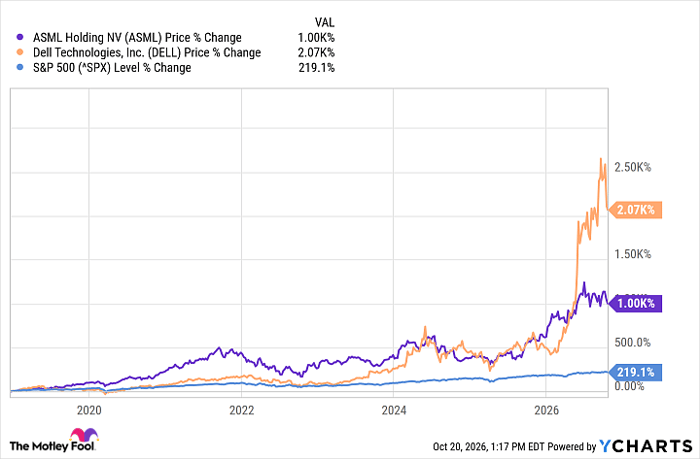
ASML data by YCharts
Dell is also much less expensive than ASML. Both companies pay a modest dividend. However, I'm not convinced Dell has the same level of moat that ASML does. The Dutch company provides the sophisticated lithography equipment that's absolutely necessary for manufacturing advanced semiconductors, and it's the only player in the space. Dell doesn't have any such unique offerings; there is nothing keeping its customers from turning to competitors or choosing to design their own hardware in-house. So I think ASML's premium is more than justified.
Furthermore, ASML has a much more attractive profit margin:
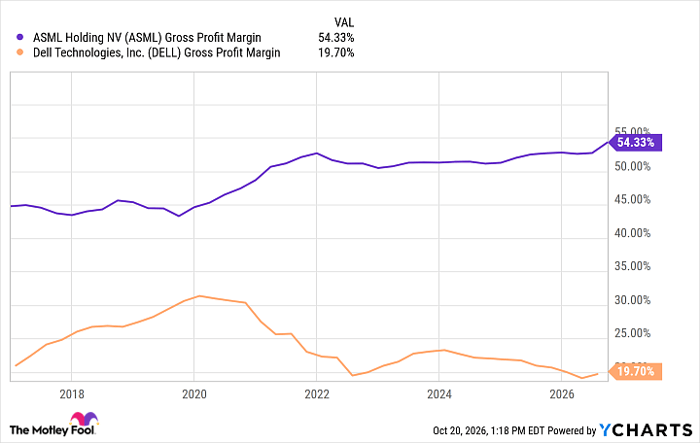
ASML Gross Profit Margin data by YCharts
Thanks to its dominance in extreme ultraviolet lithography, it has strong pricing power. Dell stock may have posted better returns over the past five years, but I am not convinced it has the moat or pricing power that ASML does. ASML looks like the better buy to me.
Missed AI’s "Act 1"? Act 2 Could Be 14x Bigger
Most investors think they missed the AI boat because they didn't buy Nvidia in 2005.
But according to our analysts, we’re only at the end of "Act 1"—the R&D phase. "Act 2" is the global rollout, a massive technology build-out that Google’s CEO says could be more profound than fire or electricity.
While everyone watches the chip designers, one "backbone" company provides the critical technology that Nvidia and AMD literally cannot function without. We’ve detailed this under-the-radar player in our new AI Playbook.
Continue »
Erin Kennedy has no position in any of the stocks mentioned. The Motley Fool has positions in and recommends ASML and Broadcom. The Motley Fool has a disclosure policy.
Recommended Articles


