


General Mills Stock Is Down 30%, and Wall Street Analysts Keep Cutting Their Price Targets. Here's Why History Says They're Missing the Bigger Picture.
Key Points
General Mills is a large and well-respected packaged food company.
The consumer staples icon has faced difficult periods before and survived in its over 100-year history.
General Mills is working to adapt to changing consumer tastes while also addressing rising costs.
- 10 stocks we like better than General Mills ›
Shares of General Mills (NYSE: GIS) are down around 30% over the past year. That's way worse than the average consumer staples stock, which is up nearly 10% over the same span. Wall Street is very downbeat on General Mills right now. While no analyst cut its rating on the company after it reported fiscal first-quarter 2027 earnings, only three analysts rate it a buy.
But if history is any guide, the food maker will eventually get back on track. Here's why you may want to buy it despite Wall Street's negative view.
Missed Nvidia in 2009? This Rare Signal Is Flashing Again. In 2009, a "Double Down" signal flashed for a little-known chipmaker called Nvidia. For the first time in years, that same "Total Conviction" signal is flashing for a company 1/100th the size of Nvidia. Continue »

Image source: Getty Images.
What's wrong with General Mills?
From a big-picture perspective, General Mills is dealing with the same basic issues as every other consumer staples company. Consumer buying habits are changing, inflation is causing consumers to tighten their belts, and inflation is increasing company costs. It is a very difficult period, and General Mills has been struggling.
For example, in the first quarter of fiscal 2027, the company's sales fell 3%, and its organic sales were flat. Still, that's actually an improvement from 2026, when the company's sales fell 5%, and organic sales were off by 2%. But it wasn't enough of a change to get Wall Street analysts back on board, with Bank of America (NYSE: BAC) and Evercore ISI actually cutting their price targets.
That said, there was some good news in the quarter. For example, the company's food service and international businesses benefited from sales growth in the quarter. Meanwhile, management highlights that flat organic sales growth suggests the business is stabilizing overall. But it would be hard to argue that the company isn't still struggling. However, that's not the worst thing in the world for long-term dividend investors.
General Mills is a survivor
The simple truth is that no company as long-established as General Mills, which traces its history back to the mid-1800s, can avoid hard times. The real question for long-term investors is: how does a company like General Mills handle hard times? The answer is by adjusting.
In fact, fiscal 2026 was a very big transition year for the food maker. It realized that its pricing was out of line with peers and consumer spending levels, and it cut prices. That was a key reason why the year was so bad, financially speaking. The truth is, despite the weak top line, General Mills' fiscal first-quarter 2027 results were stronger than it expected. In addition, the company has been working to reduce costs and modernize its brands to better meet consumer taste preferences. These are all of the things you would expect a well-run company to do.
General Mills isn't likely to go out of business anytime soon. The real risk is the dividend, noting that adjusted fiscal first-quarter 2027 earnings of $0.75 per share leads to a payout ratio of roughly 80%, given its $0.61 per share dividend. That's a little high, which is why the dividend is being held steady while the company works through this difficult period.
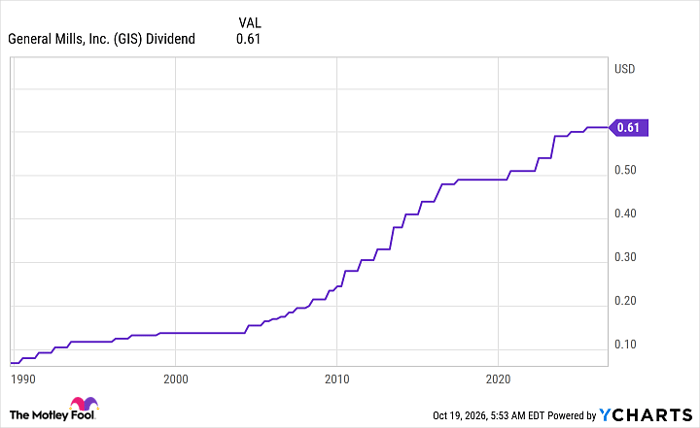
GIS Dividend data by YCharts
That's a dividend warning sign, but one that needs to be taken with a grain of salt. General Mills has held the dividend steady before during difficult periods and resumed increases after the trouble has passed. Right now, the company is focusing on reducing leverage and adjusting its business to the current environment. But according to management, the dividend remains a key focus. Given the history here, it is probably worth giving management the benefit of the doubt.
General Mills is paying you well to wait
The truth is, General Mills isn't going to turn its business around overnight. You should be prepared to make a long-term commitment if you buy it today. However, with a 7.3% yield, you are getting paid very well to wait. And while the payout ratio is a bit high, there is still wiggle room before a cut is likely to be on the table. The one caveat is that a new CEO will take over at the start of 2027. However, that CEO is a 27-year veteran of General Mills, so it is likely that the company's approach won't change much, and neither will its commitment to its dividend.
Should you buy stock in General Mills right now?
Before you buy stock in General Mills, consider this:
The Motley Fool Stock Advisor analyst team just identified what they believe are the 10 best stocks for investors to buy now… and General Mills wasn’t one of them. The 10 stocks that made the cut could produce monster returns in the coming years.
Consider when Netflix made this list on December 17, 2004... if you invested $1,000 at the time of our recommendation, you’d have $376,696!* Or when Nvidia made this list on April 15, 2005... if you invested $1,000 at the time of our recommendation, you’d have $1,333,920!*
Now, it’s worth noting Stock Advisor’s total average return is 925% — a market-crushing outperformance compared to 212% for the S&P 500. Don't miss the latest top 10 list, available with Stock Advisor, and join an investing community built by individual investors for individual investors.
See the 10 stocks »
*Stock Advisor returns as of October 20, 2026.
Bank of America is an advertising partner of Motley Fool Money. Reuben Gregg Brewer has positions in General Mills. The Motley Fool has no position in any of the stocks mentioned. The Motley Fool has a disclosure policy.
Recommended Articles


