


Should You Buy the iShares Semiconductor ETF After Its 25% Plunge? The Answer Might Surprise You.
Key Points
The iShares Semiconductor ETF is invested in 30 of America's top suppliers of artificial intelligence chips and components.
The ETF is down 25% from its June peak, as investors start pricing in a potential slowdown in the data center spending boom.
Despite the recent volatility, the ETF has still delivered market-beating returns since it was established in 2001.
- 10 stocks we like better than iShares Trust - iShares Semiconductor ETF ›
The iShares Semiconductor ETF (NASDAQ: SOXX) is an exchange-traded fund (ETF) that exclusively invests in American companies that design, manufacture, and distribute chips and components, with a particular focus on those powering the artificial intelligence (AI) revolution.
The ETF peaked at $655.01 per share in June, and it has since plummeted by 25% (as of the market close last Friday, Oct. 16) on concerns about the sustainability of the AI data center spending boom.
Missed Nvidia in 2009? This Rare Signal Is Flashing Again. In 2009, a "Double Down" signal flashed for a little-known chipmaker called Nvidia. For the first time in years, that same "Total Conviction" signal is flashing for a company 1/100th the size of Nvidia. Continue »
However, the ETF is still sitting on a year-to-date gain of 63%, and it has consistently produced market-beating returns since it was established in 2001. So, should investors buy the dip? Read on for the surprising answer.

Image source: Getty Images.
Semiconductor stocks have been on a tear since early 2023
The iShares Semiconductor ETF holds 30 of America's most prominent semiconductor stocks, but it's quite top-heavy with its five largest holdings representing 40.5% of the value of its entire portfolio.
|
Stock |
iShares ETF Portfolio Weighting |
|---|---|
|
1. Advanced Micro Devices |
9.42% |
|
2. Intel Corporation |
8.40% |
|
3. Nvidia |
7.76% |
|
4. Micron Technology |
7.66% |
|
5. Broadcom |
7.33% |
Data source: iShares. Portfolio weightings are accurate as of Oct. 15, 2026, and are subject to change.
AMD and Nvidia supply some of the world's best graphics processing units (GPUs) for data centers, which are the main chips used in AI training and inference workloads. Broadcom is competing with them by helping customers design and fabricate custom AI accelerators, a type of data center processor that can be tailored to specific AI models.
Micron Technology, on the other hand, is one of the world's top suppliers of high-bandwidth memory (HBM), which sits alongside GPUs to keep data flowing smoothly. Without HBM, AI chatbots wouldn't be able to consistently provide instantaneous responses, nor would AI agents be able to automate tasks effectively.
All of the abovementioned companies have experienced more demand than they could possibly supply for their chips and components over the last few years, giving them an unprecedented ability to dictate prices, which boosted their profit margins. As a result, they have produced blistering returns for shareholders since the AI boom started gathering momentum in early 2023.
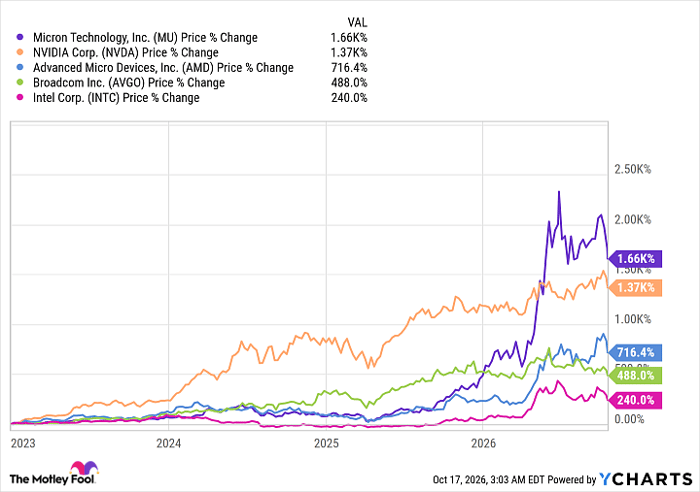
MU data by YCharts
Prior to the AI boom, the iShares Semiconductor ETF has benefited from a range of other technological revolutions including the dawn of the smartphone, and the widespread adoption of enterprise software and cloud computing. As a result, it has delivered a compound annual return of 14.7% since it was established in 2001, crushing the S&P 500 which returned an average of 8.9% per year over the same period.
Looking ahead, forecasts for the AI boom remain strong. According to Nvidia, the top five hyperscale companies alone (which includes Amazon, Microsoft, and Alphabet) are on track to spend nearly $800 billion on data center infrastructure in 2026, and they could spend a further $1.3 trillion in 2027.
Several risks could derail those forecasts
There are mounting concerns that AI demand might actually be weaker than expected. Last week, Anthropic revealed its third-quarter financial results to select investors, and while revenue came in at a record $16.8 billion, its sequential growth rate appeared to decelerate. As a result, the company could attract a valuation of $1.5 trillion at its upcoming initial public offering (IPO), down from previous expectations of $2 trillion. This might affect how much money it can raise from investors.
To make matters worse, Australian AI data center company, Firmus, cancelled its IPO two weeks ago because of weak investor demand. It was trying to raise $5 billion to build more infrastructure across Australasia. Moreover, major data center operators like CoreWeave and Oracle have seen their borrowing costs surge recently, so they might struggle to raise additional funding going forward.
If these companies can't access the money they need to build more infrastructure and buy more chips, the semiconductor industry is going to experience a sharp drop in demand. That's a massive problem because AMD chief executive Lisa Su recently said her company will substantially increase supply in 2027, while at the same time Micron, SK Hynix and Samsung are racing to build new memory production facilities in the U.S.
More production capacity will put downward pressure on prices, which could lead to lower profit margins, and weak demand will only magnify those effects. Since earnings drive stock prices, this spells bad news for the iShares Semiconductor ETF.
As a result, while this ETF could be a great buy for investors who are willing to hold it for a long-term period of five to 10 years, they might have to endure significant downside in the near term. Therefore, it's probably a good idea to wait on the sidelines until the dust settles before taking a position.
Should you buy stock in iShares Trust - iShares Semiconductor ETF right now?
Before you buy stock in iShares Trust - iShares Semiconductor ETF, consider this:
The Motley Fool Stock Advisor analyst team just identified what they believe are the 10 best stocks for investors to buy now… and iShares Trust - iShares Semiconductor ETF wasn’t one of them. The 10 stocks that made the cut could produce monster returns in the coming years.
Consider when Netflix made this list on December 17, 2004... if you invested $1,000 at the time of our recommendation, you’d have $380,363!* Or when Nvidia made this list on April 15, 2005... if you invested $1,000 at the time of our recommendation, you’d have $1,315,732!*
Now, it’s worth noting Stock Advisor’s total average return is 919% — a market-crushing outperformance compared to 211% for the S&P 500. Don't miss the latest top 10 list, available with Stock Advisor, and join an investing community built by individual investors for individual investors.
See the 10 stocks »
*Stock Advisor returns as of October 20, 2026.
Anthony Di Pizio has no position in any of the stocks mentioned. The Motley Fool has positions in and recommends Advanced Micro Devices, Alphabet, Amazon, Broadcom, Intel, Micron Technology, Microsoft, Nvidia, Oracle, and iShares Trust-iShares Semiconductor ETF. The Motley Fool has a disclosure policy.
Recommended Articles


