


Inflation Just Hit 3.7%. Here's Why Walmart and Costco Could Be the Biggest Winners.
Key Points
September's CPI print rose 3.7% year over year, driven mostly by a 34.2% jump in gasoline prices.
Walmart and Costco's low-margin, high-volume models, including Costco's self-imposed 14% markup cap, mean the "value" pitch to shoppers is structural, not just marketing.
Both stocks trade at rich valuations after strong quarters, so the inflation tailwind is already partly priced in.
- 10 stocks we like better than Walmart ›
Prices just accelerated again, and that's not great news if you're the one filling up the gas tank or ringing up groceries. It feels like every month, my wallet buys fewer groceries and less gas. It's hard times for all. But it's worth asking a different question than most people do when a hot inflation print hits: which companies actually get stronger while everyone else's budget gets squeezed?
Two of the biggest names in American retail, Walmart (NASDAQ: WMT) and Costco Wholesale (NASDAQ: COST), have built their entire business models around exactly this moment, and the latest numbers from both suggest it's working.
Missed Nvidia in 2009? This Rare Signal Is Flashing Again. In 2009, a "Double Down" signal flashed for a little-known chipmaker called Nvidia. For the first time in years, that same "Total Conviction" signal is flashing for a company 1/100th the size of Nvidia. Continue »
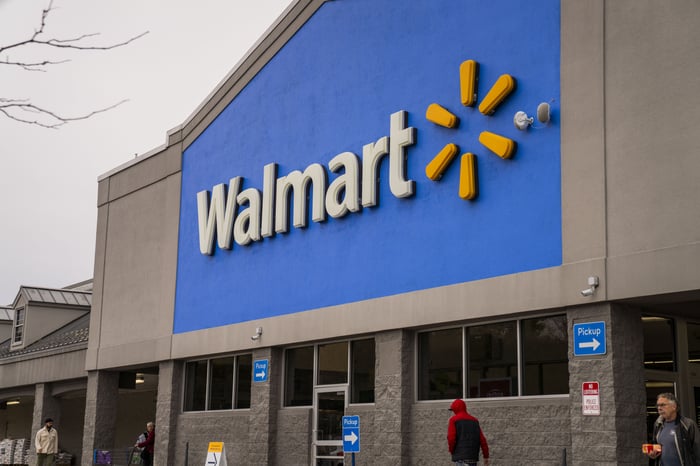
Image source: Getty Images.
What the September inflation report said
The Consumer Price Index rose 3.7% over the 12 months ending in September, up from 3.4% in August, according to the Bureau of Labor Statistics. Gasoline did most of the damage, up 9.1% for the month and 34.2% over the year, while core inflation (stripping out food and energy) ran a cooler 2.6%. Food away from home -- restaurant meals, basically -- climbed 3.5% over the year, notably faster than the 1.8% rise in food you buy to cook at home. That gap matters when discussing stocks like Costco and Walmart. When eating out gets pricier faster than groceries, people cook more and shop harder for the best price on what they put in the cart.
The value angle of these stocks is getting real
Walmart and Costco don't market as cheap, but their business models are built so thin that there's barely any markup to cut if they wanted to. Costco caps its own markup at 14% on regular merchandise and 15% on its Kirkland Signature private label, full stop, a rule the company has stuck to for decades specifically so members never have reason to doubt they're getting the best price. Costco makes its real money on membership fees, not on what's on the shelf, so there is no incentive to overcharge on a jar of peanut butter. Walmart runs on a similar logic at even bigger scale: it would rather sell more stuff at a sliver of margin than fewer things at a fat one. When inflation hits, that structural cheapness becomes a magnet for savvy consumers looking to get the most bang for their buck. This leads to higher sales and better growth for the stock.
The numbers back it up
Walmart's U.S. comparable sales grew 3.4% last quarter, excluding a one-time drag from health and wellness, while total revenue climbed 5.9% to $187.9 billion and e-commerce sales jumped 23% globally, per Retail Dive. Former CEO Doug McMillon told Fox that the company has been "holding at the lower end and adding at the upper end," meaning higher-income shoppers are showing up alongside its traditional base, exactly what you'd expect when everyone's hunting for value.
Costco's fiscal fourth quarter was even sharper: sales rose 11.2% to $93.9 billion, comparable sales climbed 9.4%, and membership fee income grew 7.3% to $1.85 billion. Renewal rates hit 92.3% in the U.S. and Canada, and executive memberships, the pricier tier that pays Costco back in cash rewards, grew 9.4% to an all-time high of 42.3 million. So in other words, people aren't just shopping at Costco; they're willing to pay extra to keep shopping there.
Are the stocks actually still worth buying?
This is where it gets less clean. Both stocks already reflect much of this good news, and both have been on something of a tear recently. Both are up over 10% in the last month. Walmart trades in the mid-30s on a forward earnings valuation, well above its own five-year median in the mid-20s, a sign the market has been pricing in a lot of optimism lately. Costco trades even richer in absolute terms, in the low-40s, but that's actually close to where it's traded on average over the past several years, so the premium there is less of a new story and more just the price of admission to a business this good.
Neither is a screaming bargain today, and a slowdown in comp sales or a sentiment shift could hit these stocks harder than a typical retailer given how much optimism is already baked in. But if inflation keeps running hot into 2027, I'd rather own the two retailers whose entire model depends on being the cheapest option in town than bet against them.
Should you buy stock in Walmart right now?
Before you buy stock in Walmart, consider this:
The Motley Fool Stock Advisor analyst team just identified what they believe are the 10 best stocks for investors to buy now… and Walmart wasn’t one of them. The 10 stocks that made the cut could produce monster returns in the coming years.
Consider when Netflix made this list on December 17, 2004... if you invested $1,000 at the time of our recommendation, you’d have $380,363!* Or when Nvidia made this list on April 15, 2005... if you invested $1,000 at the time of our recommendation, you’d have $1,315,732!*
Now, it’s worth noting Stock Advisor’s total average return is 919% — a market-crushing outperformance compared to 211% for the S&P 500. Don't miss the latest top 10 list, available with Stock Advisor, and join an investing community built by individual investors for individual investors.
See the 10 stocks »
*Stock Advisor returns as of October 20, 2026.
Micah Zimmerman has no position in any of the stocks mentioned. The Motley Fool has positions in and recommends Costco Wholesale and Walmart. The Motley Fool has a disclosure policy.
Recommended Articles


