


IonQ, Rigetti Computing, D-Wave Quantum, and Quantum Computing Inc. Are Shaking Wall Street to Its Core With This $1 Billion Warning
Key Points
Next to the artificial intelligence infrastructure build-out, no trend is capturing the attention of investors quite like the evolution of quantum computing.
Form 4 filings show that quantum computing insiders have been decisive sellers of their company’s stock over the last half-decade.
Additionally, insider buying has been virtually nonexistent, and history may explain why.
- 10 stocks we like better than IonQ ›
Although artificial intelligence has been the talk of Wall Street over the last four years, it's not the only game-changing trend that's helped lift the major stock indexes to new heights. The evolution of quantum computing is also playing an important role.
Four pure-play quantum computing stocks have skyrocketed over the last two years. IonQ (NYSE:IONQ), Rigetti Computing (NASDAQ:RGTI), D-Wave Quantum (NASDAQ:QBTS), and Quantum Computing Inc. (NASDAQ:QUBT) have delivered respective gains of 154%, 1,180%, 1,030%, and 738% over the trailing two-year period, as of Oct. 16.
Missed Nvidia in 2009? This Rare Signal Is Flashing Again. In 2009, a "Double Down" signal flashed for a little-known chipmaker called Nvidia. For the first time in years, that same "Total Conviction" signal is flashing for a company 1/100th the size of Nvidia. Continue »

Image source: Getty Images.
On the one hand, the practical applications for quantum computing, coupled with several newly signed contracts for these pure-play companies, have investors seeing dollar signs. However, the people who know these rapidly growing quantum computing companies best are sending all the wrong signals to Wall Street.
Insiders have been heading to the exit for years
Wall Street analysts are paid to know the ins and outs of the companies and industries they cover. But no individuals understand a company better than its insiders.
An "insider" is a high-ranking executive, board member, or beneficial owner of at least 10% of a company's outstanding shares who may possess non-public information. For the sake of transparency and to comply with securities law, insiders are required to file Form 4 with regulators anytime they buy or sell their company's stock.
According to the trailing five years of Form 4 filings, insiders at Wall Street's most heralded quantum computing companies have been decisive sellers:
- IonQ: $576,620,769 in net selling
- Rigetti: $82,993,683
- D-Wave: $331,331,615
- Quantum Computing: $33,893,854
In aggregate, pure-play quantum computing insiders have sold $1.02 billion more in shares than they've purchased since Oct. 16, 2021.
The potential silver lining to this net-selling activity is that not all stock sales are inherently bad news. Executives and board members are commonly compensated with stock and/or options, often requiring these individuals to sell a portion of their holdings to cover federal and/or state tax liability. Tax-based selling, or sales to diversify an insider's investment portfolio, shouldn't be a concern for investors.
But this is really only half of the story. The other side of the coin, insider buying, is just as relevant.
Over the trailing five-year period, insider purchases have been practically nonexistent:
- IonQ: $3,349,000 in insider buying
- Rigetti: $625,000
- D-Wave: $309,080
- Quantum Computing: $0
Collectively, insiders have purchased less than $4.3 million of their company's stock since mid-October 2021. While there are several reasons to sell a stock, there's only one reason for insiders to buy: the expectation of share price appreciation. Clearly, insiders aren't buying.
Valuation could be a reason for this dynamic. All four pure-play quantum computing stocks are trading well above 30 times trailing 12-month sales. Historically, a price-to-sales ratio above 30 has been a beacon for locating bubbles on Wall Street.
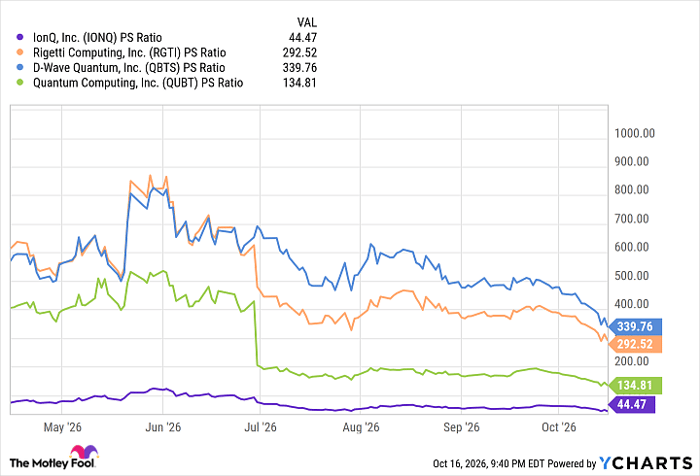
IONQ PS Ratio data by YCharts.
Historical precedent may also be cause for concern. There hasn't been a game-changing tech innovation in more than 30 years that's avoided an early-innings bubble-bursting event. These bubbles continue to form and subsequently burst because investors overestimate the pace of optimization for tech innovations.
While quantum computing has an exciting future, it'll likely take many years before businesses optimize this technology to boost their sales and profits.
Should you buy stock in IonQ right now?
Before you buy stock in IonQ, consider this:
The Motley Fool Stock Advisor analyst team just identified what they believe are the 10 best stocks for investors to buy now… and IonQ wasn’t one of them. The 10 stocks that made the cut could produce monster returns in the coming years.
Consider when Netflix made this list on December 17, 2004... if you invested $1,000 at the time of our recommendation, you’d have $380,363!* Or when Nvidia made this list on April 15, 2005... if you invested $1,000 at the time of our recommendation, you’d have $1,315,732!*
Now, it’s worth noting Stock Advisor’s total average return is 919% — a market-crushing outperformance compared to 211% for the S&P 500. Don't miss the latest top 10 list, available with Stock Advisor, and join an investing community built by individual investors for individual investors.
See the 10 stocks »
*Stock Advisor returns as of October 20, 2026.
Sean Williams has no position in any of the stocks mentioned. The Motley Fool has positions in and recommends IonQ. The Motley Fool has a disclosure policy.
Recommended Articles


