


Warren Buffett's Market Warning Is Hard to Ignore. But I'd Buy These 3 Stocks Anyway.
Key Points
Pharmaceutical giant Pfizer is in the midst of a transition that’s moving faster than most investors might think.
Google parent Alphabet isn’t nearly as vulnerable to economic headwinds as it seems.
Brookfield Renewable’s generous dividend will continue to be paid regardless of the economic backdrop.
- 10 stocks we like better than Pfizer ›
Stocks continue to test record highs. But every bullish step forward pushes the market closer to a correction, if not a full-blown bear market.
That's the interpretation of the so-called Warren Buffett indicator at this time, anyway. The ratio comparing the total market cap of the U.S. stock market (as measured by the combined value of the Wilshire 5000's companies) to the nation's gross domestic product, or GDP, currently stands at a record high of 237.5%. It's a sign that stocks are dangerously overvalued.
Missed Nvidia in 2009? This Rare Signal Is Flashing Again. In 2009, a "Double Down" signal flashed for a little-known chipmaker called Nvidia. For the first time in years, that same "Total Conviction" signal is flashing for a company 1/100th the size of Nvidia. Continue »
For perspective, this indicator only peaked at 138.5% at the height of the dot-com mania in early 2000, and barely and briefly eclipsed 100% in 2007, right before the subprime mortgage meltdown upended the rest of the domestic economy. Warren Buffett also recently commented in an interview with CNBC that "prices for an awful lot of things will look very silly." Investors have good reason to be concerned.
Still, the backdrop doesn't necessarily dictate whether or not you invest, but how you invest. There are always stocks worth owning. It's just a matter of figuring out which names those are, given the environment at the time. To this end, here's a closer look at three stocks to consider buying now regardless of Buffett's warning.
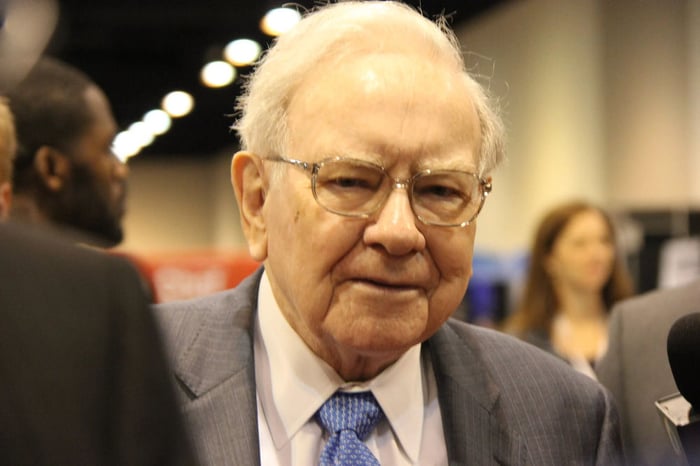
Warren Buffett. Image source: The Motley Fool.
Pfizer
It's no secret why Pfizer (NYSE: PFE) shares have struggled since peaking in late 2021. The wind-down of the COVID-19 pandemic simply ended overwhelming demand for its Paxlovid treatment, as well as for its vaccine co-developed with BioNTech. That year's revenue of just over $100 billion has since fallen back to its pre-pandemic annual norm of around $60 billion, with the impending expiration of its patents on Eliquis, Ibrance, Xtandi, and its pneumonia vaccine Prevnar 13 threatening roughly one-third of its current drug portfolio and weighing on the stock in the meantime.
Investors may be so fixated on Pfizer's past, however, that they're ignoring its promising future.
Granted, the crux of this bright future is still well down the road. Although the pharmaceutical company hopes to eventually have at least eight blockbuster oncology drugs in its portfolio, doubling the number of cancer patients it's currently serving, the drugmaker also knows this effort isn't likely to reach its full revenue stride until 2030. That's quite a wait, even for the most patient of shareholders.
Just understand that we'll see incremental progress along the way that could provide some degree of bullish tailwind for the stock. For instance, although it's still a relatively small profit center, Q2's $667 million in sales of cancer-fighting Padcev, which Pfizer added to its portfolio with its 2023 acquisition of Seagen, is a 23% improvement on this drug's revenue from a year earlier. Meanwhile, the very same drug is currently being tested in a couple of other clinical trials.
If nothing else, Pfizer is a compelling prospect in this environment simply because most of its revenue is driven by insurance reimbursements rather than economically sensitive discretionary spending.
Newcomers are also being well compensated for their risk and patience, by the way. This ticker's forward-looking dividend yield currently stands at nearly 6%.
Alphabet
At first blush, Alphabet (NASDAQ: GOOG) (NASDAQ: GOOGL) seems vulnerable to the potential marketwide repricing being flagged by the sky-high Buffett indicator. It's waist-deep in artificial intelligence (AI) waters. Plus, its core business is still economically sensitive advertising. Except neither risk is quite what it looks like it is on the surface.
As for AI, while it's certainly possible that all the money earmarked for institutional investment in this area could dry up before it's spent, Alphabet remains well positioned to capture its fair share of whatever growth awaits on this front. Even if it's not the most-used platform (yet), Google's AI chatbot, Gemini, is now outgrowing its competitors, while data from Synergy Research Group indicates Google is the only major name in the cloud computing business that's actually gaining market share.
Credit Alphabet's existing scale and reach, along with its subsequent pricing power, mostly.
As for its advertising business, which is largely centered around its flagship search engine, don't misread Google's place within the internet's landscape. It's not just a search engine. It's the default gateway to the World Wide Web, fielding nearly 90% of the planet's web queries regardless of the economic environment, according to numbers from Statcounter, which also says Google's Android is installed on 69% of the world's mobile devices. Gmail is also the world's most-used free email platform, although the very same platform is also the most-used paid email platform for organizations that want to use their own domains in their email addresses. All of these are connections that can be monetized in myriad ways.
That being said, although advertising has historically been an easy expense for companies to cut quickly in tough economic environments, there's a case to be made that in a weak economy, online advertising could see a swell of demand simply because it's the most cost-effective lever to pull. Alphabet certainly remains well positioned to benefit from that dynamic.
Brookfield Renewable
Last but not least, add Brookfield Renewable (NYSE: BEPC) to your list of stocks to buy despite the marketwide warning. It's a curious company. Rather than acting as a conventional power utility outfit, Brookfield partially or wholly owns stakes in several relatively small utility companies operating in spaces including wind, hydroelectric, and solar. It's also showing growing interest in nuclear power.
At one point, such a complex conglomerate of low-scale utilities would have been difficult to manage. Thanks to advancements in these power sources' underlying infrastructure, though, the business model now works. It just requires capital, which Brookfield brings to the table. The company is confidently -- but not unreasonably -- targeting average annual returns of 12% to 15% on shareholders' money.
That's not quite the reason this ticker is such a compelling prospect under marketwide valuation, though. Rather, BEPC is attractive for the foreseeable future because it offers a dividend the company expects to grow indefinitely regardless of what the future holds. You'd be plugging into this name while its forward-looking dividend yield stands at 5.4%, based on a dividend the company realistically expects to grow between 5% and 9% per year. Such cash flow means a great deal when little else is working in the stock market.
Just make sure you're buying the right Brookfield Renewable. There's a limited partnership version of this very same company that trades under the ticker "BEP." Owning publicly traded stakes in partnerships, though, comes with additional tax-filing requirements that may be more trouble than they're worth. Besides, the organization will be swapping out all of its partnership shares for ordinary common shares before the end of the year anyway.
Should you buy stock in Pfizer right now?
Before you buy stock in Pfizer, consider this:
The Motley Fool Stock Advisor analyst team just identified what they believe are the 10 best stocks for investors to buy now… and Pfizer wasn’t one of them. The 10 stocks that made the cut could produce monster returns in the coming years.
Consider when Netflix made this list on December 17, 2004... if you invested $1,000 at the time of our recommendation, you’d have $380,363!* Or when Nvidia made this list on April 15, 2005... if you invested $1,000 at the time of our recommendation, you’d have $1,315,732!*
Now, it’s worth noting Stock Advisor’s total average return is 919% — a market-crushing outperformance compared to 211% for the S&P 500. Don't miss the latest top 10 list, available with Stock Advisor, and join an investing community built by individual investors for individual investors.
See the 10 stocks »
*Stock Advisor returns as of October 18, 2026.
James Brumley has positions in Alphabet. The Motley Fool has positions in and recommends Alphabet, BioNTech Se, and Pfizer. The Motley Fool recommends Brookfield Renewable and Brookfield Renewable Partners. The Motley Fool has a disclosure policy.
Recommended Articles


