


Will Broadcom Rejoin the $2 Trillion Club in 2027?
Key Points
Broadcom is helping artificial intelligence companies design and fabricate their own data center chips, giving them an alternative to Nvidia's GPUs.
OpenAI, Anthropic, Alphabet, and Meta Platforms are just some of Broadcom's top customers at the moment.
Broadcom stock only needs a modest gain for its market cap to cross $2 trillion again, but its valuation might be a barrier in the near term.
- 10 stocks we like better than Broadcom ›
As I write this on Oct. 14, there are 12 publicly traded American companies with market capitalizations of at least $1 trillion, and six of them are worth $2 trillion or more. Broadcom (NASDAQ: AVGO) was recently in that exclusive club, but its stock has fallen by 26% from its June peak as investors worry about the sustainability of the artificial intelligence (AI) infrastructure spending boom.
Over the last few months, AI labs like Anthropic, OpenAI, and xAI floated plans to slow down the pace of AI development to lower the potential risks to humanity. Moreover, many businesses have started prioritizing efficiency when running AI workloads to save money. And last week, one of Australia's largest AI data center start-ups pulled the plug on its initial public offering (IPO) due to a lack of demand from investors.
Missed AI’s "Act 1"? Act 2 Could Be 15x Bigger. Most investors think they missed the AI boat because they didn't buy Nvidia in 2005. But according to our analysts, we’re only at the end of "Act 1"—the R&D phase. "Act 2" is the global rollout. Continue »
Broadcom supplies some of the best data center chips and components for developing AI, so its stock is highly sensitive to some of the abovementioned headwinds. However, management is forecasting significant revenue growth over the next couple of years, which could lead to significant returns for investors. The company currently has a market cap of $1.71 trillion, but can it rejoin the $2 trillion club within the next year?

Image source: Getty Images.
Broadcom has an impressive customer list
The graphics processing units (GPUs) supplied by companies like Nvidia and Advanced Micro Devices are the best plug-and-play data center chips for AI workloads. However, customers like OpenAI, Anthropic, Alphabet and Meta Platforms are gravitating toward more specialized chips to suit their own specific requirements, so Broadcom is helping them design and fabricate custom AI accelerators.
Broadcom says optimizing an accelerator for a specific large language model (LLM) is the key to outperforming any GPU. It also prevents AI companies from being locked into closed ecosystems where they have no control over pricing or innovation. The company recently helped OpenAI design a data center chip called Jalapeño, which reportedly performs as well as Nvidia's latest Vera Rubin GPU systems when the start-up is running its own models.
Broadcom and Alphabet have also developed several generations of custom chips called Tensor Processing Units (TPUs). Alphabet uses them to improve its Gemini family of LLMs, and it also rents them to other businesses through its Google Cloud platform. The company recently started selling TPUs directly to third parties like Anthropic to unlock an additional revenue stream.
Broadcom says Alphabet's latest v8i TPUs are as good, if not better than Nvidia's new Vera Rubin GPU systems in terms of performance. Broadcom expects each successive generation to experience growing demand as they hit the market in 2028 and 2029, especially from Anthropic which is expected to be the largest buyer from next year.
Accelerating revenue growth, and strong forward guidance
Broadcom delivered $29.6 billion in total revenue during its fiscal 2026 third quarter (ended Aug. 2). It was an 86% increase from the year-ago period, a sharp acceleration from the 48% revenue growth the company generated in the second quarter just three months earlier.
AI semiconductor sales accounted for $16.7 billion of Broadcom's total third-quarter revenue, up by a whopping 221%, so they were the primary source of the company's overall top-line growth. Plus, management issued a fresh forecast which suggests AI semiconductor sales growth could accelerate further to 236% in the current fourth quarter, which ends in early November.
Broadcom CEO Hock Tan also said AI revenue could hit $115 billion during fiscal 2027, and then double to $230 billion in fiscal 2028. However, investors might want to take these aggressive medium-term estimates with a grain of salt, because it's difficult to predict how data center spending will evolve over the next couple of years given the headwinds I mentioned earlier.
In September, Anthropic founder Dario Amodei published a blog post arguing in favor of slowing the pace of AI development, amid a spate of dangerous cyber attacks. The founders of OpenAI and xAI publicly agreed with Amodei's stance, and if these labs follow through, it could lead to a reduction in semiconductor demand.
But even before the blog post, a survey by UBS Group found that 60% of businesses were already routing some tasks to more efficient AI models to reduce costs. These models typically consume less computing power than those from labs like Anthropic and OpenAI, so this trend could become a headwind for semiconductor demand in the future.
Broadcom stock isn't cheap
Given Broadcom's market cap is already $1.71 trillion, its stock only needs to climb by 17% for the company to rejoin the $2 trillion club. However, valuation could stand in the way of even that modest gain, at least in the near term.
Based on Broadcom's trailing 12-month revenue, its stock is trading at a price-to-sales (P/S) ratio of 19.5, almost double its 10-year average of 10.6. The stock appears much cheaper on a forward basis if we rely solely on Tan's AI revenue estimates for fiscal 2027 and fiscal 2028, which could pave the way for upside. But if the company doesn't hit those numbers, then the stock might actually decline over the next 12 to 24 months instead.
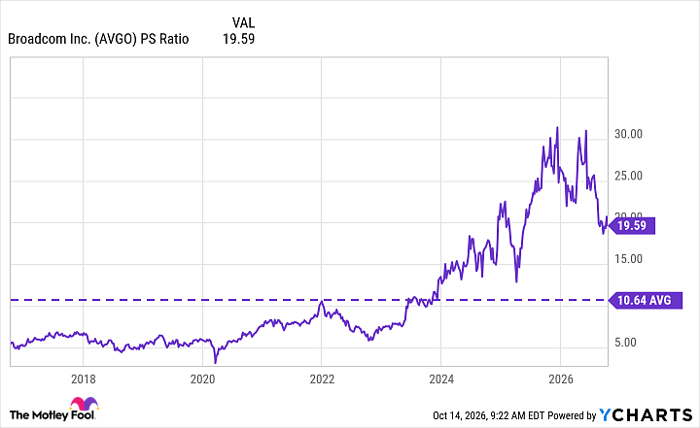
AVGO PS Ratio data by YCharts
Broadcom's next two or three quarterly reports might determine whether or not it rejoins the $2 trillion club in 2027. If investors see that the company is on track to meet its AI revenue targets, they might feel confident enough to buy its stock despite its high trailing P/S ratio.
Should you buy stock in Broadcom right now?
Before you buy stock in Broadcom, consider this:
The Motley Fool Stock Advisor analyst team just identified what they believe are the 10 best stocks for investors to buy now… and Broadcom wasn’t one of them. The 10 stocks that made the cut could produce monster returns in the coming years.
Consider when Netflix made this list on December 17, 2004... if you invested $1,000 at the time of our recommendation, you’d have $391,581!* Or when Nvidia made this list on April 15, 2005... if you invested $1,000 at the time of our recommendation, you’d have $1,334,780!*
Now, it’s worth noting Stock Advisor’s total average return is 936% — a market-crushing outperformance compared to 213% for the S&P 500. Don't miss the latest top 10 list, available with Stock Advisor, and join an investing community built by individual investors for individual investors.
See the 10 stocks »
*Stock Advisor returns as of October 16, 2026.
Anthony Di Pizio has no position in any of the stocks mentioned. The Motley Fool has positions in and recommends Advanced Micro Devices, Alphabet, Broadcom, Meta Platforms, and Nvidia. The Motley Fool has a disclosure policy.
Recommended Articles


