


Is It Really "Safe" to Invest in Tech ETFs Right Now? Here's What History Suggests.
Key Points
AI stocks are driving impressive earnings growth for the tech sector.
Tech valuations might not be “too high” because company earnings are growing even faster than share prices.
The Invesco QQQ ETF lets you own the Nasdaq-100 at a low cost -- and has delivered 16.4% annualized returns in the past five years despite a bear market in 2022.
- 10 stocks we like better than Invesco NASDAQ 100 ETF ›
The biggest question on many investors' minds right now is: Are tech stocks overpriced, due for a sell-off, or poised for further growth? The tech-heavy Nasdaq-100 index has gained about 109% in the past five years, powered by enthusiasm for the artificial intelligence (AI) boom.
But tech stocks can be risky and volatile. The Nasdaq-100 can deliver both big declines and big gains. And right now, many investors have some healthy skepticism about AI stocks. Will AI really deliver the hoped-for gains in economic growth and productivity -- and if so, which companies will profit most?
Missed AI’s "Act 1"? Act 2 Could Be 15x Bigger. Most investors think they missed the AI boat because they didn't buy Nvidia in 2005. But according to our analysts, we’re only at the end of "Act 1"—the R&D phase. "Act 2" is the global rollout. Continue »
If you're optimistic about the future of AI and want to keep buying tech stocks, tech exchange-traded funds (ETFs) like the Invesco Nasdaq 100 ETF (NASDAQ: QQQM) can be an easy way to invest in the sector.
Here are three good reasons to be bullish on tech ETFs.

Image source: Getty Images.
1. Tech earnings are growing fast
The tech sector's earnings are strong and growing fast. According to an Oct. 9 report from FactSet, year-over-year earnings growth for the S&P 500 information technology sector increased to 65.1% in the third quarter (up from 57% on June 30).
FactSet also found that 81% of information technology sector companies in the S&P 500 saw an increase in mean earnings per share (EPS) estimate since June 30. The biggest contributors to the tech sector's increase in expected earnings this quarter were Nvidia, Micron Technology, Dell Technologies, and Intel.
These are all prominent AI stocks that sell semiconductors, chips, and servers to companies building AI data centers and infrastructure. As long as major AI hyperscalers keep investing hundreds of billions of dollars in capital expenditures, these suppliers of the AI boom are likely to keep prospering.
2. The AI build-out is not like the dot-com era
Sometimes investors who are nervous about tech stocks compare the past few years' AI build-out to the stock market run-up of the late 1990s dot-com bubble. A big difference is that in the late 1990s, investors were pouring money into wildly unprofitable dot-com start-ups that lacked a real business model. People were excited about the potential of the internet, even though most dot-com companies hadn't figured out how to make money with it yet.
The AI boom is being driven by some of the most profitable companies ever. AI hyperscalers like Alphabet, Meta Platforms, and Microsoft can afford to spend the hundreds of billions of dollars they're investing in AI development. Analysis from Fidelity in July found that U.S. tech companies in 2026 have been spending a much smaller percentage of their free cash flow than they were in the dot-com era.
The AI boom could slow down. AI might not pay off for all of these companies. Some hyperscalers might scale back their AI capex. But even then, that doesn't mean we'll see a stock market crash that's identical to the dot-com bubble. Today's tech sector is bigger, more profitable, and more diversified than it was in the dot-com days.
3. Tech stocks might be cheaper than a year ago
Many investors worry that tech stocks are overvalued. But the numbers don't really back that up. Tech stocks might not be cheap, but they might be getting less expensive. As of Oct. 9 , the Nasdaq-100 was trading at a price-to-earnings (P/E) ratio of 31.51, which was 6% lower than its 33.55 multiple one year ago.
This isn't happening because tech stock prices are going down, but because earnings keep going up. The "E" in the P/E ratio keeps getting bigger, which makes the multiple smaller. For example, here is a chart of Nvidia's forward P/E ratio and its earnings per share (EPS) estimates for the next fiscal year. This stock's earnings just keep going up -- making it look cheaper.
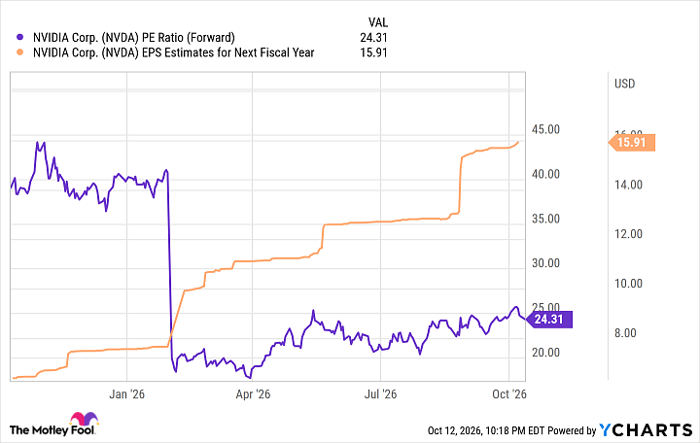
NVDA PE Ratio (Forward) data by YCharts
Which tech ETF should you buy?
No one knows what will happen next with the AI trade or the tech sector. Semiconductor stocks may outperform software stocks, or vice versa. But if you want to make a targeted investment in the tech sector, the Invesco Nasdaq 100 ETF (QQQM) could be a good choice.
This low-cost tech ETF lets you own all 100 companies of the tech-heavy Nasdaq-100 index. In the past five years, it has delivered annualized returns of 16.4% (by net asset value).
Keep in mind that any stock or ETF can be risky. QQQM had a bad year during the 2022 bear market -- that year, this tech ETF was down 32.45%. But even with that big loss in 2022, the Invesco Nasdaq 100 ETF bounced back to deliver strong returns for long-term investors.
If you believe in the long-term growth and resilience of the U.S. tech economy, now could still be a good time to buy this Nasdaq ETF.
Should you buy stock in Invesco NASDAQ 100 ETF right now?
Before you buy stock in Invesco NASDAQ 100 ETF, consider this:
The Motley Fool Stock Advisor analyst team just identified what they believe are the 10 best stocks for investors to buy now… and Invesco NASDAQ 100 ETF wasn’t one of them. The 10 stocks that made the cut could produce monster returns in the coming years.
Consider when Netflix made this list on December 17, 2004... if you invested $1,000 at the time of our recommendation, you’d have $380,579!* Or when Nvidia made this list on April 15, 2005... if you invested $1,000 at the time of our recommendation, you’d have $1,359,789!*
Now, it’s worth noting Stock Advisor’s total average return is 934% — a market-crushing outperformance compared to 213% for the S&P 500. Don't miss the latest top 10 list, available with Stock Advisor, and join an investing community built by individual investors for individual investors.
See the 10 stocks »
*Stock Advisor returns as of October 15, 2026.
Ben Gran has no position in any of the stocks mentioned. The Motley Fool has positions in and recommends Alphabet, Intel, Meta Platforms, Micron Technology, Microsoft, and Nvidia. The Motley Fool has a disclosure policy.
Recommended Articles


