


'Big Short' Michael Burry Slams OpenAI and Anthropic: Is Slowing AI R&D a Safety Initiative or IPO Hype?
TradingKey - Michael Burry, the real-life figure behind the movie "The Big Short" and a prominent short seller, posted on social media strongly criticizing the initiative proposed by the management of OpenAI and Anthropic to "slow down frontier AI research and development," arguing that the statements are overtly self-serving and that their true intention may not be to control technological risks, but rather to protect the market positions of industry leaders and construct a more attractive narrative for potential IPOs.
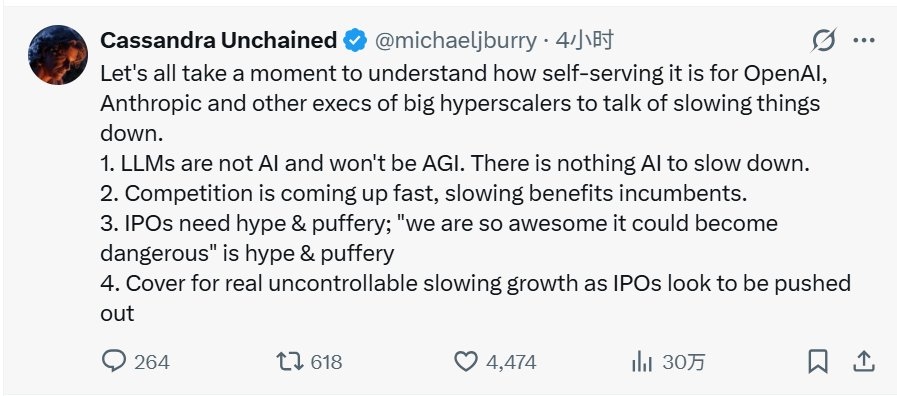
Source: X
The controversy stems from a lengthy article previously published by Anthropic CEO Dario Amodei. Amodei warned that as model capabilities continue to strengthen, the pace at which AI systems participate in developing next-generation AI is accelerating, and risks such as cyberattacks, loss of model control, and recursive self-improvement could exceed the industry's current management capabilities. Therefore, frontier AI companies need to appropriately control the pace of capability enhancements to buy more time for safety assessments and regulatory mechanisms.
Amodei proposed that Anthropic will introduce independent third-party evaluation teams and grant them system access close to that of full-time employees, including office equipment, internal tools, and model evaluation environments similar to those of the company's risk team. These external organizations will be responsible for verifying whether companies fulfill their safety commitments, scrutinizing model training processes, and reporting potential incidents. Amodei also called on other leading AI labs to adopt similar measures and urged businesses and governments to establish broader safety standards around frontier models.
OpenAI CEO Sam Altman subsequently publicly voiced support for this proposal. He stated that granting independent evaluation organizations employee-like access is a worthwhile proposal and that OpenAI will make the same arrangement. xAI founder Elon Musk similarly agreed with Amodei's assessment of AI risks.
Why Michael Burry Is Questioning
Michael Burry offered a starkly different explanation for this. He first questioned how these companies define "artificial intelligence," arguing that current large language models are merely technical systems relying on massive amounts of data and compute resources to make predictions—they are neither artificial general intelligence in the true sense, nor will they naturally evolve into AGI. In Burry's view, if existing LLMs do not possess the autonomous intelligent capabilities described by these companies, then the assertion that "the technology is too powerful, so development must be proactively slowed down" is itself suspect.
Burry further argues that initiatives to slow down R&D could serve as a tool for industry leaders to consolidate their competitive advantages. OpenAI and Anthropic have already accumulated vast computing resources, talent pools, training data, and capital support, while open-source models and emerging AI companies are rapidly narrowing the gap. If regulators raise the threshold for model training and safety reviews based on standards proposed by market leaders, competitors with limited capital and compute will bear higher compliance costs, making it even easier for incumbent giants to maintain their dominance.
In other words, Burry does not view this debate as a pure technology safety discussion, but rather sees it as a commercial competition over the power to set industry rules. Companies possessing leading models emphasize risks on one hand while participating in shaping regulatory frameworks on the other. The resulting rules may end up benefiting well-funded, technologically mature incumbents while restricting latecomers from challenging the market structure.
IPOs are also a primary focus of Burry's criticism. He believes that AI companies that have yet to achieve stable profitability need to prove the irreplacability of their technology to capital markets, and stating that "our model is so powerful that it could be dangerous" happens to reinforce perceptions of scarcity and industry leadership. This narrative not only attracts market attention but also helps companies maintain higher valuations prior to an IPO. In his view, framing technological capabilities as a potential threat requiring global coordination to control may essentially be a more sophisticated form of promotion.
Burry also suspects that the so-called voluntary slowdown in R&D may be a way to find a more favorable explanation for a natural deceleration in industry growth. Training frontier models demands ever-increasing amounts of GPUs, electricity, data centers, and capital, yet significant uncertainty remains over whether marginal improvements in model performance can match cost growth over the long run. If technological progress begins to slow, fundraising becomes harder, or listing plans are delayed, companies can repackage a forced slowdown as proactively taking on safety responsibilities.
Recommended Articles


