


Got $1,000? Here's What an Intel Investment Made the Day the U.S. Government Took Its Stake Would Be Worth Today.
Key Points
Nearly 13 months ago, the federal government invested $8.9 billion in Intel.
That stake is now worth $43.9 billion.
An investment made by a retail investor on the same day as Washington's deal was announced wouldn't be quite as profitable for one simple reason.
- 10 stocks we like better than Intel ›
One of the signature policies in President Donald Trump's second term has been taking direct equity investments in public companies. Since June 2025, the U.S. has taken stakes in at least 30 companies.
But the biggest -- and arguably most well-known -- of these investments was made in chipmaker Intel (NASDAQ: INTC). The Trump administration converted $5.7 billion in unpaid grants that were to have been awarded to the company under the CHIPS Act, plus another $3.2 billion in grants awarded under the Secure Enclave program, into funding for a direct purchase of newly issued shares.
Missed Nvidia in 2009? This Rare Signal Is Flashing Again. In 2009, a "Double Down" signal flashed for a little-known chipmaker called Nvidia. For the first time in years, that same "Total Conviction" signal is flashing for a company 1/100th the size of Nvidia. Continue »
The result was that the U.S. government acquired a 9.9% equity stake in Intel, receiving 433.3 million shares of common stock at $20.47 per share. Today, Intel stock is trading at just over $101, so the value of the government's investment has increased by 395%, from $8.9 billion to $43.9 billion.
But how would you have done had you bought $1,000 in Intel stock the day you learned that Washington was taking a stake in the chipmaker?
Image source: Intel.
Your Intel investment versus the government
Intel announced its deal with the federal government on Aug. 22, 2025. Shares opened at $23.65 that day, reached a high of $25.23, and closed at $24.80. For the sake of this discussion, we'll assume that you timed your purchase at the beginning of the trading day, as that was also the stock's low point. That means you'd be sitting on a 328% return in just over a year -- not too shabby.
Assuming that your brokerage offers fractional share purchases (as most now do), your $1,000 on Aug. 22, 2025, would have paid for 42.28 shares of Intel stock. And at the stock's price of $101.35 at this writing, your Intel stake would be worth $4,285. So, you wouldn't have profited quite as much as the federal government because it got a better deal on the stock price. But you'd likely still be thrilled with the return on your investment.
Why is Intel doing so well these days?
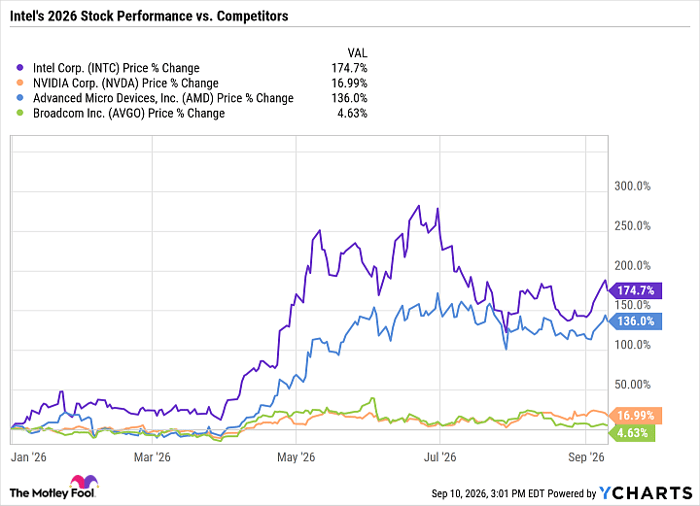
Intel has been one of the best chipmakers you could own this year. Its stock is up 174% -- soundly outperforming peers such as Nvidia, Advanced Micro Devices, and Broadcom.
INTC data by YCharts.
The company has been benefiting from increased demand for its server central processing units (CPUs) and its custom AI chips to run agentic artificial intelligence applications.
And rising server prices have helped push the company's margins even higher. According to Wells Fargo analyst Aaron Rakers, Intel shipped 9% more Xeon server processors in the second quarter than it did in the prior-year period, but their average selling price increased by 48% from the previous year.
That helped push second-quarter revenue to $16.1 billion, up 25% from a year earlier, and gross margins improved from 27.5% to 40.4%. The company reported an $11 billion net loss, with diluted losses per share of $2.16, but the red ink was attributable to its deal with the U.S. government -- Intel's report shows a $12.5 billion loss on escrowed shares, and noted those shares will be released to the Department of Commerce as it performs and receives funds from the federal government. GAAP operating income was $1.79 billion, showing that the company's business performance was much better than the bottom-line net loss would imply.
Intel's client computing and physical AI business generated $8.9 billion in revenue in the quarter, up 13% from a year ago, while its data center and AI (DCAI) business brought in $6.3 billion, up 59%.
Intel is also growing its third-party foundry business -- a market dominated by Taiwan Semiconductor Manufacturing. Intel signed its first major foundry deal in July to make next-generation security chips for cybersecurity giant Fortinet. Intel has been investing heavily in hopes of turning its foundry operations into a profit center, but the segment still posted a $2.1 billion loss in the second quarter despite increased revenues.
What should you be expecting from Intel now?
Intel hasn't scheduled its third-quarter report, but it will likely share those results in late October. The consensus expectation of analysts is that it will report revenue of $16.42 billion, up 20% from a year ago, and earnings of $0.39 per share, up from $0.23 per share a year ago.
Among the analysts covering the stock (per Yahoo! Finance), the average 12-month price target is nearly $116, about 15% higher than its current price.
This implies that there are still gains to be had, and an investment made the day the federal government purchased its stake should continue to grow in the short term. But for long-term growth, Intel will need to continue to expand its AI data server business -- and find more customers to justify its foundry investments.
Should you buy stock in Intel right now?
Before you buy stock in Intel, consider this:
The Motley Fool Stock Advisor analyst team just identified what they believe are the 10 best stocks for investors to buy now… and Intel wasn’t one of them. The 10 stocks that made the cut could produce monster returns in the coming years.
Consider when Netflix made this list on December 17, 2004... if you invested $1,000 at the time of our recommendation, you’d have $417,413!* Or when Nvidia made this list on April 15, 2005... if you invested $1,000 at the time of our recommendation, you’d have $1,341,294!*
Now, it’s worth noting Stock Advisor’s total average return is 950% — a market-crushing outperformance compared to 210% for the S&P 500. Don't miss the latest top 10 list, available with Stock Advisor, and join an investing community built by individual investors for individual investors.
See the 10 stocks »
*Stock Advisor returns as of September 13, 2026.
Wells Fargo is an advertising partner of Motley Fool Money. Patrick Sanders has positions in Nvidia. The Motley Fool has positions in and recommends Advanced Micro Devices, Broadcom, Fortinet, Intel, Nvidia, and Taiwan Semiconductor Manufacturing. The Motley Fool has a disclosure policy.
Recommended Articles


