


Is Chewy a Buy After Its Latest Earnings Report?
Key Points
Chewy matched expectations and raised its full-year guidance, but investors were still disappointed.
Management cited weak attachment and premiumization trends.
Its recent acquisitions of SmartPak and Modern Animal are delivering better results than expected.
- 10 stocks we like better than Chewy ›
Shares of Chewy (NYSE:CHWY) fell 11% on Wednesday after the online pet-supplies retailer reported disappointing results in its second-quarter earnings report.
Chewy posted revenue growth of 7.3% to $3.33 billion, which was slightly ahead of estimates at $3.32 billion. However, excluding its acquisitions of SmartPak and Modern Animal, revenue was up just 5.7%.
Missed Nvidia in 2009? This Rare Signal Is Flashing Again. In 2009, a "Double Down" signal flashed for a little-known chipmaker called Nvidia. For the first time in years, that same "Total Conviction" signal is flashing for a company 1/100th the size of Nvidia. Continue »
Further down the income statement, gross margin held steady at 30.4%, and adjusted earnings per share improved from $0.33 to $0.36, which matched estimates.

Image source: Getty Images.
Why Chewy stock still fell
In addition to meeting expectations, Chewy also raised its guidance for the full year. The company now sees revenue of $13.46 billion-$13.57 billion, representing 6.8%-7.7% growth. It also raised its adjusted earnings before interest, taxes, depreciation, and amortization (EBITDA) margin guidance from 6.6%-6.8% to 6.7%-6.8%. The guidance hike was primarily due to the strength of the recent acquisitions, rather than the core business.
However, the raised guidance seemed to be overshadowed by comments on the earnings call indicating that consumer demand was still sluggish, as management noted continued pressure on discretionary attachment and premiumization.
Pet products are generally thought of as a consumer staples category, as they're a need rather than a want, but Chewy's growth potential lies in its ability to sell add-ons like toys or coax customers into spending more money on premium pet food, as well as adding new customers. Its percentage of sales from autoship continues to grow, reaching 84.6% in the quarter, which is in line with the company's strategy, but that leaves less room for one-off purchases that can drive growth.
What's next for Chewy
The pet industry has struggled since the pandemic, as the surge in pet adoptions led to an unsustainable boom in the industry, and growth rates have significantly slowed since then.
Chewy was valued like a growth stock at one point, but it seems its heady days of market share gains and rapid growth have faded, and the category it competes in is mature. It's hard to fault the business for doing anything wrong in the quarter, and the moves to diversify with those two acquisitions make sense, but it seems like the stock price is still correcting from earlier expectations of higher growth. The current concerns about inflation and weak consumer discretionary spending haven't helped either.
Is Chewy a buy?
As the chart below shows, Chewy has delivered years of underwhelming stock performance and slowing growth.
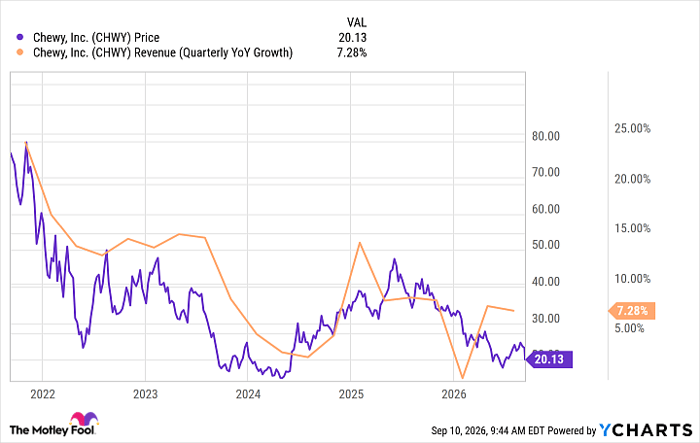
CHWY data by YCharts
With the stock down 50% from its 52-week-high, the best argument for buying Chewy right now may be that the stock is cheap. Based on its adjusted earnings per share consensus of $1.52 for the year, Chewy trades at a forward P/E of just 13. However, that forecast is propped up by adjustments like share-based compensation, which is on track for $300 million this year. On a generally accepted accounting principles (GAAP) basis, the consensus calls for just $0.79, giving it a more average P/E ratio of 25.
At this point, Chewy is starting to resemble a slower-growth consumer staples stock like Procter & Gamble, rather than the disruptive growth stock it was once seen as. Given that, I think the stock is best avoided, at least until the company can deliver faster organic growth. There are better buys elsewhere.
Should you buy stock in Chewy right now?
Before you buy stock in Chewy, consider this:
The Motley Fool Stock Advisor analyst team just identified what they believe are the 10 best stocks for investors to buy now… and Chewy wasn’t one of them. The 10 stocks that made the cut could produce monster returns in the coming years.
Consider when Netflix made this list on December 17, 2004... if you invested $1,000 at the time of our recommendation, you’d have $410,024!* Or when Nvidia made this list on April 15, 2005... if you invested $1,000 at the time of our recommendation, you’d have $1,372,815!*
Now, it’s worth noting Stock Advisor’s total average return is 950% — a market-crushing outperformance compared to 211% for the S&P 500. Don't miss the latest top 10 list, available with Stock Advisor, and join an investing community built by individual investors for individual investors.
See the 10 stocks »
*Stock Advisor returns as of September 10, 2026.
Jeremy Bowman has no position in any of the stocks mentioned. The Motley Fool has positions in and recommends Chewy. The Motley Fool has a disclosure policy.
Recommended Articles


